
Logo

American Heart Association

  52
  0


Final ID: Thu125

O-GlcNAcylation Couples Metabolism With Epigenetics in Vascular Recovery

Abstract Body: The restoration of the microvasculature contributes to cardiovascular regeneration. Our previous work indicated that angiogenic transdifferentiation from fibroblasts to endothelial cells promotes vascular recovery from limb ischemia and a glycolytic shift is required for transdifferentiation. However, a comprehensive profile of the metabolic changes during transdifferentiation has not been performed, and the contribution of metabolic regulation in vascular recovery through transdifferentiation in vivo remains to be determined.
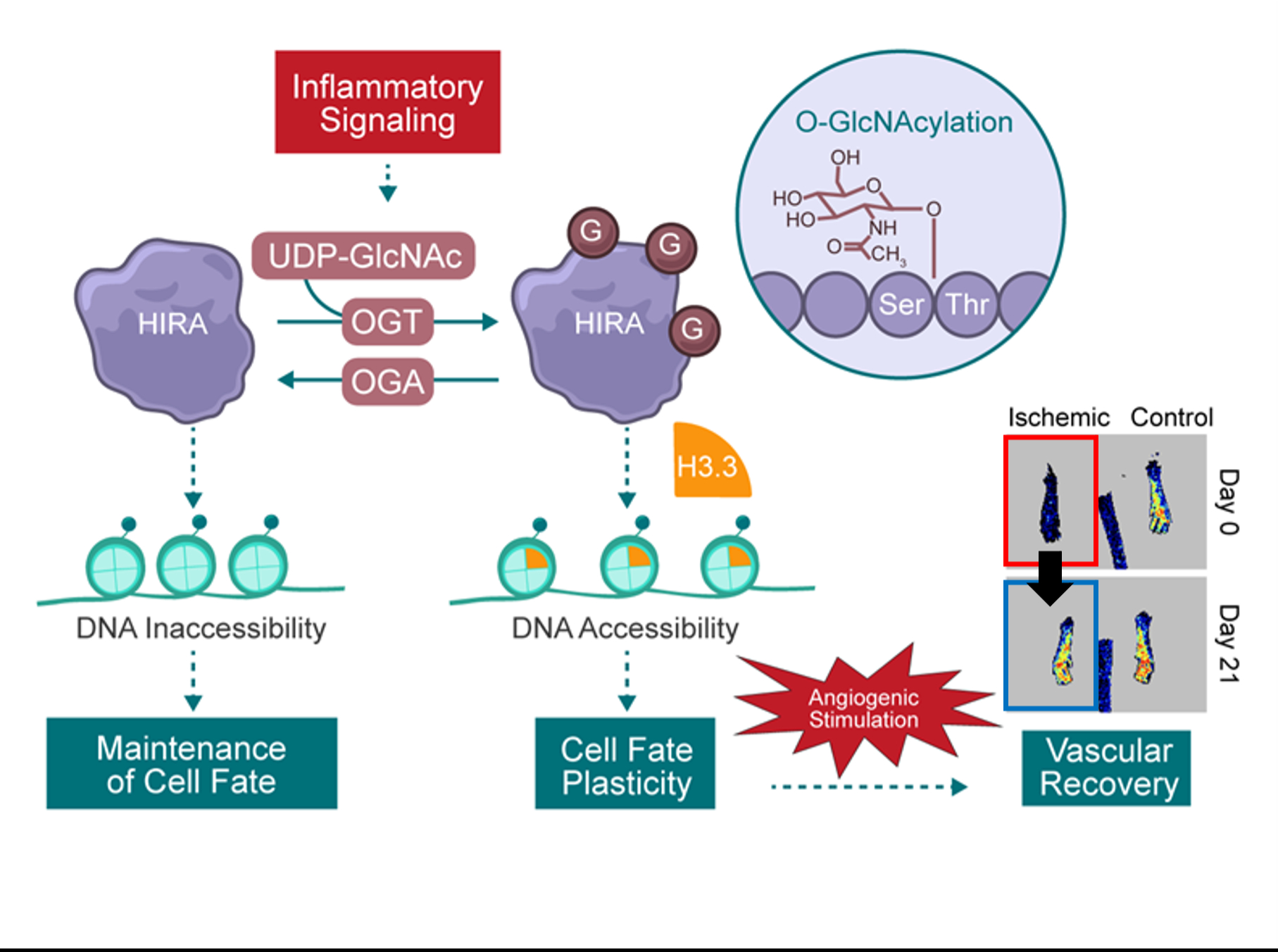
We used unbiased liquid chromatography-mass spectrometry (LC-MS) based metabolomics and identified uridine diphosphate N-acetylglucosamine (UDP-GlcNAc) as the most upregulated metabolite during transdifferentiation during transdifferentiation. UDP-GlcNAc is the substrate for the post-translational modification, O-GlcNAcylation. O-GlcNActransferase (OGT) and O-GlcNAcase (OGA) are the pair of enzymes that add or remove this protein modification, respectively. We pharmacologically and genetically manipulated this pair of enzymes in vitro or in vivo and determined that inhibition of OGT impaired transdifferentiation, while inhibition of OGA enhanced transdifferentiation. Mechanistically, we provide evidence indicating that O-GlcNAcylation orchestrates epigenetic remodeling during transdifferentiation through modifying histone chaperone protein HIRA, which controls the de novo deposition of the non-canonical histone variant H3.3 to the chromatin, a critical event intricately linked to transcription activation. Furthermore, our findings are substantiated by lineage tracing and conditional knockout studies in mice, which underscore the pivotal role of O-GlcNAcylation in promoting angiogenic transdifferentiation, partly via activation of the HIRA-H3.3 pathway, and subsequent revascularization in vivo.
In conclusion, O-GlcNAcylation is a critical post-translational modification that enhances angiogenic transdifferentiation through a HIRA-dependent H3.3 deposition mechanism, thereby strengthening vascular recovery. This is the first study to demonstrate a clear regulatory role for O-GlcNAcylation in cellular reprogramming and uncover potential molecular pathways conducive to enhancing perfusion restoration in ischemic tissue. These findings offer a promising avenue for the development of novel therapeutic interventions targeting vascular ischemia.
  • Li, Shuang  ( HOUSTON METHODIST RESEARCH INSTITUT , Houston , Texas , United States )
  • Cooke, John  ( HOUSTON METHODIST RESEARCH INS , Houston , Texas , United States )
  • Lai, Li  ( HOUSTON METHODIST RESEARCH INSTITUT , Houston , Texas , United States )
  • Author Disclosures:
    Shuang Li: No Answer | John Cooke: No Answer | Li Lai: DO NOT have relevant financial relationships
Meeting Info:

Basic Cardiovascular Sciences 2025

2025

Baltimore, Maryland

Session Info:

Poster Session and Reception 2

Thursday, 07/24/2025 , 04:30PM - 07:00PM

Poster Session and Reception

More abstracts on this topic:
A human cardiomyocyte model of CD36 haploinsufficiency uncovers fatty acid oxidation deficits driving dilated cardiomyopathy

Al Sayed Zeina, Klattenhoff Carla, Aragam Krishna, Ellinor Patrick, Willcox Jon, Zheng Alice, Koledova Vera, Srivastava Salil, Yin Xiaofei, Chaffin Mark, Rigaud Vagner, Kovacs-bogdan Erika

A Community-Based Intervention to Improve Cardiovascular Health Understanding in the Dallas-Fort Worth South Asian Community

Deo Parminder, Rohatgi Anand, Sharma Parul, Sathyamoorthy Mohanakrishnan

More abstracts from these authors:
Linking Diabetes and Peripheral Artery Disease: Long Non-Coding RNA-Regulated Endotheliopathy

Chen Zhen, Malhi Naseeb, Luo Yingjun, Cooke John

Vascular Recovery from Ischemia: Role of mRNA Base Modification

Li Shuang, Zou Dawei, Carter Kaylee, Brannan Kristopher, Lai Li, Cooke John

You have to be authorized to contact abstract author. Please, Login
Not Available