
Logo

American Heart Association

  59
  0


Final ID: Wed112

Decoding the regulatory role of functional SNP rs17617337 in human dilated cardiomyopathy.

Abstract Body: Background: Dilated cardiomyopathy (DCM) is a common form of human cardiomyopathy with complex genetic causes. Genome wide association studies (GWAS) have identified numerous non-coding single nucleotide polymorphisms (SNPs) associated with DCM, but their regulatory roles remain largely unknown. We hypothesize that these SNPs influence DCM pathogenesis by altering the transcription factors (TFs) binding and target gene expression.
Methods: We developed a computational algorithm to prioritize functional SNPs (fSNPs) based on their genomic loci and regulatory potential in cardiac cells. Electrophoretic mobility shift assays (EMSA) and mass spectrometry (MS) were applied to reveal the TFs binding biasedly to key fSNP loci. Moreover, CRISPR-based gene editing was employed to generate inducible TF depletion and fSNP knock-in (KI) human induced pluripotent stem cell-derived cardiomyocytes (iPSC-CMs). Functional analyses, including sarcomere integrity, calcium handling, and autophagic stress markers, were conducted under normal and pathological conditions with maturation medium (MM) and isoproterenol (ISO) treatment.
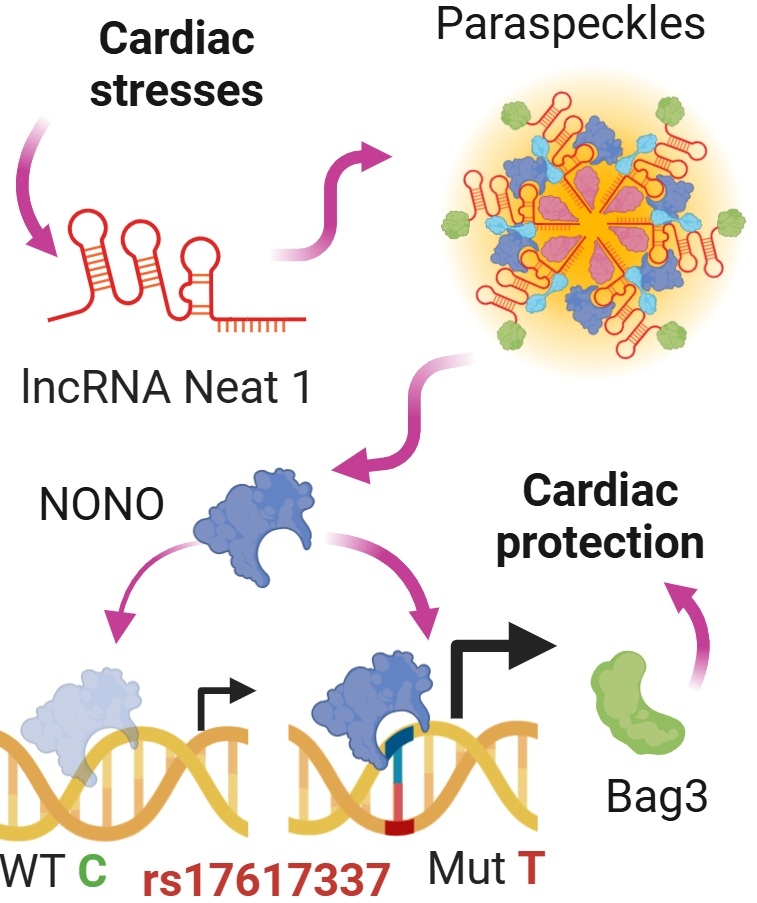
Results: Our analysis identified 127 top-ranked fSNPs in regulatory genomic regions associated with DCM. Among them, rs17617337 emerged as a key protective candidate, residing in the BAG3 intron—a gene essential for cardiac structural and functional homeostasis. EMSA and MS studies revealed that the nuclear paraspeckle protein NONO preferentially binds the protective T allele of rs17617337, potentially regulating BAG3 expression. In the iPSC-CM models, NONO depletion using the dTAG system reduced BAG3 expression and disrupted sarcomere structure and contractile function. Under pathological stress, the increased LncRNA NEAT1 expression enhanced paraspeckle formation, serving as a functional scaffold for NONO’s regulatory role. The rs17617337 T allele facilitated NONO binding, and together with increased paraspeckles, synergistically preserved BAG3 expression, improved sarcomere organization, and maintained cardiac function in SNP-KI cells under cardiac stress.
Conclusion: Our findings uncover a protective mechanism in which rs17617337 and NONO regulate BAG3 expression and mitigate DCM risk under cardiac stress. This study underscores the potential of iPSC and CRISPR platforms for investigating the regulatory roles of SNPs, advancing post-GWAS mechanistic research, and guiding the development of personalized therapies for complex diseases.
  • Yu, Qi  ( Vascular Medicine Institute , PITTSBURGH , Pennsylvania , United States )
  • Barndt, Robert  ( University of Pittsburgh , Pittsburgh , Pennsylvania , United States )
  • Okawa, Satoshi  ( UNIVERSITY OF Pittsburgh , Pittsburgh , Pennsylvania , United States )
  • Chan, Stephen  ( UNIVERSITY OF PITTSBURGH , Pittsburgh , Pennsylvania , United States )
  • Wu, Haodi  ( UNIVERSITY OF Pittsburgh , Pittsburgh , Pennsylvania , United States )
  • Author Disclosures:
    Qi Yu: No Answer | Robert Barndt: No Answer | Satoshi Okawa: No Answer | Stephen Chan: DO have relevant financial relationships ; Consultant:United Therapeutics:Active (exists now) ; Ownership Interest:Synhale Therapeutics:Active (exists now) ; Individual Stocks/Stock Options:Synhale Therapeutics:Active (exists now) ; Research Funding (PI or named investigator):NIH:Active (exists now) ; Research Funding (PI or named investigator):AHA:Active (exists now) ; Research Funding (PI or named investigator):WoodNext Foundation:Active (exists now) ; Research Funding (PI or named investigator):Bayer:Active (exists now) ; Research Funding (PI or named investigator):United Therapeutics:Active (exists now) ; Consultant:Merck:Past (completed) | Haodi Wu: DO NOT have relevant financial relationships
Meeting Info:

Basic Cardiovascular Sciences 2025

2025

Baltimore, Maryland

Session Info:

Poster Session and Reception 1

Wednesday, 07/23/2025 , 04:30PM - 07:00PM

Poster Session and Reception

More abstracts on this topic:
A DHX38 Spliceosomal Mutation Impairs MYC Signaling, Cardiac Transcriptome Splicing, and Leads to Diastolic Dysfunction

Iwanski Jessika, Sarvagalla Sailu, Methawasin Mei, Van Den Berg Marloes, Churko Jared

9p21.3 variants drive coronary calcification by suppressing statherin expression

Soheili Fariborz, Almontashiri Naif, Heydarikhorneh Niloufar, Vilmundarson Ragnar, Chen Hsiao-huei, Stewart Alexandre

More abstracts from these authors:
Long-Range Chromatin Interaction Mapping Links SNP rs115561468 to Trimethyllysine Metabolism in Coronary Artery Disease

Jiang Siyi, Kirillova Anna, Girard Will, Kelly Neil, Chan Stephen, Okawa Satoshi, Kalepalli Nishita, El Khoury Wadih, Shah Anisha, Tang Ying, Tai Yi Yin, Sun Wei, Yue Yunshan

Glutamine-serine Metabolism Control Pathologic Vascular Stiffness

Chan Stephen

You have to be authorized to contact abstract author. Please, Login
Not Available