
Logo

American Heart Association

  70
  0


Final ID: Or302

Differentiating Local from Global Repolarization Changes During Intra-Cardiac Mapping: The Inception of a Novel Mapping Technology

Abstract Body: Background: Steep local repol gradients are critically more important than global repol changes. Activation recovery intervals (ARI) of unipolar electrograms (Uni) estimation of repol integrate far-field signals and may not detect local gradients. Multielectrode array catheters have allowed for the innovation of principal component-referenced Uni (UniPCR), which attenuates far-field contribution in electrical signals. Here we apply this concept to estimate global and local repol changes.
Hypothesis: We assessed the hypothesis that UniPCR ARI will correlate to optical APD80 better than Uni ARI and UniPCR ARI will more accurately detect local repol changes than Uni ARI by attenuating the far-field.
Aim: We aimed to validate UniPCR as a superior alternative to the Wyatt ARI method on Uni with optical APD80 as reference in detecting local repol changes.
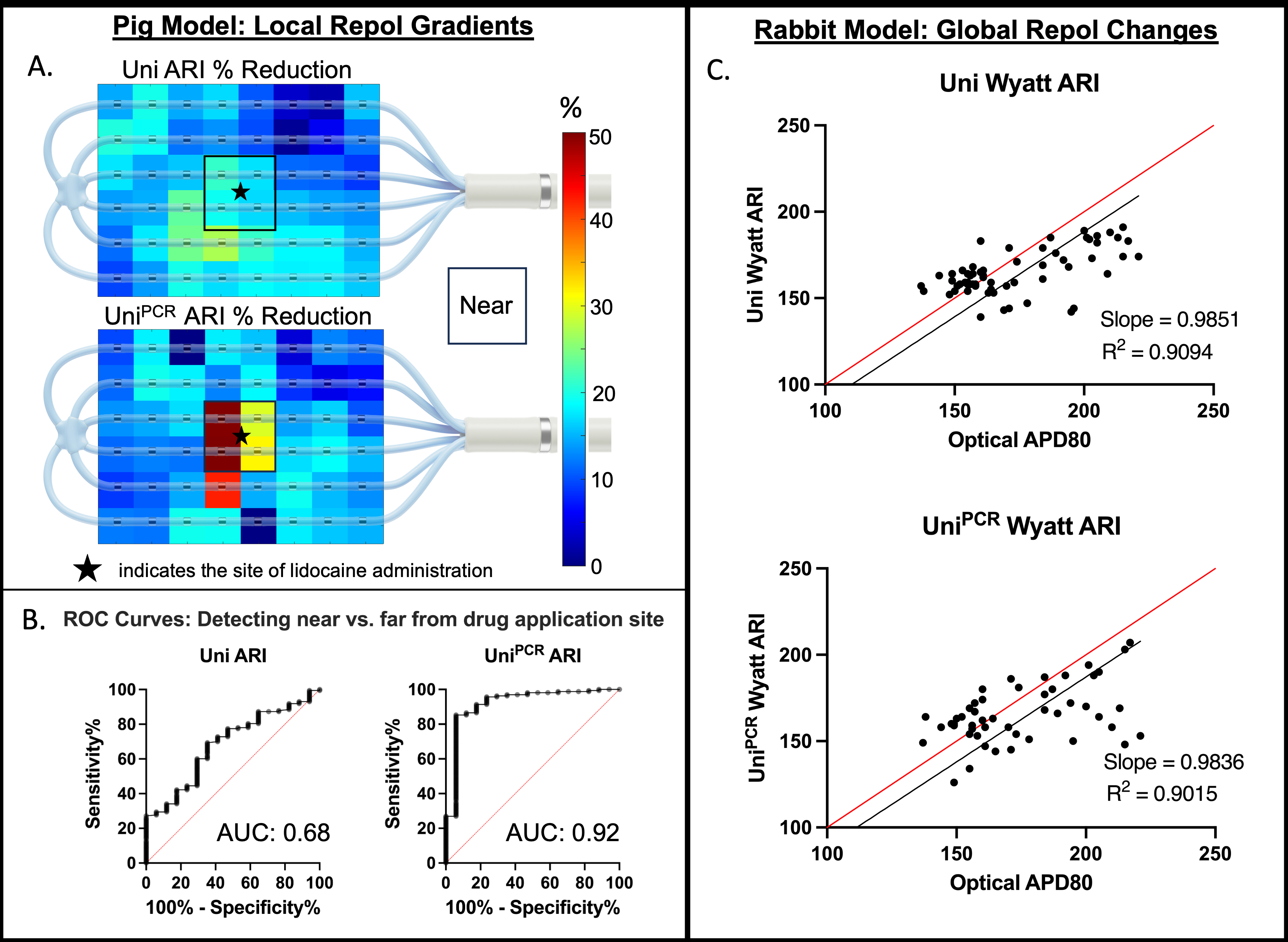
Methods: To validate UniPCR ARI for detecting global repol changes, we conducted simultaneous optical and electrical mapping in a rabbit model (n=3) following pinacidil/ibutilide infusion and compared optical APD to Uni vs UniPCR ARIs. To alter repol locally, we performed epicardial mapping in pig Langendorff experiments (n=4) and topically administered lidocaine at the center of the electrode array. We compared the changes in ARI from Uni vs. UniPCR before and after application of the drug.
Results: When repol is altered globally, there is a high correlation between both UniPCR and optical APD80 (slope = 0.98, R2 = 0.90) and Uni and optical APD80 (slope = 0.99, R2 = 0.91). When there is a local repol gradient, a greater difference in percent change near vs. far from the application site was observed in the UniPCR (32.0%, p <0.0001) compared to the Uni (5.2%, p = 0.0144). UniPCR ARI (AUC-ROC = 0.9) more accurately predicted areas near vs. far from the application site than Uni ARI (AUC-ROC = 0.7).
Conclusion: Global changes in repol can be detected by both Uni and UniPCR ARI. However, UniPCR is more sensitive to local repol gradients than Uni ARI. Implementing such mapping technology has greater implications for defining arrhythmogenicity of regional myocardium.
  • Subha, Tasnia  ( University Health Network , Toronto , Ontario , Canada )
  • Nanthakumar, Kumaraswamy  ( University Health Network , Toronto , Ontario , Canada )
  • Masse, Stephane  ( University Health Network , Toronto , Ontario , Canada )
  • Abderrahman, Yusuf  ( University Health Network , Toronto , Ontario , Canada )
  • Lai, Patrick  ( University Health Network , Toronto , Ontario , Canada )
  • Asta, John  ( University Health Network , Toronto , Ontario , Canada )
  • Bhaskaran, Abhishek  ( University Health Network , Toronto , Ontario , Canada )
  • Chakraborty, Praloy  ( University Health Network , Toronto , Ontario , Canada )
  • Chauhan, Vijay  ( University Health Network , Toronto , Ontario , Canada )
  • Dorian, Paul  ( St Michael's Hospital , Toronto , Ontario , Canada )
  • Author Disclosures:
    Tasnia Subha: DO NOT have relevant financial relationships | Kumaraswamy Nanthakumar: No Answer | Stephane Masse: No Answer | Yusuf Abderrahman: No Answer | Patrick Lai: No Answer | John Asta: No Answer | Abhishek Bhaskaran: No Answer | Praloy Chakraborty: No Answer | Vijay Chauhan: No Answer | Paul Dorian: DO NOT have relevant financial relationships
Meeting Info:

Basic Cardiovascular Sciences 2025

2025

Baltimore, Maryland

Session Info:

Unlocking New Mechanisms in Cardiac Arrhythmia

Friday, 07/25/2025 , 09:45AM - 11:00AM

General Session

More abstracts on this topic:
More abstracts from these authors:
Physician follow up and cardiac testing after a first diagnosis with secondary vs. primary atrial fibrillation in-hospital

Mohammed Basma, Abdel-qadir Husam, Fang Jiming, Dorian Paul, Lee Douglas, Ha Andrew, Jackevicius Cynthia, Ko Dennis, Austin Peter, Singh Sheldon

Autonomic Modulation & Cardioneuroablation: Not so fast, but also not so slow

Po Sunny, Gollob Michael, Chakraborty Praloy

You have to be authorized to contact abstract author. Please, Login
Not Available