Enhancing human pluripotent stem cell differentiation to cardiomyocytes through cardiac progenitor reseeding and cryopreservation
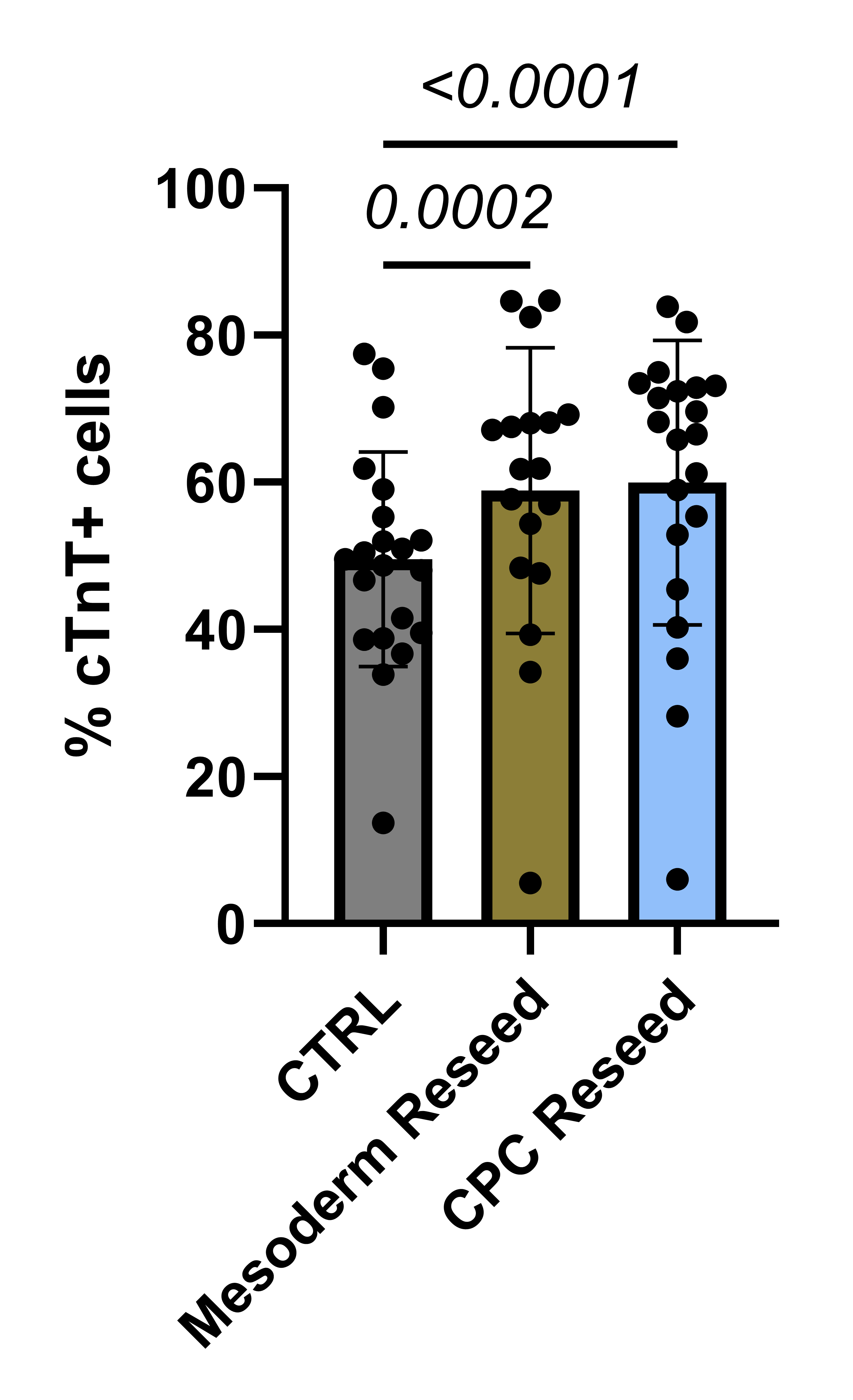
Abstract Body: Background: Human pluripotent stem cell-derived cardiomyocytes (hPSC-CMs) have the ability to transform heart disease treatment. Seminal preclinical studies have demonstrated that hPSC-CMs can remuscularize the heart in animal models of heart failure, motivating several ongoing clinical trials worldwide. Despite their promise, hPSC-CM differentiation protocols are plagued by batch and cell line variability in CM purity. Differentiation efficiency is heavily influenced by cell density and CHIR99021 concentration at the onset of differentiation. Using optimized differentiation parameters, only 15% of CM differentiations in our laboratory achieve a high purity threshold of 70% CMs, which has been established to improve contractility in transplantation studies. Although proper cell density is critical at the start of differentiation, few studies have examined altering cell density during progenitor stages of differentiation. Moreover, identifying stages during differentiation where cells can be frozen and recovered efficiently would enhance process flexibility. Hypothesis: We hypothesized that cell density may influence hPSC-CM differentiation efficiency at the mesoderm and cardiac progenitor cell (CPC) stages. Additionally, we hypothesized that cryopreservation prior to the cardiac progenitor stage and subsequent efficient differentiation to CMs would be achievable. Methods: To test these hypotheses, we reseeded hPSC-CM progenitors at a lower density either during differentiation or following cryopreservation to complete differentiation. To assess differentiation efficiency, we used flow cytometry of cTnT to identify CM. To assess CM phenotype differences after reseeding, we measured contractility, sarcomere length, multinucleation, junctional Cx43, and CM number. Results: Reseeding progenitors between the EOMES+ mesoderm and ISL1+/NKX2-5+ cardiac progenitor stages improved CM purity by 10-20% without negatively affecting contractility, sarcomere length, multinucleation, junctional Cx43, or CM number. Moreover, EOMES+ mesoderm and ISL1+/NKX2-5+ cardiac progenitors were cryopreservable with similar improvements in CM purity after resuming differentiation, facilitating storage of CM progenitor batches and on-demand CM production. Conclusions: In summary, we increased hPSC-CM differentiation purity by lowering progenitor cell density and demonstrated that EOMES+ mesoderm progenitors and ISL1+/NKX2-5+ cardiac progenitors were cryopreservable.
Feeney, Austin
(
University of Wisconsin-Madison
, Madison , Wisconsin , United States )
Author Disclosures:
Austin Feeney:DO NOT have relevant financial relationships