Carboxyl-Terminus of Hsc70-Interacting Protein Facilitates Angiotensin II-induced Phenotypic Switching in Vascular Smooth Muscle Cells
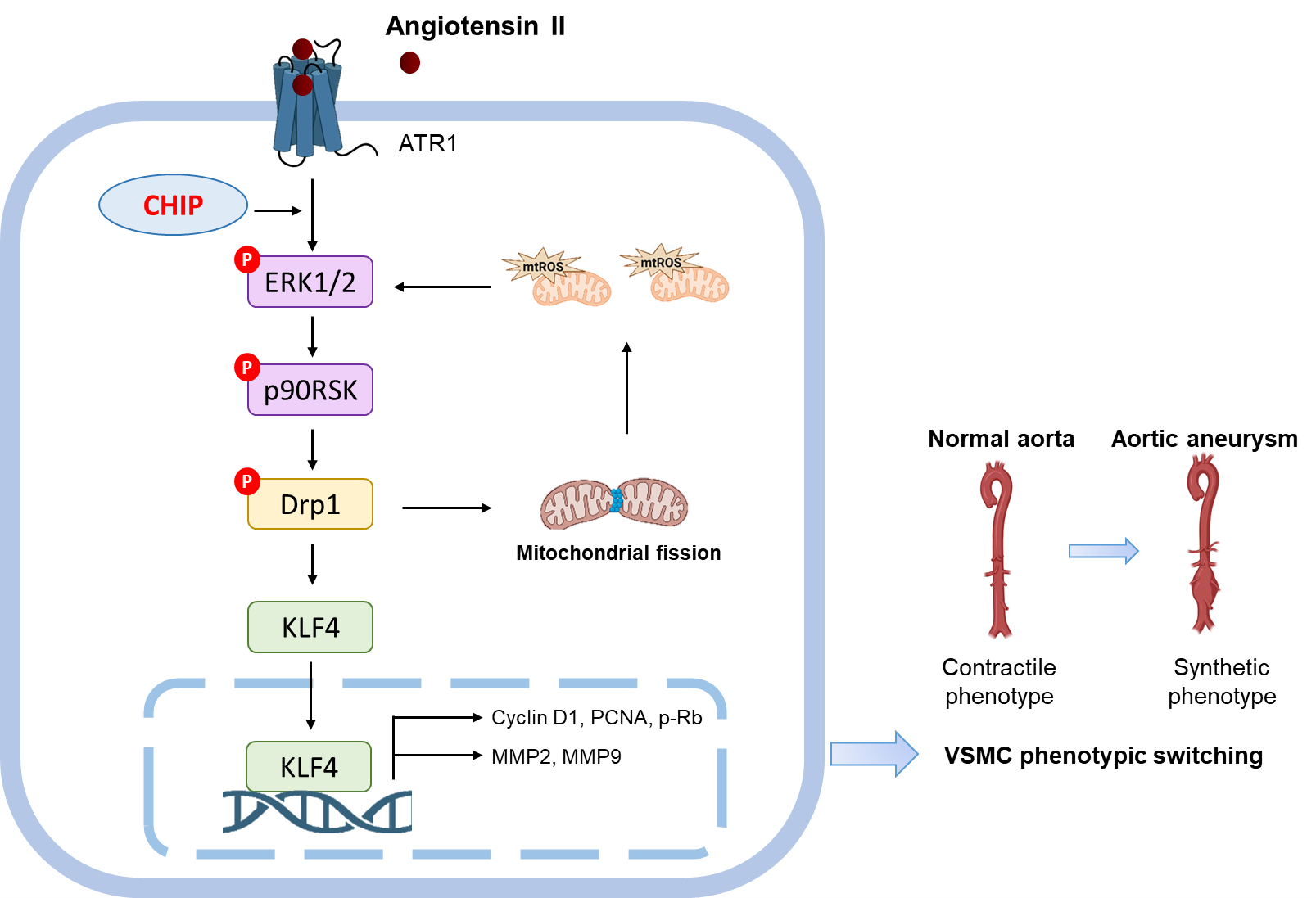
Abstract Body: Introduction: Mitochondria regulate metabolism, ROS production, cell growth, and apoptosis. Their dysfunction in vascular smooth muscle cells (VSMCs) contributes to vascular diseases like abdominal aortic aneurysm and restenosis. Carboxyl-terminus of Hsc70-interacting protein (CHIP), a U-box type chaperone-associated E3 ligase, is crucial for maintaining protein homeostasis. Hypothesis: We assessed the hypothesis that CHIP is involved in VSMC dysfunction, focusing on its regulation of the p90RSK pathway in response to angiotensin II (Ang II). Methods: VSMCs were isolated from wild-type (WT) and CHIP-deficient mouse, and molecular mechanisms were analyzed using Western blot, qRT-PCR, MitoTracker, JC-1, MitoSOX, and ATAC-seq; in vivo, mice were treated with Ang II infusion and β-aminopropionitrile for 14 days. Results: CHIP deficiency suppressed Ang II-induced ERK1/2/p90RSK-mediated KLF4 upregulation, thereby downregulating cell proliferation and cell migration by 95.00 ± 2.87% (p < 0.01, n=4). In rat aortic SMCs, si-CHIP inhibited Ang II-induced mitochondrial ROS production, Drp1 phosphorylation, and mitochondria fragmentation. ERK1/2 inhibition (U0126) or p90RSK depletion reduced Drp1 activation, suppressing KLF4-driven phenotypic switching. Interestingly, ATAC-seq analysis revealed that chromatin accessibility at the KLF4 promoter and enhancer regions was significantly reduced in CHIP-deficient cells. This suggests that CHIP plays a key role in KLF4 transcriptional regulation and that its deficiency may suppress KLF4-mediated phenotypic switching in VSMCs. In vivo, CHIP deficiency lowered Ang II-induced aortic aneurysm incidence by 42.86% (n=7) and reduced elastin degradation and calcification, similar to Drp1 inhibition (Mdivi-1). Immunohistochemistry showed lower p-p90RSK and p-Drp1 in CHIP deficient aortas than in Ang II/BAPN-treated controls. Conclusions: These results suggest that mitochondrial fission plays a key role in Ang II-induced ERK1/2/p90RSK-mediated VSMC proliferation and migration. CHIP regulates mitochondrial fission through the ERK1/2/p90RSK pathway, highlighting its potential as a therapeutic target for VSMC dysfunction.
Nguyen, Thuy Le Lam
(
Chungnam National University
, Daejeon , Korea (the Republic of) )
Huynh, Thi Ngoc Diem
(
Stanford University
, Stanford , California , United States )
Jin, Yujin
(
Chungnam National University
, Daejeon , Korea (the Republic of) )
Heo, Kyung-sun
(
Chungnam National University
, Daejeon , Korea (the Republic of) )
Author Disclosures:
Thuy Le Lam Nguyen:DO NOT have relevant financial relationships
| Thi Ngoc Diem Huynh:No Answer
| Yujin Jin:No Answer
| Kyung-Sun Heo:No Answer