Microbubble-Induced Shock Waves in Blood: Investigating Multiphase Sanal Flow Choking During Decompression
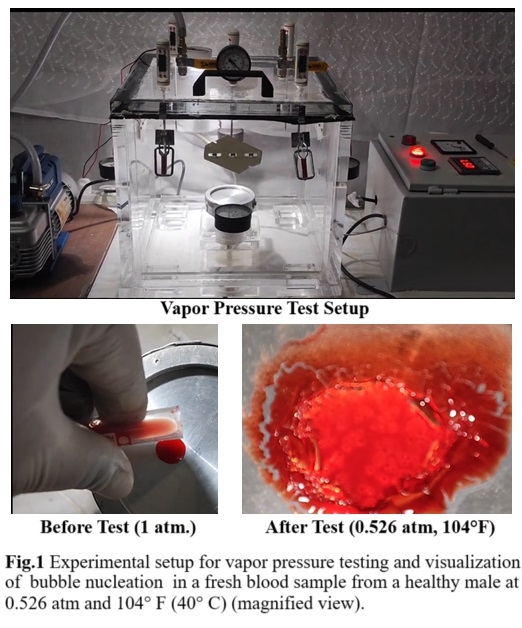
Abstract Body: Introduction In vivo studies confirm multi-phase flow choking in the cardiovascular system (CVS) (Circ. Res.,2022;131:AP3028; Phys. Fluids 34,101302(2022)). This in vitro study investigates Sanal flow choking under reduced pressure (Circ. Res.,2021;129:AP422), where rapid pressure drops induce microbubble formation in blood, generating shock waves—challenging traditional incompressible blood flow models (Springer Nature 2024, doi.org/10.1007/s12055-024-01859-7). Flow choking, often linked to stenotic narrowing, can also result from viscosity, vapor pressure, heat capacity, turbulence, and microbubble interactions. When a bubble's internal-to-external pressure ratio reaches a critical threshold, its rupture generates shock waves, affecting circulation and tissue perfusion. Research Question/Hypothesis Can reduced pressure trigger microbubble nucleation and shock waves in blood, demonstrating compressible behavior? We hypothesize that lowering blood pressure below its vapor pressure induces phase transition, leading to microbubble formation. At a critical threshold, bubble rupture generates shock waves, validating Sanal flow choking in blood. Objectives This study investigates blood vapor pressure and microbubble nucleation under controlled vacuum conditions, simulating decompression sickness (DCS). Methods Blood samples from healthy volunteers were subjected to vacuum pressures of 350-650 mmHg at 37-40°C. Microbubble formation, vapor pressure, and phase transitions were monitored and analyzed. Results Microbubble nucleation occurred at 590-625 mmHg, increasing in intensity at higher vacuum pressures (Fig.1). Gender-based differences in vapor pressure were observed. Microbubble rupture and acoustic signals confirmed Sanal flow choking and shock wave formation. Statistical analysis showed a significant correlation between pressure, temperature, and bubble nucleation. Conclusion This in vitro study provides evidence of microbubble nucleation in blood at low pressure, supporting Sanal flow choking and shock wave formation. These findings highlight blood’s compressible nature and its role in decompression-related pathologies. As sound waves pass through a bubbly medium, oscillating bubbles absorb energy, altering wave propagation and potentially slowing it to match biofluid velocity—causing multi-phase Sanal flow choking in the CVS. This research enhances understanding of cardiovascular risk assessment, DCS, and medical imaging reliability in altered pressure environments.
V R, Sanal Kumar
(
Amity University
, Noida , India )