
Logo

American Heart Association

  53
  0


Final ID: Wed169

Platelet Transfusion Simulation Effectively Reverses Aspirin-Induced Platelet Inhibition In Vitro: A Role for Stored Platelets?

Abstract Body: Aspirin (ASA) irreversibly inhibits platelet cyclooxygenase-1, impairing thromboxane A2 synthesis and reducing platelet aggregation. Platelet (PLT) transfusion can be used to restore function, yet the impact of cold storage (CS) on transfusion efficacy in this context in bleeding patients and other disease etiologies remains unclear. There is a lack of preclinical human models for high-throughput developmental research.

We hypothesized that PLT transfusion would restore function in ASA-treated blood and CS-PLTs would have equivalent efficacy to Day 0 PLTs in a high throughput in vitro model.

This exploratory in vitro study assessed PLT function before and after simulated PLT transfusion in ASA (125 μM)-treated whole blood using two assays: TEG 6s platelet mapping (PM) and Impedance Aggregometry (IA). For TEG (n=5), fresh (Day 0, n=2) or CS PLTs (≤Day 14, n=3) were mixed at 20% of whole blood volume. For IA (n=4), CS PLTs (≤21 days, n=4) were tested at 30% and 40%, maintaining constant hematocrit with autologous RBCs. A paired t-test and repeated-measures ANOVA were used for statistical analysis.

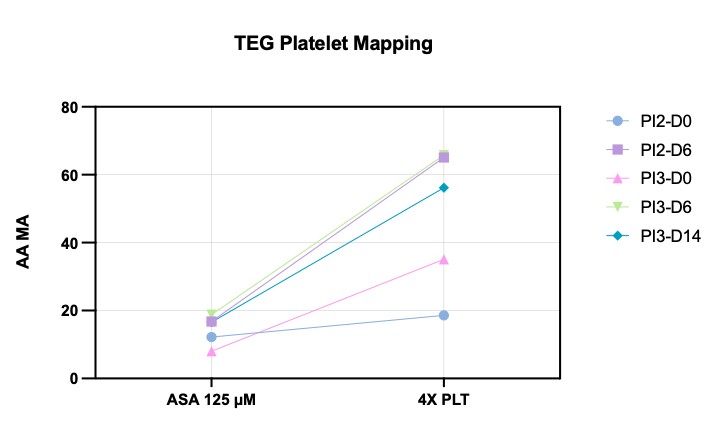
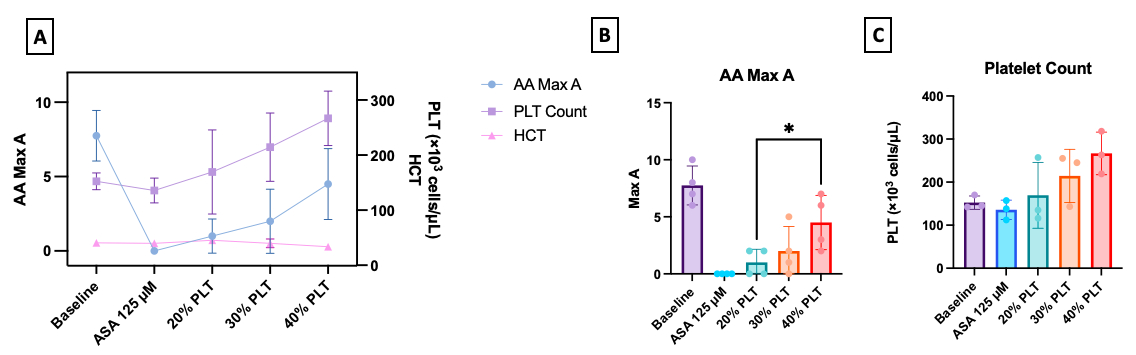
ASA induced 94 ± 4.2% inhibition of arachidonic acid (AA) response on TEG in vitro. PLT mixing significantly restored Maximum Amplitude (MA) from 14.5 ± 4.4 to 48.2± 20.7 (p = 0.01) (Figure 1). CS PLTs on Day 6 (n = 2) had the highest recovery (MA = 65.5 ± 0.5) compared to fresh PLTs at Day 0 (n = 2, MA = 26.9 ± 11.7). Day 14 (n=1) also reversed dysfunction (MA = 56.2). CS PLT mixing however did not change PLT count (227.0 ± 90.0 vs. 221.0 ± 81.0 pre-mixing), confirming platelet activity recovery rather than a numerical increase. IA (Figure 2) showed that 40% CS PLT (≤21 days, n=4) mixing increased function with no significant difference from baseline. (AA Max 4.5 ± 2.4 vs. 7.8 ± 1.7). Similarly, 30% PLT transfusion showed partial recovery, while 20% resulted in limited recovery. PLT counts trended upward but without statistically significant differences across conditions.

PLT transfusion in vitro effectively restores PLT function following ASA-induced inhibition, supporting its role as rapid strategy for urgent reversal. CS PLTs show strong efficacy, reinforcing their clinical viability in transfusion protocols. Further research with a larger sample size and additional assays is needed to comprehensively assess their efficacy, though our preliminary data support feasibility of this model to be used in future research to refine approaches and develop novel strategies.
  • Al Khraisat, Laith  ( University of Pittsburgh , Pittsburgh , Pennsylvania , United States )
  • Lee, Robert  ( University of North Carolina , Chapel Hill , North Carolina , United States )
  • Neal, Matthew  ( University of Pittsburgh , Pittsburgh , Pennsylvania , United States )
  • Shea, Susan  ( University of Pittsburgh , Pittsburgh , Pennsylvania , United States )
  • Mihalko, Emily  ( University of Pittsburgh , Pittsburgh , Pennsylvania , United States )
  • Author Disclosures:
    Laith Al Khraisat: DO NOT have relevant financial relationships | Robert Lee: No Answer | Matthew Neal: No Answer | Susan Shea: DO NOT have relevant financial relationships | Emily Mihalko: DO NOT have relevant financial relationships
Meeting Info:

Basic Cardiovascular Sciences 2025

2025

Baltimore, Maryland

Session Info:

Poster Session and Reception 1

Wednesday, 07/23/2025 , 04:30PM - 07:00PM

Poster Session and Reception

More abstracts on this topic:
Aspirin Shows Comparable Efficacy to Other Antithrombotic Strategies in Preventing Recurrent Stroke in Patients with Aortic Arch Atheroma: A Systematic Review

Blackman Antoinette, Lins De Oliveira Gabriel

Effect of Tirofiban on 90-day Functional Outcomes in Patients with Presumed Non-Embolic Stroke

Olive-gadea Marta, Behera Usha Kiran, Geyik Serdar, Rizzo Federica, Rodrigo-gisbert Marc, Garcia-tornel Garcia-camba Alvaro, Muchada Marian, Simonetti Renato, Ribo Marc, Bajrami Arsida, Pamidimukkala Vijaya, Flores Alan, Rubiera Marta, Aksoy Sena, Yelamanchi Rama Chandra, Estrada Edgardo, Polavarapu Naren

More abstracts from these authors:
Long wavelength light exposure reduces ischemic stroke brain injury through reduced platelet function

Denorme Frederik, Andraska Elizabeth, Kaltenmeier Christof, Arivudainambi Aishwarrya, Dyer Mitchell, Rosengart Matthew, Neal Matthew, Campbell Robert

You have to be authorized to contact abstract author. Please, Login
Not Available