
Logo

American Heart Association

  57
  0


Final ID: Fri089

Effect of Empagliflozin on Cardiac Arrhythmia by Attenuating Cardiac Fibrosis via NaV1.5 Regulation in β-Adrenergic Stimulated KK/HIJ Mice

Abstract Body: Introduction
The progression of cardiac fibrosis leads to increased myocardial stiffness and disruption of the cardiac conduction system as well as impaired contractile function. Empagliflozin is a drug for type 2 diabetes mellitus patients and lowers glucose reabsorption by inhibiting sodium-glucose co-transporter 2 (SGLT2). Recent studies reported that empagliflozin can produce off-target effects that improve cardiac function independently of diabetes. Although empagliflozin has shown to attenuate cardiac fibrosis, the underlying regulatory mechanisms remain to be elucidated.

Methods
The mouse model with cardiac fibrosis was established by inducing β-adrenergic stimulation through osmotic pump in KK/HIJ mouse. Echocardiographic, histological and electrophysiological experiments were conducted in saline or isoproterenol (30 mg/kg)-induced C57BL/6 mouse and KK/HIJ mouse following intraperitoneally injection of vehicle (DMSO) vs. empagliflozin (10 mg/kg).

Results
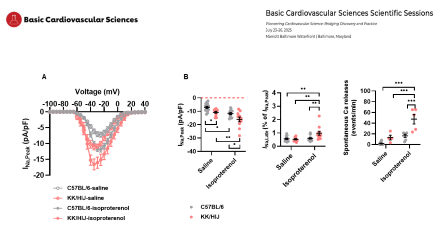
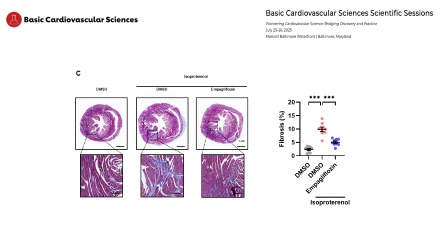
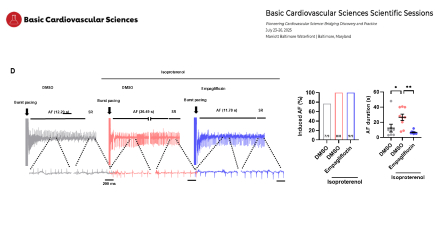
In the KK/HIJ mice following isoproterenol infusion, i) cardiac hypertrophy and fibrosis were induced (p<0.001); ii) left ventricular ejection fraction and fractional shortening were decreased, but not significantly; iii) QRS width and QTc interval were prolonged (p<0.001); iv) AF inducibility was increased, but not significantly; v) action potential duration was prolonged (p<0.05); vi) INa,Peak (-16.07±1.76 vs. -7.06±0.77, p<0.01) and INa,Late (0.98±0.15 vs. 0.56±0.05, p<0.01) were increased, and vii) spontaneous Ca2+ release was increased (47.33±9 vs. 4.72±3.02, p<0.001), compared to C57BL/6 mice. After empagliflozin injection, isoproterenol-induced KK/HIJ mice showed that the histological, echocardiographic and electrophysiological properties significantly improved compared to the vehicle group. Both inducibility and duration of AF were also significantly reduced in the empagliflozin group than in vehicle group.

Conclusion
This study demonstrated that empagliflozin, a SGLT2i, improved cardiac fibrosis and reduced AF inducibility/duration through modulation of electrophysiological remodeling, suggesting that empagliflozin can be considered a potential new antiarrhythmic drug for atrial fibrillation.
  • Yu, Byeongil  ( Korea University , Seoul , Korea (the Republic of) )
  • Lee, Minju  ( Korea University , Seoul , Korea (the Republic of) )
  • Choi, Jong-il  ( Korea University Medical Center , Seoul , Korea (the Republic of) )
  • Author Disclosures:
    Byeongil Yu: DO NOT have relevant financial relationships | Minju Lee: No Answer | Jong-Il Choi: No Answer
Meeting Info:

Basic Cardiovascular Sciences 2025

2025

Baltimore, Maryland

Session Info:

Poster Session and Reception 3

Friday, 07/25/2025 , 04:30PM - 07:00PM

Poster Session and Reception

More abstracts on this topic:
AI Modeling Predicts BI 749327 disrupts Transient Receptor Potential Canonical 6 channel formation to rescue dystrophic cardiomyopathy

Brusacoram Annabelle, Guru Sameer, Nunez Raymundo, Smith Brian, Lin Brian

A Curious Complete Heart Block with Carfilzomib

Shah Mohammed, Rahman Naveed, Al-mohamad Talal, Batra Sejal, Vyas Apurva

More abstracts from these authors:
New Perspective on Guideline-Based Management of Atrial Fibrillation According to Socioeconomic Disparity

Kim Yeji, Seo Chang-ok, Jeong Joo Hee, Lee Hyoung Seok, Shim Jaemin, Kim Young-hoon, Choi Jong-il

You have to be authorized to contact abstract author. Please, Login
Not Available