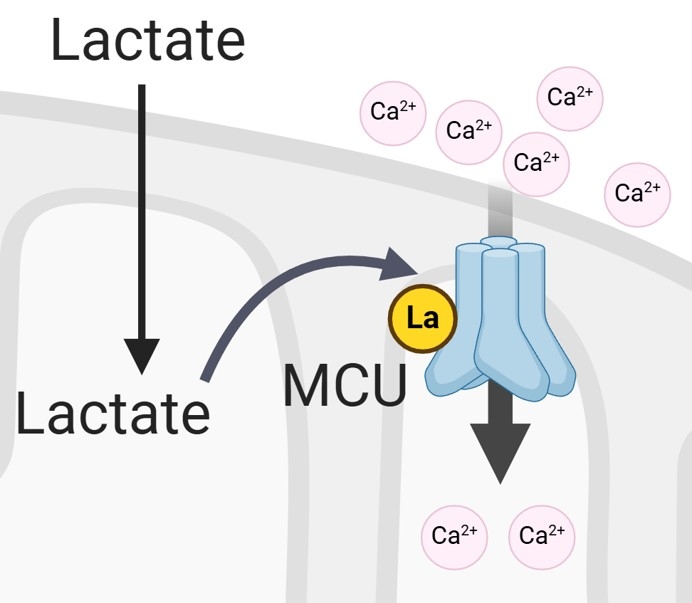
Lysine-lactylation of the Mitochondrial Calcium Uniporter and Its Role in Mitochondrial Calcium Flux
Abstract Body: Introduction. The mitochondrial calcium uniporter (MCU) serves as the primary route for acute mitochondrial calcium (mCa2+) influx, playing a critical role in regulating bioenergetics, cell signaling, and cellular health. While MCU function is well-documented, its regulation by post-translational modifications (PTMs) remains poorly understood, representing a key gap in our knowledge of mCa2+ homeostasis. Lysine lactylation (Kla), a recently discovered PTM, involves the addition of lactate-derived acyl groups (Lactyl-CoA) to lysine residues on proteins, suggesting a direct link between metabolic reprogramming and protein function. Given that lactate is actively transported into mitochondria and integrated into the tricarboxylic acid cycle, Kla may serve as a metabolic sensor regulating mitochondrial processes. However, whether MCU undergoes lactylation and how this modification influences mCa2+ transport remain unexplored. Addressing this gap is critical for understanding how metabolic stress impacts mCa2+ signaling, with potential implications for cardiovascular diseases. Hypothesis. We hypothesize that MCU Kla modulates its calcium transport activity, linking metabolic shifts to mitochondrial function. Aims. This research aims to examine the Kla of the MCU, identify specific Kla sites, and evaluate the effects of Kla on mCa2+ flux. Methods. Using bioinformatics, biochemical assays, and site-directed mutagenesis, we examined MCU lactylation under elevated and reduced lactate conditions. Ca2+ imaging was employed to assess mCa2+ uptake in cells expressing wild-type and Kla mutant MCU variants. Results. We identified specific lysine residues in MCU’s juxtamembrane region that undergo Kla. Functional assays demonstrated that Kla reduces MCU-mediated mCa2+ uptake, implicating Kla as a metabolic regulator of mCa2+ homeostasis. Conclusion(s). This study identifies MCU lactylation as a novel regulatory mechanism linking metabolic reprogramming to mCa2+ transport. By demonstrating that lactate-driven modifications influence mitochondrial calcium uptake, our findings provide new insights into metabolic control of mitochondrial function, with potential implications for cardiovascular and metabolic diseases.
Samantaray, Kunal
(
Wake Forest University
, Winston Salem , North Carolina , United States )
Goyani, Shanikumar
(
Wake Forest University
, Winston Salem , North Carolina , United States )
Sinha, Anupriya
(
Wake Forest University
, Winston Salem , North Carolina , United States )
Patnaik, Sriram
(
Wake Forest University
, Winston Salem , North Carolina , United States )
Breglio, Jennifer
(
Wake Forest University
, Winston Salem , North Carolina , United States )
Jadiya, Pooja
(
Wake Forest University
, Winston Salem , North Carolina , United States )
Tomar, Dhanendra
(
Wake Forest University
, Winston Salem , North Carolina , United States )
Author Disclosures:
Kunal Samantaray:DO NOT have relevant financial relationships
| Shanikumar Goyani:DO NOT have relevant financial relationships
| Anupriya Sinha:DO NOT have relevant financial relationships
| Sriram Patnaik:No Answer
| Jennifer Breglio:No Answer
| pooja jadiya:DO NOT have relevant financial relationships
| Dhanendra Tomar:DO NOT have relevant financial relationships