
Optimizing mRNA-LNP Delivery to the Heart via Transcatheter Intracoronary Administration
Abstract Body: Introduction: Recent advancements in mRNA technology have highlighted its potential in developing novel treatments for heart failure. Lipid nanoparticles (LNPs) serve as a well-established and efficient vehicle for mRNA delivery; however, optimizing their delivery to the heart remains a challenge. This study aimed to investigate the efficacy of transcatheter intracoronary (IC) administration with intravenous (IV) and intramyocardial (IM) administration for delivering mRNA-LNPs to the heart.
Methods: Fluorescence-labeled LNPs encapsulating Firefly Luciferase (FLuc) mRNA were administered via each methods in normal rabbits (3.0–3.5kg) to investigate in vivo mRNA-LNP dynamics. LNP accumulation and FLuc expression in the heart were assessed using an in vivo imaging system (IVIS) 4 hours post-administration (mRNA 25 µg/kg), followed by immunohistochemical analysis. The same protocol was applied to an ischemia-reperfusion (I/R) model rabbit to evaluate differences in mRNA-LNP distribution in diseased hearts.
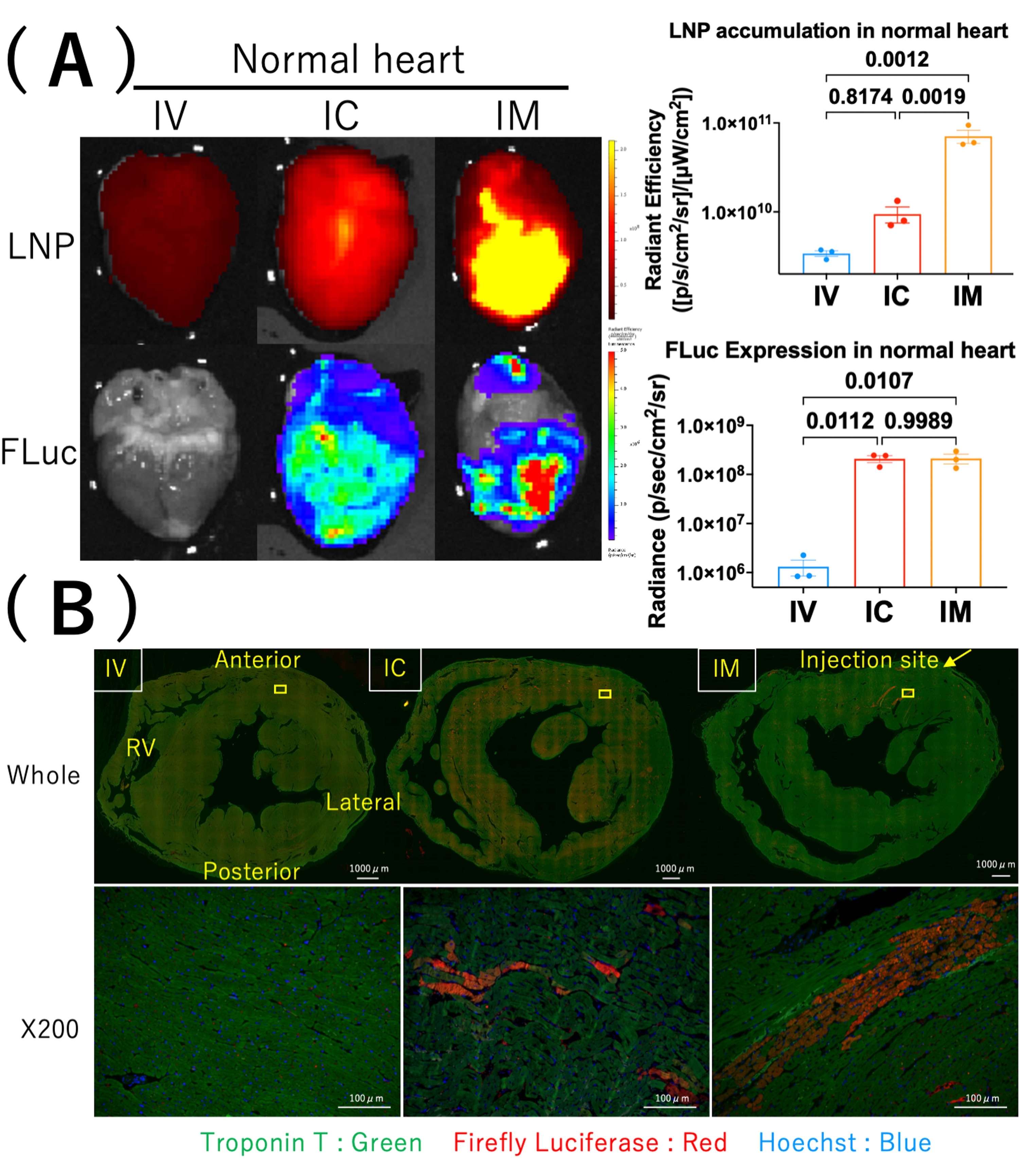
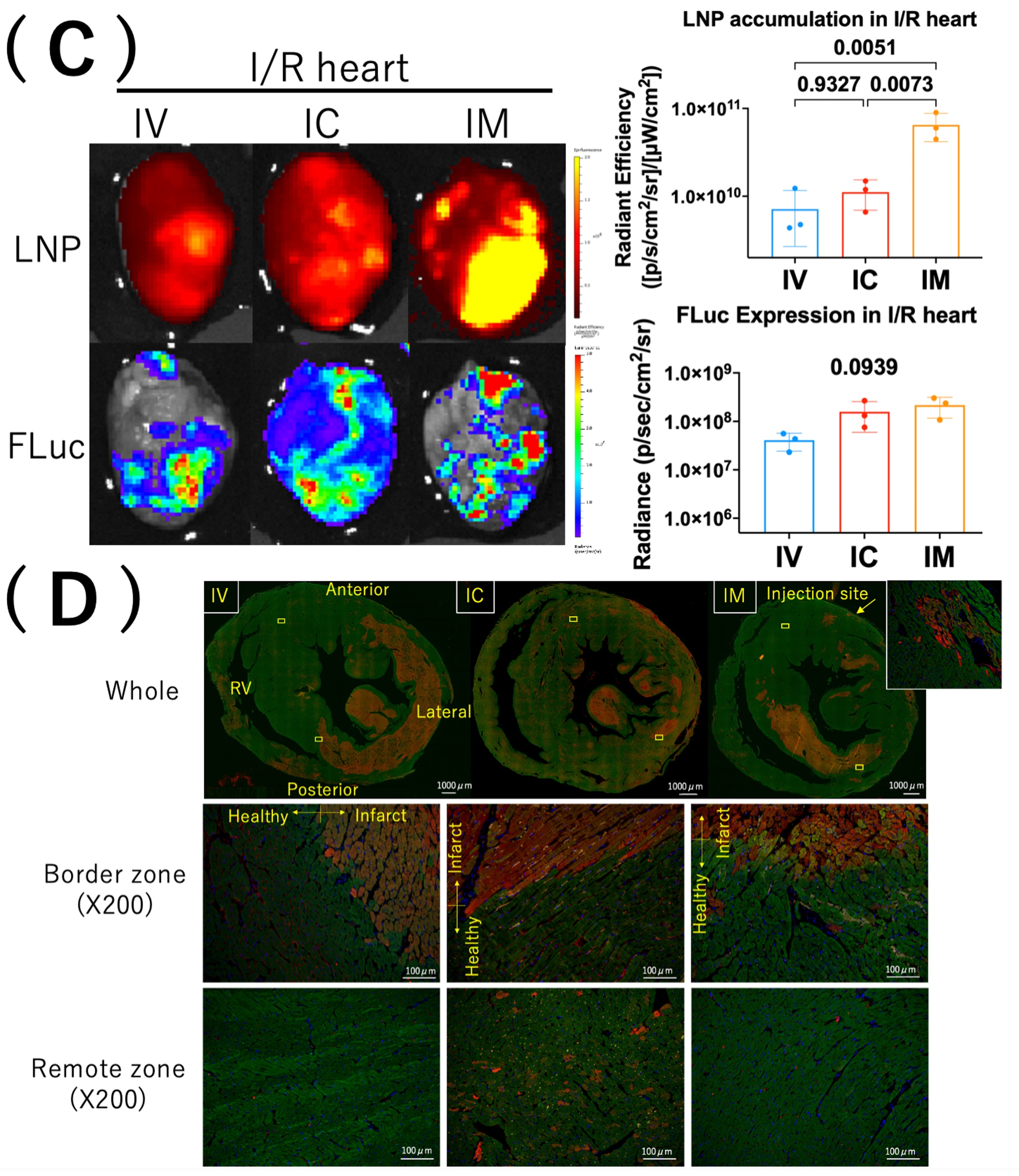
Results: In normal rabbits, IVIS imaging demonstrated higher LNP accumulation in the IM group than in the IC group, while the IV group exhibited little accumulation. FLuc expression was significantly higher in the IC group than in the IV group, which showed little expression, whereas comparable levels were observed between the IC and IM groups (A). Histological analysis revealed that FLuc-expressing cells were primarily troponin T-positive cardiomyocytes at the injection site in the IM group, whereas IC administration led to widespread FLuc expression in cardiomyocytes throughout the heart (B), consistent with IVIS findings. In the I/R model, the IV group exhibited increased LNP accumulation and FLuc expression compared to normal rabbits. The IC group demonstrated significantly higher FLuc expression than the IV group, with comparable levels between the IC and IM groups (C). Histological analysis revealed that a large number of FLuc-expressing cardiomyocytes were observed in the infarct area in all administration methods, while only the IC group showed FLuc-expressing cardiomyocytes in remote (non-infarct) areas (D).
Conclusions: The IC administration efficiently delivers mRNA-LNPs not only to the infarct (damaged) area but also to the remote (non-damaged) area in I/R hearts. This approach represents a safe and effective method for achieving broader cardiomyocyte transfection, potentially enhancing mRNA-based therapeutic strategies for heart failure.
Handa, Kazuma
( Osaka University
, Osaka
, Japan
)
Miki, Kenji
( Osaka University
, Osaka
, Japan
)
Miyagawa, Shigeru
( Osaka University
, Osaka
, Japan
)
Kawamura, Masashi
( Osaka University
, Osaka
, Japan
)
Sasai, Masao
( Osaka University
, Osaka
, Japan
)
Matsuzaki, Takashi
( Osaka University
, Osaka
, Japan
)
Harada, Akima
( Osaka University
, Osaka
, Japan
)
Fujimura, Lisa
( Osaka University
, Osaka
, Japan
)
Saito, Shunsuke
( Osaka University
, Osaka
, Japan
)
Fujishiro, Anri
( Terumo Corporation
, Kanagawa
, Japan
)
Hirano, Kunio
( Terumo Corporation
, Kanagawa
, Japan
)