CYP2C19 and ABCB1 variants and acute myocardial infarction risk in hospitalized patients with clopidogrel therapy: A prospective cohort study in China
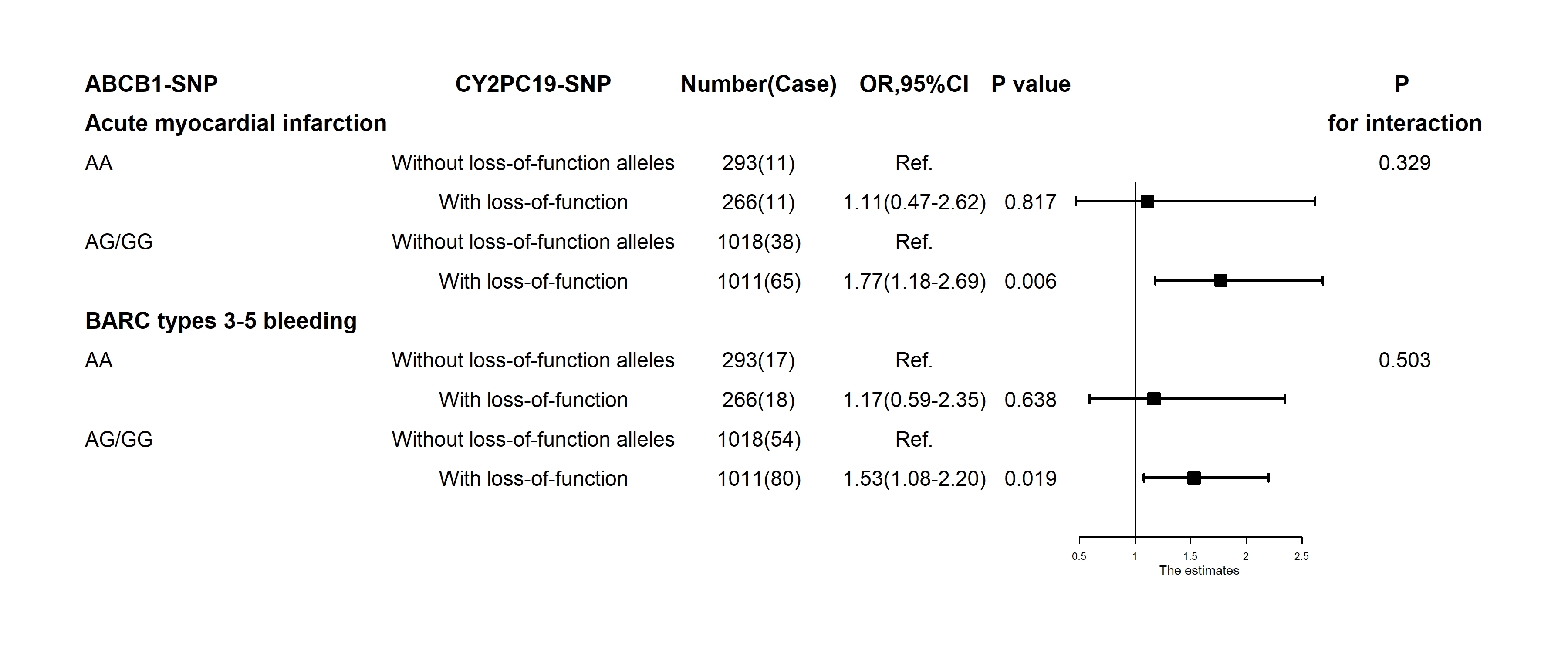
Abstract Body: Background: Genetic variants in ABCB1 and CYP2C19 are known to affect clopidogrel metabolism and response. However, among the high-risk in-hospital patients treated with clopidogrel, these genetic variants impact on the real-world efficacy outcomes remain unclear and understudied. To evaluate the association between ABCB1 and CYP2C19 variants and the incidence of in-hospital acute myocardial infarction (AMI) among clopidogrel-treated patients. Methods: We conducted a candidate genetic analysis using data from the TianShan Cardio-Cerebrovascular Pharmacogenomics Cohort (TS-CVD-PGx cohort). All patients who received clopidogrel as a preventative treatment at hospital admission from May 1, 2021, to December 31, 2023 were included. Genotyping was performed for the ABCB1 (3435A>G; rs1045642),CYP2C19*2 (681G>A, rs4244285), and CYP2C19*3 (636G>A, rs4986893) genes. The primary outcome was the occurrence of new-onset AMI and explorative outcome the bleeding during hospitalization. The independent and combined effects of ABCB1 and CYP2C19 variants was assessed. Results: Among the 2588 study participants (mean age 62 years, 77.8% male), 125 experienced new-onset or recurrent AMI during hospitalization. Patients with ABCB1-3435AA genotype showed a trend toward lower risk of in-hospital AMI compared to those with ABCB1-3435AG/GG genotypes (OR, 1.31; 95% CI, 0.83-2.14; P=0.266). Carriers of CYP2C19 loss-of-function alleles demonstrated significantly higher risk of in-hospital AMI (OR, 1.63; 95% CI, 1.13-2.37; P=0.009). These results were consistent across the key clinical subgroups. No significant interaction was observed between ABCB1 and CYP2C19 variants on both efficacy and safety outcomes. Conclusions: Among hospitalized patients receiving clopidogrel, CYP2C19 loss-of-function alleles were significantly associated with increased risk of in-hospital AMI, while ABCB1 risk allele showed a marginally significant effect probably due to a lack of sufficient power. These findings suggest that targeted pharmacogenetic testing, particularly for CYP2C19 variants, may have clinical utility in optimizing clopidogrel therapy and improving in-hospital outcomes for severe patient.
Yuan, Yujuan
(
People’s Hospital of Xinjiang Uyghur Autonomous Region
, Urumqi , China )
Yang, Yining
(
People’s Hospital of Xinjiang Uyghur Autonomous Region
, Urumqi , China )
Author Disclosures:
Yujuan Yuan:DO NOT have relevant financial relationships
| Yining Yang:No Answer