Multiscale Platform Identifies Novel Therapeutic Targets for Fibrosis
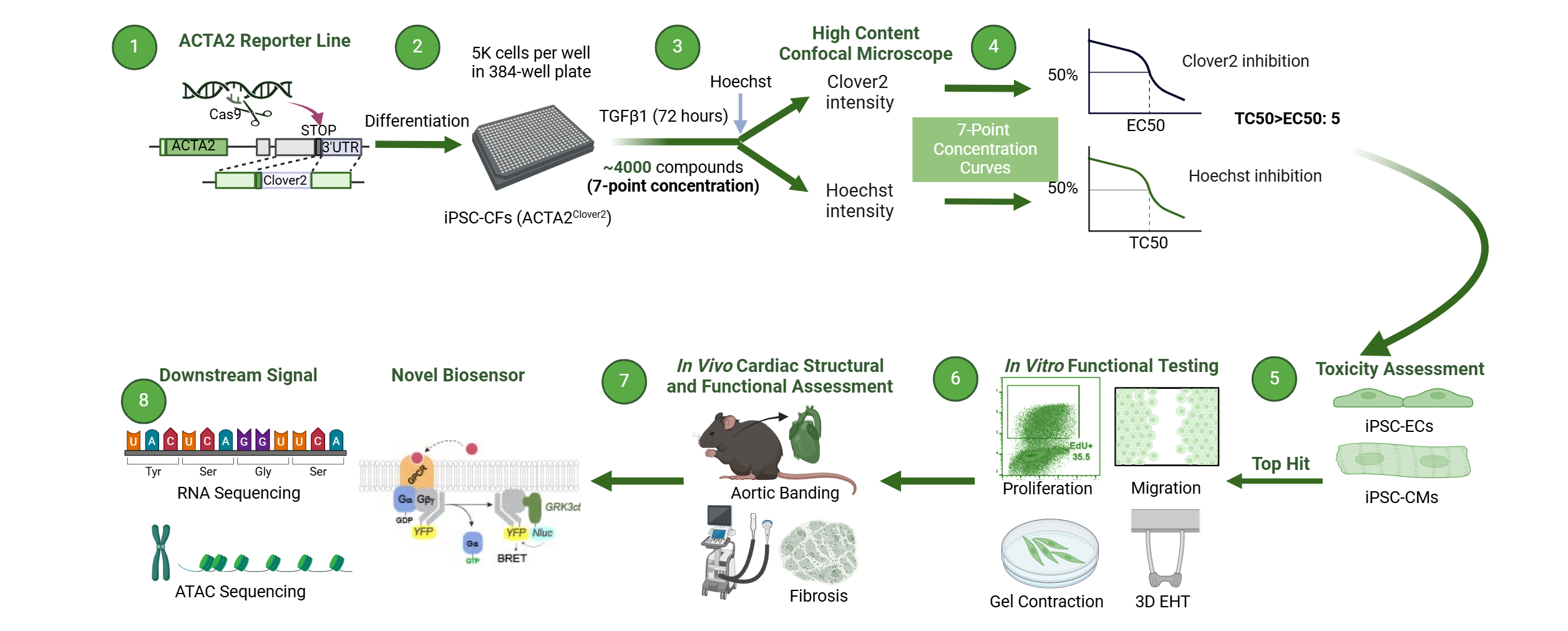
Abstract Body: Fibrosis is characterized by excessive extracellular matrix (ECM) deposition, leading to organ stiffness and eventual dysfunction. However, the considerable species differences, lack of counter-screening for toxicity, and the inability to recapitulate the complex microenvironment in 2D cells have led to the failure of promising preclinical drugs in clinical trials. Human induced pluripotent stem cell (iPSC) technology has been increasingly utilized for disease modeling, drug screening, and toxicity testing, enabling precision medicine. To identify novel antifibrotic therapies, I established a multiscale platform that integrates human iPSCs, tissue engineering, and animal models (Figure 1). First, I developed a protocol to derive cardiac fibroblasts (CFs) from human iPSCs, creating an unlimited cell source to study cardiac fibrosis. This method produces homogenous iPSC-CFs that remain quiescent and sensitive to profibrotic stimuli. For drug screening, I generated ACTA2 reporter iPSC lines to monitor MyoFB activation. To recapitulate the fibrosis-induced contractile dysfunction in vitro, I generated a 3D iPSC-derived engineered heart tissue (EHT) model composed of iPSC-cardiomyocytes (CMs) and iPSC-CFs. Profibrotic stimulation reduced contraction and relaxation velocity, along with increased passive tension, demonstrating that this EHT model faithfully recapitulated the characteristics of cardiac fibrosis in vivo. Leveraging the multiscale platform, I performed a high-throughput screening utilizing a library of ~10,000 compounds on reporter iPSC-CFs, and conducted counter-screenings in iPSC derived CMs and endothelial cells (ECs) to exclude cardiotoxicity. From the bioactive compound library, I identified an adenosine receptor (AR, family A GPCR) antagonist as a potent treatment for cardiac fibrosis. Adenosine promotes fibrosis in multiple organs. Although GPCRs are the largest family of druggable proteins encoded in the human genome, progress in targeting them has been hindered by the lack of tools to reliably measure their signaling modalities. Leveraging state-of-the-art biosensors capable of recording the activity of endogenous GPCRs, I discovered that atypical, Gβγ-dependent GPCR signaling triggered by AR underlies the antifibrotic effects. In summary, the reliable multiscale platform not only AR-triggered Gβγ signaling as a promising target, but also provides a broad approach to discovering safe and effective drugs for fibrosis therapy.
Zhang, Hao
(
Stanford University
, Mountain view , California , United States )
Shivnaraine, Rabindra
(
Stanford University
, Mountain view , California , United States )
Thai, Phung
(
UCLA
, Los Altos , California , United States )
Ren, Lu
(
Stanford University
, Palo Alto , California , United States )
Janicot, Remi
(
Boston University
, Boston , Massachusetts , United States )
Zhu, Wenjuan
(
Stanford University
, Mountain view , California , United States )
Tu, Chengyi
(
Stanford University
, Stanford , California , United States )
Siepe, Dirk
(
UT MD Anderson Cancer Center
, Houston , Texas , United States )
Maziarz, Marcin
(
Boston University
, Boston , Massachusetts , United States )
Liu, Yu
(
Stanford University
, Stanford , California , United States )
Liu, Chun
(
Medical College of Wisconsin
, Milwaukee , Wisconsin , United States )
Liu, Wenqiang
(
Stanford Cardiovascular Institute
, Palo Alto , California , United States )
Shin, Hye
(
UCLA
, Los Altos , California , United States )
Kim, Hyeon Yu
(
Northeastern University
, Boston , Massachusetts , United States )
Chandy, Mark
(
Western University
, London , Ontario , Canada )
Kalocsay, Marian
(
UT MD Anderson Cancer Center
, Houston , Texas , United States )
Chiamvimonvat, Nipavan
(
University of Arizona
, Phoenix , Arizona , United States )
Garcia-marcos, Mikel
(
Boston University School of Medicin
, Boston , Massachusetts , United States )
Wu, Joseph
(
STANFORD UNIV SCH OF MEDICINE
, Stanford , California , United States )
Author Disclosures:
Hao Zhang:DO NOT have relevant financial relationships
| Yu Liu:No Answer
| Chun Liu:No Answer
| Wenqiang Liu:No Answer
| Hye Shin:No Answer
| Hyeon Yu Kim:No Answer
| Mark Chandy:No Answer
| MARIAN KALOCSAY:DO NOT have relevant financial relationships
| Nipavan Chiamvimonvat:No Answer
| Mikel Garcia-Marcos:No Answer
| Joseph Wu:DO NOT have relevant financial relationships
| Rabindra Shivnaraine:No Answer
| Phung Thai:No Answer
| Lu Ren:DO NOT have relevant financial relationships
| Remi Janicot:No Answer
| Wenjuan Zhu:No Answer
| Chengyi Tu:No Answer
| Dirk Siepe:No Answer
| Marcin Maziarz:No Answer