
Logo

American Heart Association

  169
  0


Final ID: Mo024

Integrated analysis of ex vivo biomechanical ventricular remodeling and imaging-based in vivo strain changes in a pre-clinical murine model of radiation-induced cardiotoxicity

Abstract Body:
Introduction: Thoracic radiation therapy (RT) is commonly used for the treatment of many common malignancies, such as lung and breast cancer, but carries a high risk of radiation-induced cardiotoxicity (RIC). Existing diagnosis of RIC is challenged by subclinical ventricular dysfunction, not captured by global indices of cardiac function. Understanding RIC-driven biomechanical remodeling of the myocardium will provide novel insights into developing high-fidelity imaging approaches for early detection of RIC.
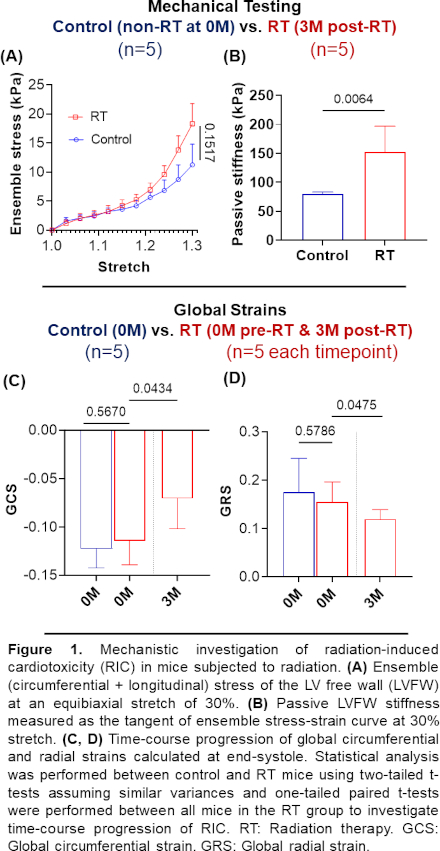
Methods: A pre-clinical model of RIC was developed by administering whole heart irradiation under image guidance in mice (8 Gy x 5) over five consecutive days. A longitudinal study was carried out to investigate the biomechanical response of the left ventricle (LV). Cardiac magnetic resonance imaging was performed to estimate end-systolic strains. Mechanical testing was performed on the harvested LV free wall (LVFW) specimens to measure passive stiffness, calculated as the tangent to the ensemble stress-strain curve at 30% strain.
Results: A significant increase in passive LVFW stiffness was observed at 3M post-RT (Figs. 1A and B). Significant declines in both global circumferential strain (GCS) and global radial strain (GRS) at 3M post-RT, compared to respective measurements at pre-RT, were observed (Figs. 1C and D). Suppressed contractile strains suggested biomechanical remodeling of the LV, including impaired contractility and passive stiffening of the LVFW, consistent with ex-vivo measurements.
Conclusion: We have established a direct correlation between ex-vivo mechanical testing (elevated stiffness) and reduced contractile strains in in-vivo analysis in a mouse model of RIC. Such integrated analysis will pave the way towards developing highly sensitive imaging approaches that non-invasively recapitulate the ventricular remodeling events associated with RIC, thereby enabling early detection of RIC in patients receiving thoracic RT.
  • Mukherjee, Tanmay  ( Texas AM University , College Station , Texas , United States )
  • Elliott, Sarah  ( UT Southwestern Medical Center , Dallas , Texas , United States )
  • Higgins, Taylor-jade  ( UT Southwestern Medical Center , Dallas , Texas , United States )
  • Wansapura, Janaka  ( UT Southwestern Medical Center , Dallas , Texas , United States )
  • Alluri, Prasanna  ( UT Southwestern Medical Center , Dallas , Texas , United States )
  • Avazmohammadi, Reza  ( Texas AM University , College Station , Texas , United States )
  • Author Disclosures:
    Tanmay Mukherjee: DO NOT have relevant financial relationships | Sarah Elliott: DO NOT have relevant financial relationships | Taylor-Jade Higgins: DO NOT have relevant financial relationships | Janaka Wansapura: No Answer | Prasanna Alluri: DO NOT have relevant financial relationships | Reza Avazmohammadi: DO NOT have relevant financial relationships
Meeting Info:

Basic Cardiovascular Sciences

2024

Chicago, Illinois

Session Info:

Poster Session and Reception I

Monday, 07/22/2024 , 04:30PM - 07:00PM

Poster Session and Reception

More abstracts on this topic:
A novel Notch and WNT signaling mechanism contribute to pediatric DCM: a pathway to new therapeutics

Nyarko Obed, Miyamoto Shelley, Stauffer Brian, Sucharov Carmen

"Blueberry On Top" Phenomenon. A Novel Strain Pattern In Patients With Apical Variant Hypertrophic Cardiomyopathy.

Alnaimat Saed, Mascara Mariah, Pulipati Yochitha, Madgula Anantha, Lygouris Georgios, Biederman Robert

More abstracts from these authors:
Integrated mechano-metabolic measures of diastolic function in mice

Mukherjee Tanmay, Venkategowda Sunil, Tong Carl, Choudhury Mahua, Avazmohammadi Reza

Sex-specific differences in the mechano-metabolic behavior of the myocardium in mice

Mukherjee Tanmay, Venkategowda Sunil, Tong Carl, Choudhury Mahua, Avazmohammadi Reza

You have to be authorized to contact abstract author. Please, Login
Not Available