Artificial Intelligence-based Software for Checking REal-world Echocardiography to ideNtify hidden Cardiac Amyloidosis: AI-SCREEN-CA
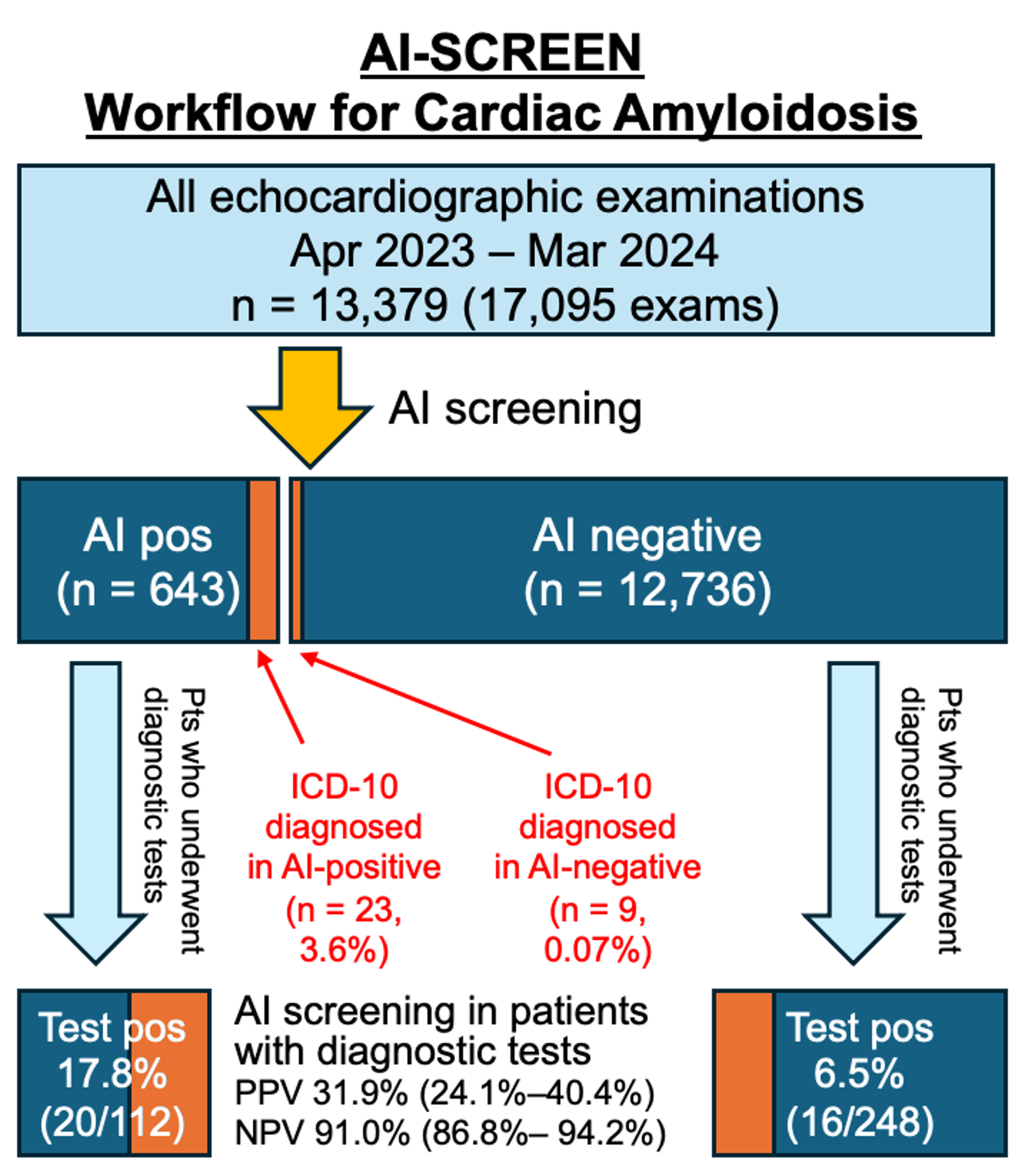
Abstract Body (Do not enter title and authors here): Background: Cardiac amyloidosis (CA) is a progressive infiltrative cardiomyopathy for which early diagnosis is essential to benefit from emerging therapies. However, CA remains underdiagnosed due to the lack of practical screening tools. Recent advances in artificial intelligence (AI) enable automated CA screening using routine echocardiographic images, but real-world diagnostic performance remains unclear. Methods: We retrospectively analyzed consecutive echocardiograms performed at a tertiary care center in Japan between April 2023 and March 2024. AI-based software automatically classified echocardiographic views, measured cardiac parameters, and screened for CA using both parameter-based and deep learning-based algorithms. Documented diagnosis was assessed via ICD-10 codes, and clinical suspicion was evaluated through diagnostic tests including tissue biopsy, 99mTc-pyrophosphate scintigraphy, cardiac MRI, or monoclonal protein assessment. The primary outcome was the number of patients identified by the AI software as having suspected CA. Results: Among 17,129 examinations, 17,095 (99.8%) from 13,379 patients were successfully analyzed by the AI software. The software flagged 643 patients (4.8%) as having suspected CA. These included 23 out of 32 clinically diagnosed CA cases identified via ICD-10 codes (sensitivity 71.9% [95% CI: 53.3%–86.3%]). Of the remaining patients without an ICD-based diagnosis, 360 patients underwent diagnostic tests, and those flagged by AI had approximately three times the prevalence (17.8%, 20 out of 112) of highly suspicious findings from these tests compared to AI-negative patients (6.5%, 16 out of 248), suggesting that true disease prevalence may be underestimated and that AI-based screening has significant potential for facilitating early diagnosis. Furthermore, considering highly suspicious diagnostic test findings as CA, the overall positive and negative predictive values of the AI were 31.9% (95% CI: 24.1%–40.4%) and 91.0% (95% CI: 86.8%–94.2%), respectively, in patients who underwetn diagnostic tests. Conclusions: AI-based echocardiographic screening demonstrated favorable diagnostic performance in real-world settings, highlighting its potential utility for identifying previously undiagnosed CA cases and supporting timely clinical management. The use of AI-based screening may improve clinical screening and facilitate early interventions.
Sakamoto, Akira
(
Juntendo University Graduate School of Medicine
, Tokyo , Japan )
Kagiyama, Nobuyuki
(
Juntendo University Graduate School of Medicine
, Tokyo , Japan )
Nakamura, Yutaka
(
Juntendo University Graduate School of Medicine
, Tokyo , Japan )
Sato, Eiichiro
(
Juntendo University Graduate School of Medicine
, Tokyo , Japan )
Fujita, Wataru
(
Juntendo University Graduate School of Medicine
, Tokyo , Japan )
Kaneko, Tomohiro
(
Juntendo University Graduate School of Medicine
, Tokyo , Japan )
Miyazaki, Sakiko
(
Juntendo University Graduate School of Medicine
, Tokyo , Japan )
Minamino, Tohru
(
Juntendo University Graduate School of Medicine
, Tokyo , Japan )
Author Disclosures:
Akira Sakamoto:DO NOT have relevant financial relationships
| Nobuyuki Kagiyama:DO have relevant financial relationships
;
Speaker:Novartis Japan:Active (exists now)
; Research Funding (PI or named investigator):Bristol Myers Squibb:Active (exists now)
; Research Funding (PI or named investigator):AstraZeneca:Active (exists now)
; Research Funding (PI or named investigator):EchoNous:Past (completed)
; Research Funding (PI or named investigator):AMI:Past (completed)
; Speaker:Bristol Myers Squibb:Active (exists now)
; Speaker:Eli Lilly:Active (exists now)
; Speaker:Boehringer Ingelheim:Active (exists now)
; Speaker:Otsuka Pharma:Active (exists now)
| Yutaka Nakamura:No Answer
| Eiichiro Sato:No Answer
| Wataru Fujita:DO NOT have relevant financial relationships
| Tomohiro Kaneko:DO NOT have relevant financial relationships
| Sakiko Miyazaki:No Answer
| Tohru Minamino:No Answer