Dose-Dependent and Sustained Reduction in Lipoprotein(a) levels after single-dose of Kylo-11, a LPA-targeted Small Interfering RNA, in Healthy Volunteers: A First-in-Human Phase I Study
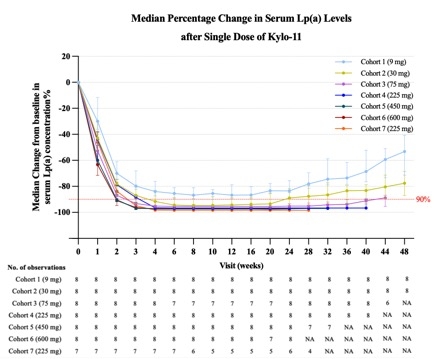
Abstract Body (Do not enter title and authors here): Background: Lipoprotein(a) [Lp(a)] is a causal risk factor for atherosclerotic cardiovascular disease, with no approved pharmacological treatments. Kylo-11 is a N-acetylgalactosamine-conjugated small interfering RNA that reduces Lp(a) synthesis in the liver. This randomized, double-blind, placebo-controlled, phase 1 study aimed to evaluate the safety, tolerability, pharmacokinetics and pharmacodynamics characteristics of Kylo-11 in Chinese healthy volunteers (NCT06363851). Methods: Sixty participants with Lp(a) 75–200 nmol/L were enrolled in Cohorts 1–6 (9–600 mg), while ten participants with Lp(a) >200 nmol/L were enrolled in Cohort 7 (225 mg). Participants received single subcutaneous doses of Kylo-11 or placebo (8:2) and followed up to 48 weeks. Serum Lp(a) was quantified via Roche Diagnostics' assay with a low limit of quantitation of 7 nmol/L. Results: In this ongoing study, mean age was 28.3 years (SD, 7.8) and 35.7% were female. Median (IQR) baseline Lp(a) was 121.1 nmol/L (95.5–151.1 nmol/L) and 219.4 nmol/L (213.1–242.8 nmol/L) for Cohort 1–6 and Cohort 7, respectively. Overall median follow-up was 228.5 days (range, 43–341 days). 55.7% participants experienced treatment-emergent adverse events (TEAEs). Most TEAEs were Grade 1–2 and unrelated to study drug. No serious TEAEs, TEAEs leading to study discontinuation or injection-site reactions occurred. Median percentage changes (IQR) from baseline in serum Lp(a) levels at 24 weeks post dose were –83.5% (–84.9% to –75.6%), –88.9% (–94.9, –81.7), –95.2 (–96.5, –93.5), –96.7 (–97.4, –96.3), –97.2 (–97.8, –96.9), –97.4 (–97.8, –96.5), and –98.4% (–98.5% to –98.3%) in Cohort 1–7, respectively. Lp(a) reduction of participants with baseline Lp(a) of 75–200 nmol/L maintained at 77.6% at Week 48 in 30 mg cohort, 88.8% at Week 44 in 75 mg cohort, and 96.7% at Week 40 in 225 mg cohort, respectively. Serum Lp(a) levels remained below 75 nmol/L in participants receiving≥30 mg of Kylo-11 from 4 weeks post dose during the follow-up. Conclusions: Kylo-11 was well tolerated in Chinese healthy volunteers. Higher doses produced greater and more sustained reductions in serum Lp(a) levels over 48 weeks of follow-up. These findings support further investigation of Kylo-11 in patients with elevated Lp(a), with potential for administration once every 6 months or annually.
Du, Xiaolin
(
Chengdu Xinhua Hospital
, Chengdu , China )