Strength-Based Exercise is Not Associated with Risk of Ventricular Arrhythmia in Arrhythmogenic Cardiomyopathy – Towards Safer Exercise Options
Abstract Body (Do not enter title and authors here): Background Arrhythmogenic cardiomyopathy (ACM) is a genetic heart disorder characterized by fibrofatty replacement of ventricular myocardium, sustained ventricular arrhythmia (VA), and elevated risk of sudden death. The most common form is arrhythmogenic right ventricular cardiomyopathy (ARVC). Current guidelines restrict high-intensity aerobic exercise and competitive sports in individuals with ACM or at-risk due to pathogenic/likely-pathogenic (P/LP); however, the impact of strength-based exercise is poorly understood.
Objective Evaluate the risk of VA in individuals with ACM and/or P/LP ACM gene variant exposed to strength-based exercise.
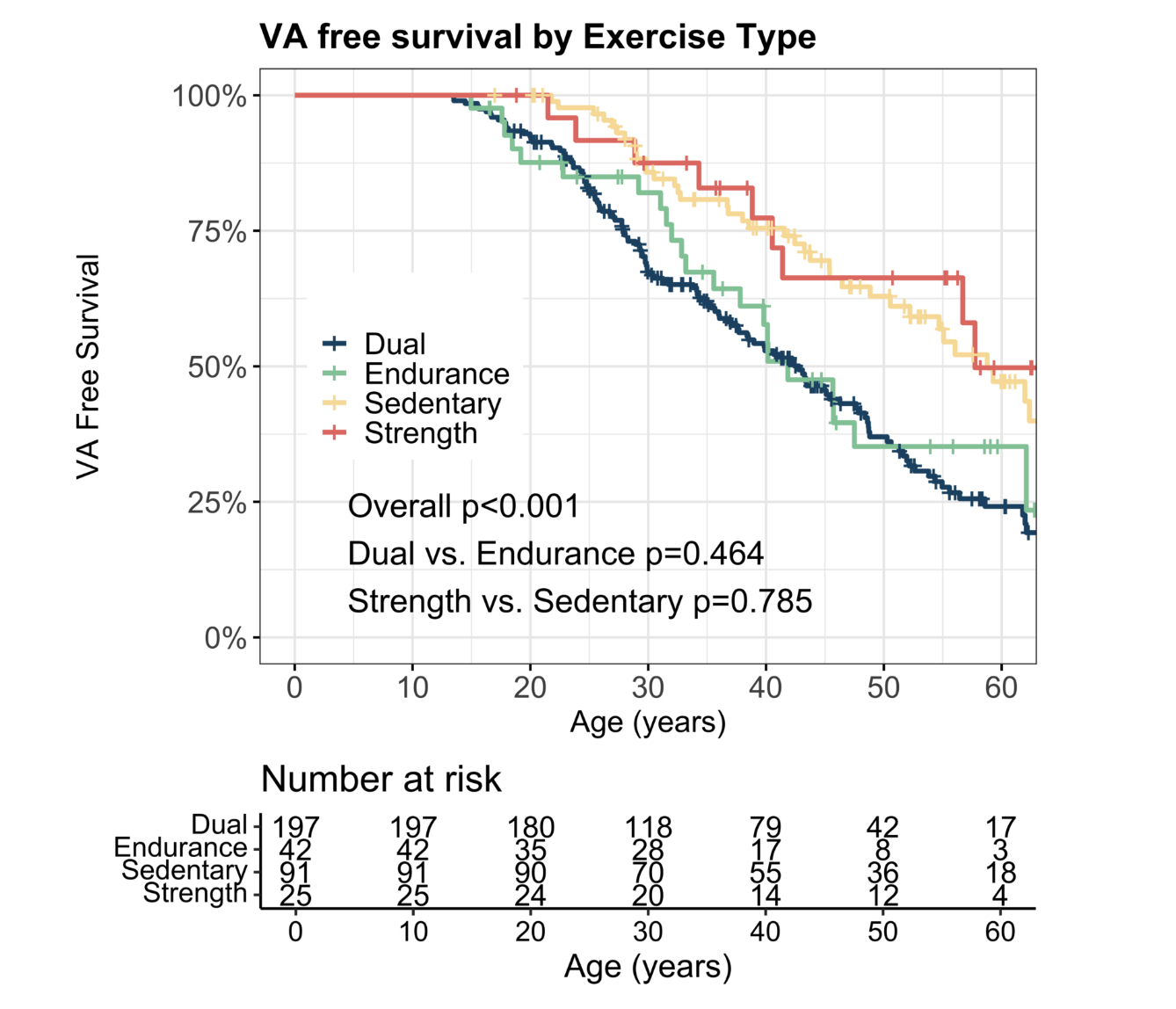
Methods Participants were from Johns Hopkins ARVC Registry who met 2010 Task Force Criteria for definitive ARVC and/or P/LP variant in an ACM gene. Exercise exposure was assessed via telephone from age 10 through follow-up. Types of endurance and strength exercise were classified using the Compendium of Physical Activities. To assess independent effects of strength exercise on VA, participants were stratified into 4 groups: dual athlete, endurance athlete, strength athlete, and sedentary. Kaplan Meier curves assessed the impact of endurance vs strength exercise on VA risk. Cox proportional hazards regression tested independent associations between strength exercise and VA.
Results N=355 individuals were included, with median age 34 (23.9, 46.1[CJ1] ) years, 45% male, 59% probands, and 71% who met definite ARVC criteria; 55% met criteria for dual athletes, 26% sedentary, 12% endurance athletes, and 7% strength athletes. Genotypes included 44% PKP2, 27% DSP, 22% gene-elusive, and 7% other. N=195 (55%) had VA at last follow-up (median age 44). Overall lifetime risk of VA was higher with increased aerobic exercise (dual + endurance) than without (strength + sedentary) (p<0.001). There was no difference between dual vs endurance athletes (p=0.46), nor strength athletes vs sedentary (p=[LY2] [CJ3] 0.78). A multivariable Cox regression showed no association of VA with strength training (p=0.53), while risk of endurance exercise was significant (HR 1.45, 95% CI: 1.13–1.85; p=0.004).
Conclusion Endurance exercise is a risk factor for VA and poor outcomes in ACM patients. Our study found no independent association between strength exercise and risk of sustained VA. These findings support individualized risk stratification and shared decision-making in ACM care and show the need for prospective studies to guide recommendations.
Chiampas, Katia
(
Johns Hopkins
, Baltimore , Maryland , United States )
Muller, Steven
(
Johns Hopkins Hospital
, Baltimore , Maryland , United States )
Osuji, Evans
(
Johns Hopkins
, Baltimore , Maryland , United States )
Jacobsen, Alan
(
University of Utah School of Medicine
, Salt Lake City , Utah , United States )
Yanek, Lisa
(
Johns Hopkins Medical Institutions
, Baltimore , Maryland , United States )
Carrick, Richard
(
Johns Hopkins Hospital
, Baltimore , Maryland , United States )
Gasperetti, Alessio
(
Johns Hopkins
, Baltimore , Maryland , United States )
Tichnell, Crystal
(
Johns Hopkins
, Baltimore , Maryland , United States )
Murray, Brittney
(
Johns Hopkins University
, Baltimore , Maryland , United States )
Calkins, Hugh
(
JOHNS HOPKINS UNIVERSITY SCHOOL MED
, Baltimore , Maryland , United States )
James, Cynthia
(
JOHNS HOPKINS UNIVERSITY
, Baltimore , Maryland , United States )
Barouch, Lili
(
Johns Hopkins University
, Columbia , Maryland , United States )
Author Disclosures:
Katia Chiampas:No Answer
| Hugh Calkins:DO NOT have relevant financial relationships
| Cynthia James:DO have relevant financial relationships
;
Research Funding (PI or named investigator):Lexeo Therapeutics:Active (exists now)
; Research Funding (PI or named investigator):EicoSIS:Past (completed)
; Research Funding (PI or named investigator):Arvada Therapeutics:Active (exists now)
; Research Funding (PI or named investigator):Tenaya Therapeutics:Active (exists now)
; Research Funding (PI or named investigator):Rocket Pharmaceuticals:Active (exists now)
| Lili Barouch:DO NOT have relevant financial relationships
| Steven Muller:DO NOT have relevant financial relationships
| Evans Osuji:DO NOT have relevant financial relationships
| Alan Jacobsen:No Answer
| Lisa Yanek:DO NOT have relevant financial relationships
| Richard Carrick:No Answer
| Alessio Gasperetti:DO NOT have relevant financial relationships
| Crystal Tichnell:No Answer
| Brittney Murray:No Answer