
Logo

American Heart Association

  15
  0


Final ID: Mo4052

Fetal left ventricular outflow tract obstruction and placental syncytiotrophoblast differentiation

Abstract Body (Do not enter title and authors here): Introduction: Placental dysfunction is an emerging contributor to neonatal morbidity and mortality in pregnancies complicated by fetal congenital heart disease (CHD). Previous work in mouse models of CHD and examination of human placental pathology indicates that the maternal-fetal interface, specifically the syncytiotrophoblast layer, can be dysmorphic in fetal CHD-affected pregnancies. We hypothesized that gene expression in a subset of placentas affected by fetal CHD would show differences in genes required for syncytiotrophoblast differentiation and function.
Methods: Placentas from pregnancies affected by fetal CHD were sampled and stored as formalin-fixed paraffin embedded blocks per pathology core standard protocol. A subset of fetal CHD cases affected by left ventricular outflow tract obstruction (LVOTO) without genetic diagnoses or major extracardiac anomalies were selected for transcriptomic analysis.
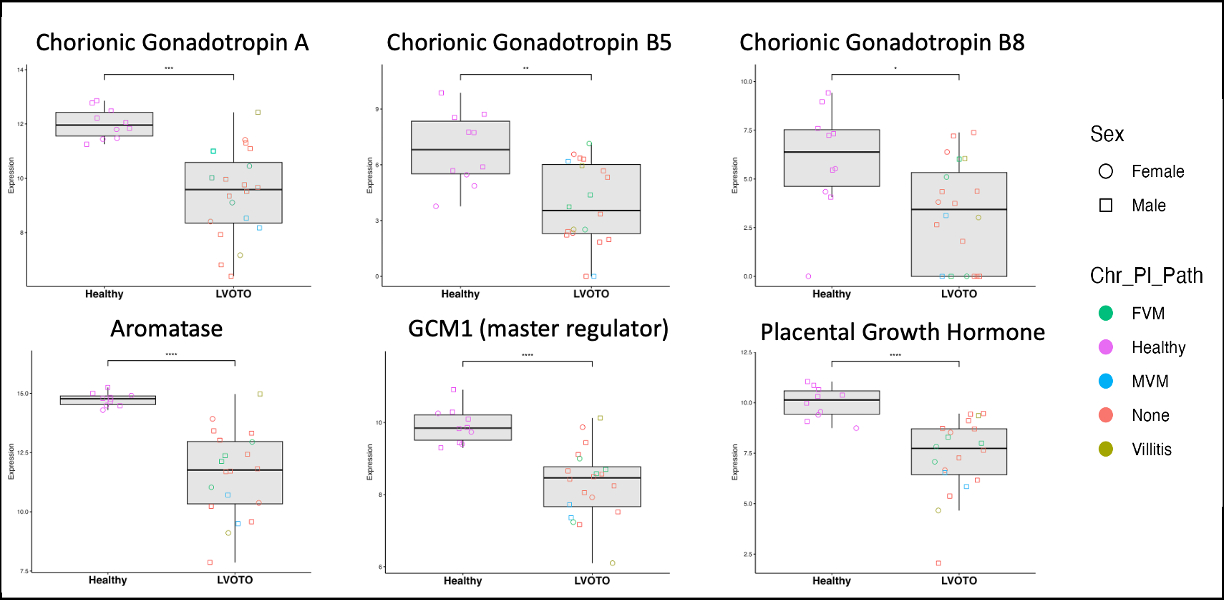
Results: Placentas affected by fetal LVOTO (n=20) demonstrated markedly reduced expression of genes associated with terminally differentiated syncytiotrophoblasts compared to controls (n=10). Specifically, aromatase (p<0.0001), placental growth hormone (p<0.0001), and multiple chorionic gonadotropin subunits and pregnancy specific glycoproteins were downregulated. Transcription factor GCM1, a master regulator of trophoblast differentiation, was also downregulated (p<0.0001). Syncytin-1, a product of syncytiotrophoblasts that facilitates their formation from cytotrophoblasts, was downregulated (p<0.0001) and syncytin-1 receptor expressed on cytotrophoblasts was upregulated (p<0.0001) in the LVOTO affected placentas. Abundance of cytotrophoblasts did not differ between groups, which showed similar expression of cytotrophoblast markers including E-cadherin and cytokeratins.
Conclusions: Dysregulation of the heart-placenta axis in fetal CHD may be a result of altered syncytiotrophoblast differentiation, resulting in decreased functional surface area at the maternal-fetal interface.
  • Dunn-fletcher, Caitlin  ( UT Southwestern Medical Center , Dallas , Texas , United States )
  • Udayakumar, Durga  ( Mayo Clinic , Rochester , Minnesota , United States )
  • Leon, Rachel  ( UT Southwestern Medical Center , Dallas , Texas , United States )
  • Author Disclosures:
    Caitlin Dunn-Fletcher: No Answer | Durga Udayakumar: No Answer | Rachel Leon: DO NOT have relevant financial relationships
Meeting Info:

Scientific Sessions 2025

2025

New Orleans, Louisiana

Session Info:

Bench to Bedside: Translational Multi-omic Models of Cardiovascular Disease 1

Monday, 11/10/2025 , 01:00PM - 02:00PM

Abstract Poster Board Session

More abstracts on this topic:
β1 integrins regulate cellular behavior and cardiomyocyte organization during ventricular wall formation

Miao Lianjie, Schwartz Robert, R Burns Alan, Kumar Ashok, Dipersio C. Michael, Wu Mingfu, Lu Yangyang, Nusrat Anika, Zhao Luqi, Castillo Micah, Xiao Yongqi, Guo Hongyan, Liu Yu, Gunaratne Preethi

Acceptability and Feasibility Of A Digital Health Intervention For Adults with Congenital Heart Disease

Valente Joseph, Reardon Leigh, Moons Philip, Okumura Megumi, Gurvitz Michelle, Agarwal Anushree, Banala Keerthana, Buenrostro Karina, Alano Lindsay, Duan Rong, Parang Kim, Manyan Karina, Bravo-jaimes Katia, Norris Mark

You have to be authorized to contact abstract author. Please, Login
Not Available