
Logo

American Heart Association

  15
  0


Final ID: Su3095

Phenotypic Age Predicts Long-Term Cardiac Outcomes Better Than Chronological Age in Patients with Acute Myocardial Infarction

Abstract Body (Do not enter title and authors here): Background: Phenotypic Age (PhenoAge), which is calculated based on chronological age and nine biomarkers, has been shown to better predict in-hospital outcomes in patients with acute myocardial infarction (AMI).
Research Question: This study aimed to determine whether PhenoAge predicts long-term cardiac outcomes in AMI patients more accurately than chronological age.
Methods: In this retrospective study, we included 5,440 patients who underwent percutaneous coronary intervention (PCI) for AMI at a tertiary hospital between December 2009 and November 2018. Clinical outcomes included cardiac death (defined as death due to heart failure, myocardial infarction, or arrhythmia) and all-cause death.
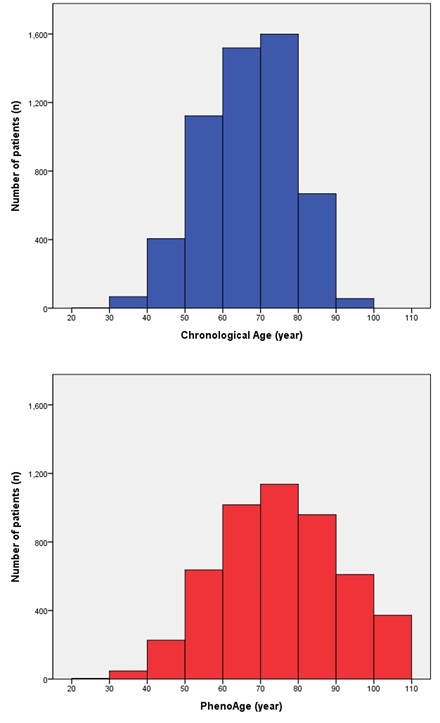
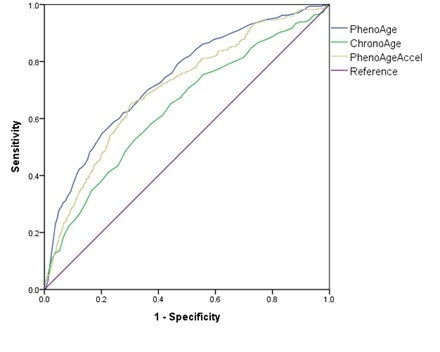
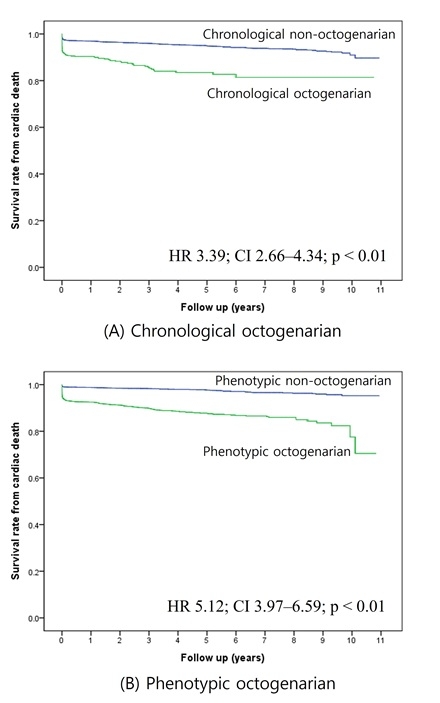
Results: The mean PhenoAge and chronological age of the entire patient cohort were 66.24 ± 11.77 years and 78.55 ± 19.07 years, respectively. During a follow-up period of 51.03 ± 36.97 months, there were 331 cases of cardiac death and 570 cases of all-cause death. The area under the curve (AUC) of the receiver operating characteristic (ROC) curve for predicting cardiac death was higher for PhenoAge (AUC: 0.746, p < 0.01) than for chronological age (AUC: 0.638, p < 0.01). Similarly, for all-cause death, PhenoAge (AUC: 0.719, p < 0.01) outperformed chronological age (AUC: 0.649, p < 0.01). However, both PhenoAge (AUC: 0.436, p < 0.01) and chronological age (AUC: 0.455, p < 0.01) showed low predictive power for revascularization. Patients with PhenoAge ≥80 had a higher risk of cardiac death than those with PhenoAge <80 [hazard ratio (HR) 5.12; 95% confidence interval (CI) 3.97–6.59; p < 0.01], and this risk was greater than that observed in patients with chronological age ≥80 compared to those <80 (HR 3.39; CI 2.66–4.34; p < 0.01).
Conclusion: PhenoAge more accurately predicts long-term outcomes, including cardiac death, than chronological age in AMI patients who underwent PCI. The risk of cardiac death in patients with PhenoAge ≥80 is higher than in those with PhenoAge <80 and exceeds the corresponding risk difference observed using chronological age.
  • Lee, Hyo Jin  ( Gyeongsang National University School of Medicine , Jinju , Korea (the Republic of) )
  • Author Disclosures:
    Hyo Jin Lee: DO NOT have relevant financial relationships
Meeting Info:

Scientific Sessions 2025

2025

New Orleans, Louisiana

Session Info:

Next-Generation Biomarkers & Omics-Driven Risk Stratification

Sunday, 11/09/2025 , 03:15PM - 04:15PM

Abstract Poster Board Session

More abstracts on this topic:
30-Day Outcomes of Dual vs Triple Antithrombotic Therapy After PCI

Meeks William, Slone Sarah, Barringhaus Kurt

ACS-Specific Gut Microbial and Metabolic Profiles Reveal Diagnostic and Recovery Markers

Xu Jing, Fu Jingyuan, Dai Die, Yang Yanan, Yang Jingang, Gao Shanshan, Wu Chongming, He Jiumin, Chen Weihua, Yang Yue-jin

More abstracts from these authors:
You have to be authorized to contact abstract author. Please, Login
Not Available