Post-LVAD Pulsatility Index Trajectories and Their Clinical Implications: A Retrospective Study of China Multicenter LVAD Cohort
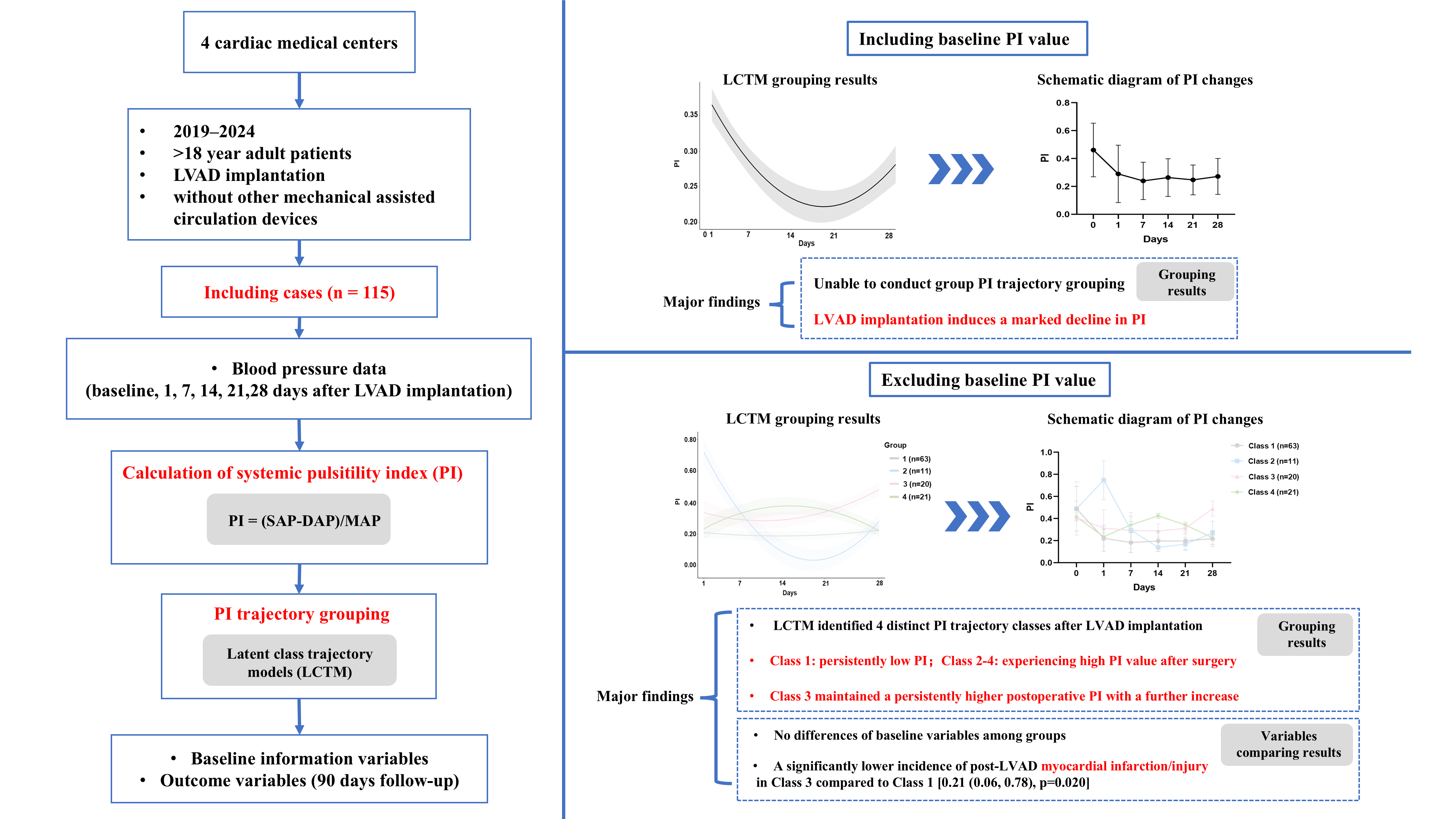
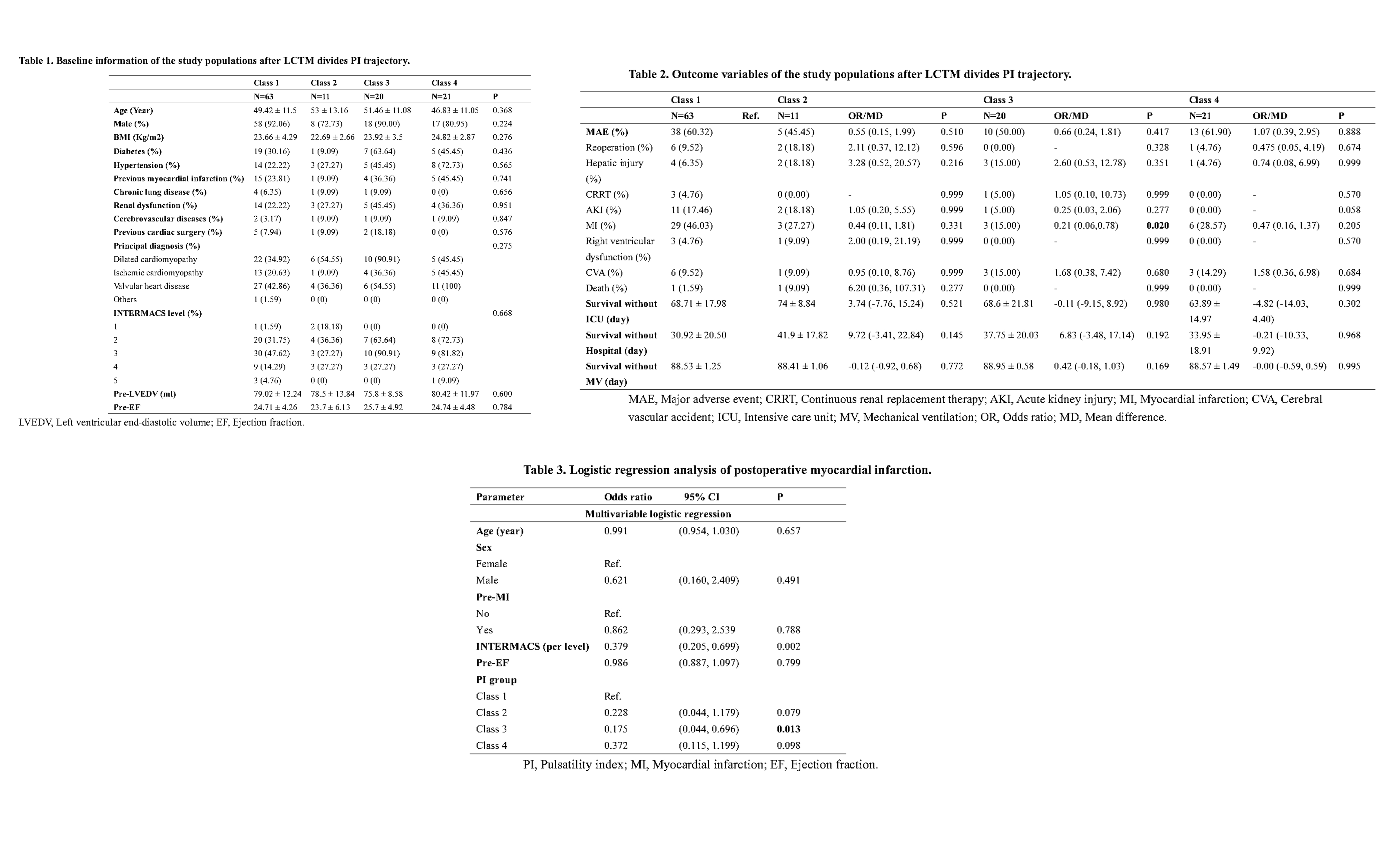
Abstract Body (Do not enter title and authors here): Introduction: Left ventricular assist devices (LVAD), widely adopted internationally, have been increasingly implemented in China as a vital life-support strategy for patients with end-stage heart failure. Non-pulsatile blood flow is a defining physiological characteristic of LVAD support. Although an association between reduced pulsatility and adverse outcomes continues to be proposed, robust clinical evidence remains lacking. Methods: Retrospective study of adults (>18 years) receiving LVADs at four Chinese cardiac medical centers (Jan 2019 - Jul 2024) was conducted. Systemic pulsatility index (PI, calculated as pulse pressure divided by the mean arterial pressure) was derived from blood pressure measurements pre-LVAD and serially post-LVAD (days 1, 7, 14, 21, 28). Latent Class Trajectory Modeling (LCTM) identified distinct population groups based on PI trajectories; optimal model selection used lowest Bayesian Information Criterion (BIC), posterior probability >0.8, and group size >2%. The primary outcome was 90-day major adverse events (MAE: mortality or complications). Association between PI trajectories and clinical outcomes were assessed using univariable and multivariable logistic regression (adjusted for age, sex, BSA, pre-MI and INTERMACS level). Results: Among 115 LVAD patients (mean age 49.4 years, 87.3% male, mean LVEF 24.8%), LCTM failed to identify distinct groups when including pre-LVAD PI. Overall, PI markedly declined post-implantation compared to baseline. However, LCTM using only post-LVAD data revealed four distinct PI trajectory classes. Patients with persistently higher PI post-LVAD had a significantly lower incidence of postoperative myocardial infarction/injury (MI) compared to those with persistently low PI (OR 0.21, 95% CI 0.06–0.78, p=0.020). Further logistic regression confirmed this association between post-LVAD PI trajectory and MI occurrence. No significant differences were observed in major adverse events, mortality, or other complications among trajectory groups. Conclusion: In China's largest LVAD cohort, PI trajectory analysis revealed that patients maintaining persistently higher PI post-LVAD had a significantly lower risk of postoperative MI compared to those with persistently low PI.
Wang, Tianlong
(
Fuwai Hospital
, Beijing , China )
Wang, Xiaohu
(
Fuwai Hospital
, Beijing , China )
Chen, Haibo
(
Fuwai Hospital
, Beijing , China )
Zhou, Xingtong
(
Fuwai Hospital
, Beijing , China )
Ji, Bingyang
(
Fuwai Hospital
, Beijing , China )
Wang, Xianqiang
(
Fuwai Hospital
, Beijing , China )