
Logo

American Heart Association

  19
  0


Final ID: MP1840

cBIN1 Gene Therapy Delivered Intramyocardially in Left Ventricle Attenuates Right Ventricular Structural Remodeling in a Canine Model of Dilated Ischemic Cardiomyopathy

Abstract Body (Do not enter title and authors here): Introduction: Myocardial infarction is a common cause of heart failure (HF), leading to scar tissue formation and increased stress on the cardiac muscle, which affects atrial and ventricular remodeling. We recently showed that gene therapy targeting cardiac bridging integrator 1 (cBIN1) improves left ventricular (LV) function by restoring T-tubule integrity in a canine model of dilated ischemic cardiomyopathy (DICM). However, it is still unclear how this improvement impacts the right ventricular (RV) structural remodeling.

Hypothesis: cBIN1 gene therapy delivered intramyocardially in the LV improves RV structural remodeling in a canine model of DICM.

Methods: A preclinical canine model of DICM was created by ligating the left anterior descending artery, resulting in a left ventricular ejection fraction < 40% and NT-proBNP level > 900 pmol/L. Ten weeks (±2) post-procedure, dogs were divided into three groups: Group 1 (n=3) received no therapy; Group 2 (n=4) received intramyocardial injections of AAV9 carrying Green Fluorescent Protein (negative control); and Group 3 (n=5) received AAV9-cBIN1. Eight weeks (±2) later, RV mechanical dyssynchrony (septal-free wall peak strain time difference) and RV free wall strain were assessed through echocardiography in awake dogs using a 4-chamber apical view. RV free wall muscle samples were analyzed for T-tubule cross-sectional area using electron microscopy and fibrosis via Masson Trichrome staining.

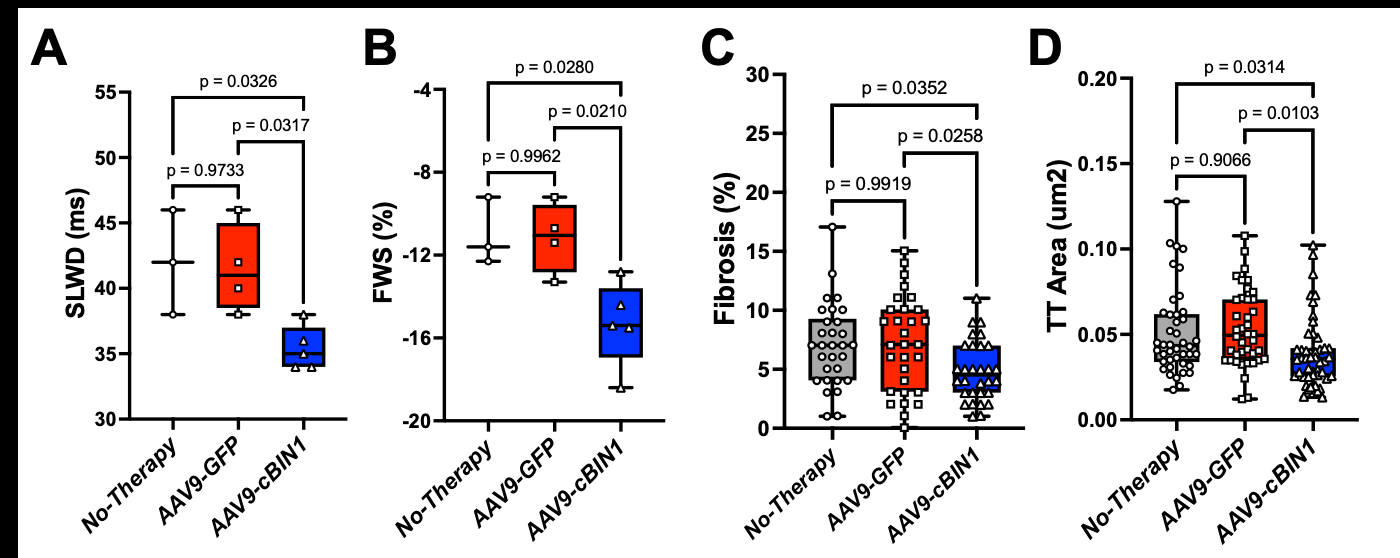
Results: cBIN1-treated animals exhibited significantly improved RV septal-free wall peak strain time difference often refers as septal-to-lateral wall delay - SLWD (Figure A) and RV free wall strain - FWS (Figure B) compared to the other HF groups that received either the control GFP therapy or no treatment. At both the tissue and subcellular levels, there was a significant improvement in RVFW fibrosis (Figure C) and T-tubule cross-sectional area (Figure D) in the cBIN1 group compared to the GFP-treated and untreated animals. Furthermore, there were no observable differences between the untreated and GFP-treated HF groups.

Conclusions: Reducing mechanical stress across the LV segments through intramyocardial delivery of cBIN1 gene therapy significantly decreased fibrosis in the RVFW muscle by restoring the T-tubule membrane architecture, which in turn improved RV strain and reduced electromechanical dyssynchrony. The study provides preclinical data to mitigate negative remodeling of the RV following ischemic events.
  • Khan, Muhammad  ( The University of Utah , Salt Lake Cty , Utah , United States )
  • Dosdall, Derek  ( The University of Utah , Salt Lake Cty , Utah , United States )
  • Yazaki, Kyoichiro  ( The University of Utah , Salt Lake Cty , Utah , United States )
  • Ruizcastillo, Sofia  ( The University of Utah , Salt Lake Cty , Utah , United States )
  • Offei, Emmanuel  ( The University of Utah , Salt Lake Cty , Utah , United States )
  • Shah, Ankur  ( The University of Utah , Salt Lake Cty , Utah , United States )
  • Yektaeian Vaziri, Ava  ( The University of Utah , Salt Lake Cty , Utah , United States )
  • Selzman, Craig  ( The University of Utah , Salt Lake Cty , Utah , United States )
  • Hong, Tingting  ( The University of Utah , Salt Lake Cty , Utah , United States )
  • Shaw, Robin  ( The University of Utah , Salt Lake Cty , Utah , United States )
  • Author Disclosures:
    Muhammad Khan: DO NOT have relevant financial relationships | Derek Dosdall: DO NOT have relevant financial relationships | Kyoichiro Yazaki: DO NOT have relevant financial relationships | Sofia Ruizcastillo: No Answer | Emmanuel Offei: No Answer | Ankur Shah: No Answer | Ava Yektaeian Vaziri: DO NOT have relevant financial relationships | Craig Selzman: No Answer | Tingting Hong: DO NOT have relevant financial relationships | Robin Shaw: DO have relevant financial relationships ; Research Funding (PI or named investigator):NIH:Active (exists now) ; Research Funding (PI or named investigator):TikkunLev Therapeutics:Active (exists now)
Meeting Info:

Scientific Sessions 2025

2025

New Orleans, Louisiana

Session Info:

Myocardial Injury and Repair: From Mechanisms to Breakthrough Therapies

Sunday, 11/09/2025 , 11:50AM - 01:00PM

Moderated Digital Poster Session

More abstracts on this topic:
A New Analytical Approach for Noninvasive Reconstruction of the Entire Left Ventricular Pressure Waveform in Myocardial Ischemia and Infarction

Bilgi Coskun, Li Jiajun, Alavi Rashid, Dai Wangde, Matthews Ray, Kloner Robert, Pahlevan Niema

2 Dimensional Echocardiography versus 3 Dimentional Echocardiography to Assess Right Ventricular Function in Pulmonary Hypertension: A Systematic Review

Chaudhry Waleed Razzaq, Hajj Fatima, Bathula Satyamedha, Meghji Mohammed Askari, Pasupuleti Hemalatha, Kiyani Madiha, Shah Syeda Simrah, Neelakantan Ramaswamy Sanathanan, Mirzaeidizaji Nakisa, St. Jacques Jahnoy, Khan Khalil Ullah, Veluchamy Elakkiya, Jesse Joshanna

More abstracts from these authors:
T-tubule microdomains promote protective mitophagy in failing hearts

Richmond Bradley, Li Jing, Funai Katsuhiko, Shaw Robin, Hong Tingting

cBIN1 Gene Therapy Improves Left Ventricular Filling Pressure in a Canine Model of Ischemic Dilated Cardiomyopathy

Khan Muhammad, Shaw Robin, Dosdall Derek, Yazaki Kyoichiro, Ishidoya Yuki, Offei Emmanuel, Ruizcastillo Sofia, Shah Ankur, Li Jing, Palatinus Joseph, Hong Tingting

You have to be authorized to contact abstract author. Please, Login
Not Available