

Logo

American Heart Association

  29
  0


Final ID: MP734

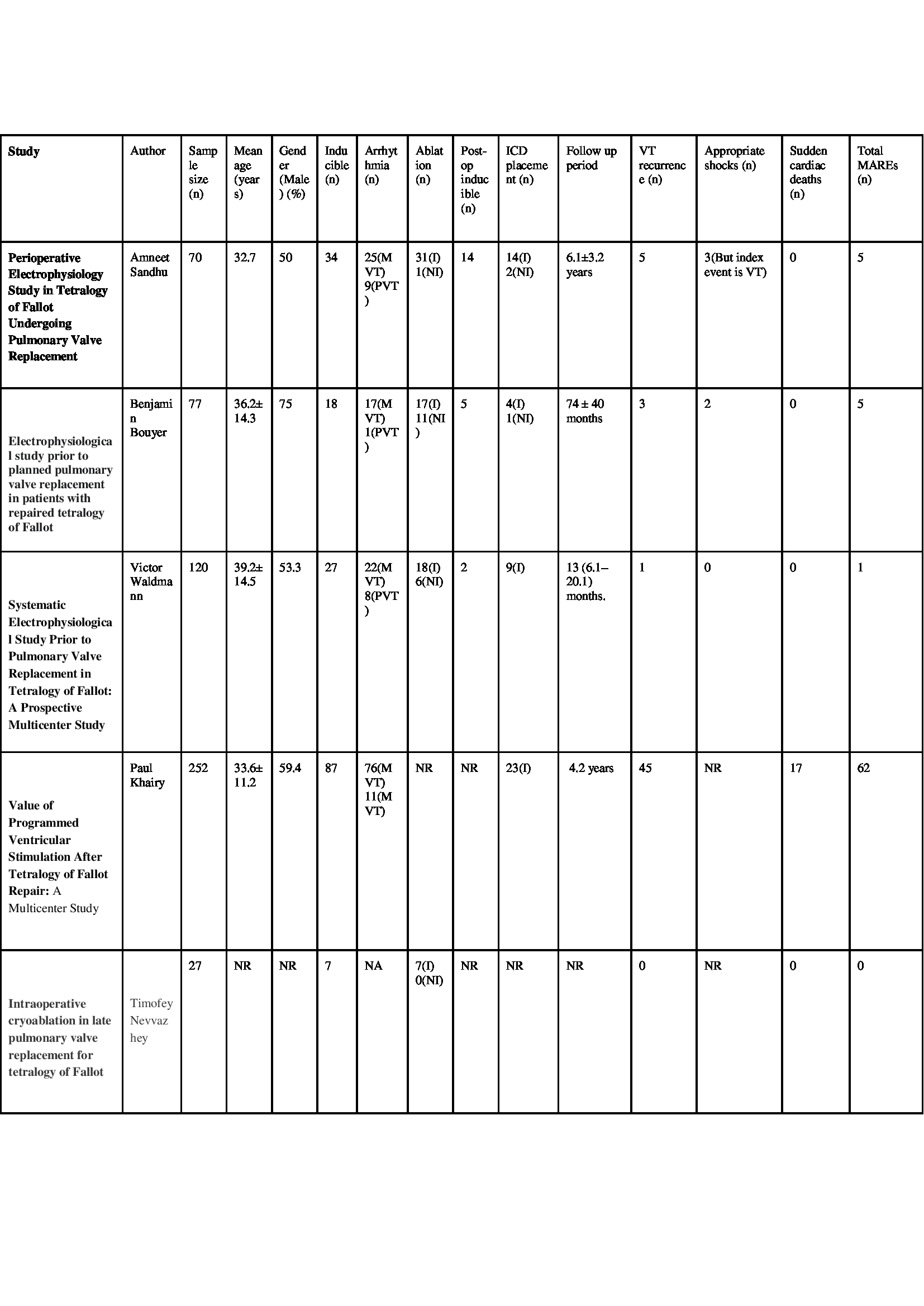
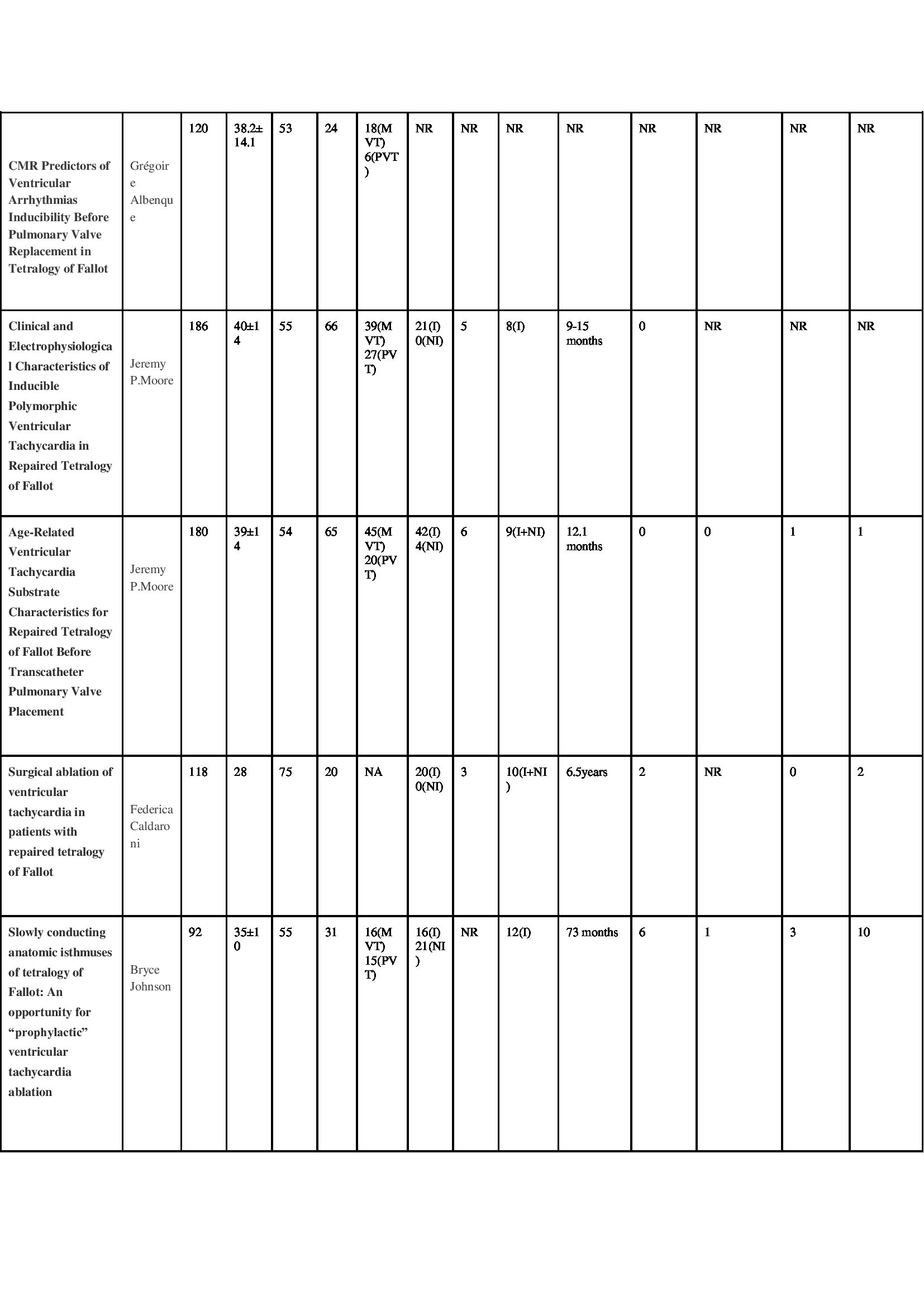
Perioperative Electrophysiological Study in Repaired Tetralogy of Fallot Undergoing Pulmonary Valve Replacement: A Systematic Review

Abstract Body (Do not enter title and authors here): Background:
Patients with repaired Tetralogy of Fallot (TOF) undergoing pulmonary valve replacement
(PVR) are at increased risk of major adverse ventricular arrhythmias and related events
(MAREs). Perioperative electrophysiological study (EPS) has been used for risk stratification
and guiding future management, but these studies are limited by small sample size.
Objectives:
To perform a systematic review of outcomes of pre-PVR EPS in TOF patients with PVR.
Methods:
A comprehensive search of PubMed, Embase, Scopus and Google scholar databases was
performed per PRISMA 2020 guidelines. Studies on patients with repaired TOF undergoing
PVR with perioperative EPS were included. Data were extracted on study design, sample
size, EPS outcomes and MAREs during follow-up.
Results:
A total of 1,528 patients (age: 35.5±3.8 y; 57% male; LVEF: 57.1±1.5%, RVEF: 42.6±1.5%)
were included from 12 studies. EPS was performed in 1212/1528 (79.3%), with sustained VT
inducibility in 404 (33.3%)-monomorphic VT in 258 (63.8%), while 808 (66.6%) were non-
inducible. 8/12 studies reported the type of PVR (transcatheter-36.8%). 174/293 (59.3%)
inducible patients had an ablation (9 studies), while ICD (6 studies) was implanted in 70/263
(26.6%). Follow-up EPS (6 studies) showed 35/230 (15.2%) remained inducible.
Overall,113 (9.3%) patients experienced MAREs over a median follow-up ranging from 6
months to 6.7 years. Sustained VT (11/12 studies) occurred in 70/1092 (6.4%), appropriate
ICD therapy (7/12 studies) in 13/622 (2.1%) and sudden cardiac death (10/12 studies) in
30/906 (3.3%). Five studies provided MARE data stratified by VT inducibility. 12/164
(7.3%) inducible patients experienced MAREs, compared to 2/318 (0.6%) non-inducible
patients.
Reported risk factors for MAREs included older age at initial repair and PVR, QRS duration
(>180ms), LVEF <45%, RVEF <35%, history of syncope, prior palliative shunts and atrial
arrhythmias. Some studies identified MRI-derived scar burden, pulmonary annulus size, and
RV/LV volume ratios as additional predictors.
Conclusion:
TOF patients remain at high risk of VA after PVR with 1/10 patients experiencing MAREs.
People with inducible VT had a 12-fold greater risk than people who were non-inducible.
EPS identifies a subset of TOF patients at higher arrhythmic risk during PVR and supports
tailored ablation and ICD strategies. Prospective multicentre studies are needed to optimize
integration of EPS and clinical risk models.
  • Reddy, Malugari Anish  ( SRIHER , Chennai , India )
  • Gupta, Ishika  ( All India Institute of Medical Sciences , Delhi , India )
  • Vijayakumar, Keerthika  ( Mayo Clinic , Rochester , Minnesota , United States )
  • Nallathambi, Naveenkumar  ( Mayo Clinic , Rochester , Minnesota , United States )
  • Nguyen, Duy  ( Mayo Clinic , Rochester , Minnesota , United States )
  • Deshmukh, Abhishek  ( Mayo Clinic , Rochester , Minnesota , United States )
  • Egbe, Alexander  ( Mayo Clinic , Rochester , Minnesota , United States )
  • Miranda, William  ( Mayo Clinic , Rochester , Minnesota , United States )
  • Madhavan, Malini  ( MAYO CLINIC , Rochester , Minnesota , United States )
  • Author Disclosures:
    Malugari Anish Reddy: DO NOT have relevant financial relationships | Ishika Gupta: DO NOT have relevant financial relationships | Keerthika Vijayakumar: DO NOT have relevant financial relationships | Naveenkumar Nallathambi: DO NOT have relevant financial relationships | Duy Nguyen: No Answer | Abhishek Deshmukh: DO NOT have relevant financial relationships | Alexander Egbe: No Answer | William Miranda: DO NOT have relevant financial relationships | Malini Madhavan: No Answer
Meeting Info:

Scientific Sessions 2025

2025

New Orleans, Louisiana

Session Info:

Optimizing Outcomes in Pediatric Cardiac Surgery: Risk Factors, Innovations, and Systems-Level Insights

Saturday, 11/08/2025 , 01:45PM - 03:00PM

Moderated Digital Poster Session

More abstracts on this topic:
Altered Pulmonary Arterial Hemodynamics in Repaired Tetralogy of Fallot Patients Referred for Pulmonary Valve Replacement: A Cross-Sectional 4D Flow Study

Fujiwara Takashi, Kwong Michael, Fonseca Brian, Stone Matthew, Browne Lorna, Barker Alex

A novel risk score predicts the prevalence of left atrial low-voltage areas and rhythm outcome in patients undergoing long-standing persistent atrial fibrillation ablation

Ooka Hirotaka, Nakao Sho, Kusuda Masaya, Ariyasu Wataru, Kudo Satoshi, Fujii Subaru, Mano Toshiaki, Matsuda Yasuhiro, Masuda Masaharu, Okamoto Shin, Ishihara Takayuki, Nanto Kiyonori, Tsujimura Takuya, Hata Yosuke, Uematsu Hiroyuki

More abstracts from these authors:
Causes and Predictors of Mortality in Adults with Congenital Heart Disease: A Single Center Study

Nallathambi Naveenkumar, Madhavan Malini, Pradeep Aishwarya, Vijayakumar Keerthika, Egbe Alexander, Miranda William, Burchill Luke, Connolly Heidi, Deshmukh Abhishek, Nguyen Duy

Role of an Electrophysiology Study in predicting Major Adverse Ventricular Arrhythmias and Related Events in patients with a Systemic Right Ventricle

Vijayakumar Keerthika, Havangi Prakash Shisheer, Nallathambi Naveenkumar, Egbe Alexander, Miranda William, Deshmukh Abhishek, Connolly Heidi, Madhavan Malini

You have to be authorized to contact abstract author. Please, Login
Not Available