
Logo

American Heart Association

  17
  0


Final ID: MP1061

Integrated Assessment of Lipoprotein(a) and ECG Changes to Predict Paroxysmal Atrial Fibrillation Recurrence After Ablation: A Retrospective Study of 2,356 Patients

Abstract Body (Do not enter title and authors here): Background: Elevated lipoprotein(a) [Lp(a)] levels have been associated with cardiovascular risk, but their prognostic value in atrial fibrillation (AF) recurrence following radiofrequency ablation remains unclear. This study aimed to evaluate the predictive role of Lp(a) in post-ablation paroxysmal AF recurrence and explore its association with electrocardiographic (ECG) changes, particularly in lead II. We further assessed whether combining Lp(a) levels with ECG markers could enhance risk stratification after ablation.
Methods: We retrospectively analyzed clinical data from 2,356 patients with paroxysmal AF who underwent radiofrequency catheter ablation at Guangdong Provincial People's Hospital between 2000 and 2023. The optimal cut-off value of Lp(a) for predicting post-ablation recurrence was determined using receiver operating characteristic (ROC) analysis. Patients were followed for a median duration of 13.7 months through outpatient visits and Holter monitoring. ECG parameters, including P-wave amplitude, PR interval, and QTc interval in lead II, were compared before ablation and during follow-up. Correlations between Lp(a) levels and ECG changes were also evaluated.
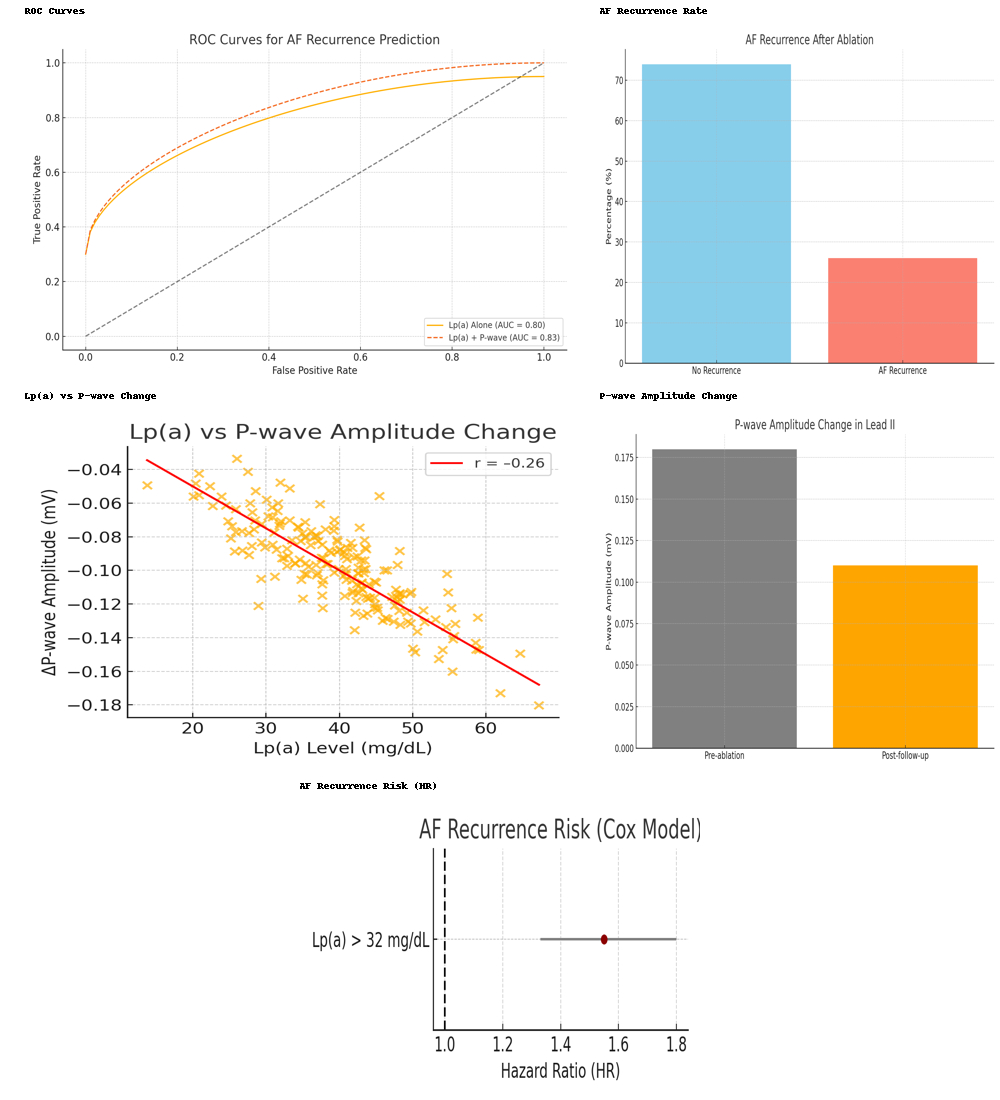
Results: Over a median follow-up of 13.7 months, AF recurrence occurred in 25.4% of patients. ROC analysis identified 32 mg/dL as the optimal Lp(a) threshold for predicting recurrence (area under the curve [AUC] = 0.72; 95% CI, 0.69–0.75; P<0.001), with a sensitivity of 68.2% and specificity of 65.4%. Patients with Lp(a) above this threshold had a significantly higher recurrence risk (hazard ratio [HR], 1.55; 95% CI, 1.33–1.80; P<0.001). P-wave amplitude in lead II decreased significantly during follow-up compared to baseline (mean decrease, 0.06 mV; P<0.001), and Lp(a) levels were negatively correlated with this change (r = –0.26; P<0.001). No significant associations were found between Lp(a) and PR or QTc intervals. The combination of Lp(a) and P-wave amplitude change improved predictive performance for recurrence (AUC = 0.78; 95% CI, 0.74–0.81; P<0.001).
Conclusions: Lp(a) is a significant predictor of paroxysmal AF recurrence after catheter ablation and is inversely associated with post-ablation reductions in P-wave amplitude in lead II, potentially reflecting atrial electrical remodeling. Integrating Lp(a) levels with ECG-derived metrics enhances predictive accuracy and may aid in postoperative risk stratification and clinical decision-making.
  • Dai, Chang  ( Guangdong Cardiovascular Inst. , Guangzhou , China )
  • Xiao, Jiquan  ( Guangdong Provincial People's Hospi , Guangzhou , China )
  • Chen, Haowei  ( Guangdong Provincial People's Hospi , Guangzhou , China )
  • Lin, Weidong  ( Guangdong Provincial People's Hospi , Guangzhou , China )
  • Liu, Fang-zhou  ( Guangdong Provincial People's Hospi , Guangzhou , China )
  • Xue, Yumei  ( Guangdong Provincial People's Hospi , Guangzhou , China )
  • Wu, Shulin  ( Guangdong Provincial People's Hospi , Guangzhou , China )
  • Author Disclosures:
    Chang Dai: DO NOT have relevant financial relationships | Jiquan Xiao: No Answer | Haowei Chen: No Answer | Weidong Lin: DO NOT have relevant financial relationships | Fang-zhou Liu: No Answer | Yumei XUE: DO NOT have relevant financial relationships | Shulin Wu: No Answer
Meeting Info:

Scientific Sessions 2025

2025

New Orleans, Louisiana

Session Info:

Clinical Electrophys: Risk Stratification

Saturday, 11/08/2025 , 01:45PM - 02:35PM

Moderated Digital Poster Session

More abstracts on this topic:
A dual-action prokaryotic sodium channel expression for electro-mechanical rescue in chronic heart failure

Wu Tianyu, Li Yongwu, Perelli Robin, Tornatore Anna, Siu Yiu Yan, Jiang Xixian, Landstrom Andrew, Bursac Nenad

A Comparative Analysis of Esophageal Cooling for Preventing Esophageal Injury Post Atrial Fibrillation Catheter Ablation: A Systematic Review and Meta-analysis

Ibrahim Momen Mohamed, Al Hennawi Hussam, Tanas Yousef, Abourady Youmna, Sewedan Nourhan, Hashem Ahmed Magdy, Motawea Karam R.

You have to be authorized to contact abstract author. Please, Login
Not Available