Clinical and Demographic Predictors of Surgical Intervention in a Multidisciplinary Lymphedema Program: A Vascular Medicine Perspective
Abstract Body (Do not enter title and authors here): Introduction Lymphedema is increasingly recognized as a condition best served within multidisciplinary care models. Identifying patient characteristics associated with surgical compared to medical management may help streamline care.
Objective: This study aimed to identify factors associated with surgical intervention among patients evaluated at a multidisciplinary lymphatic center.
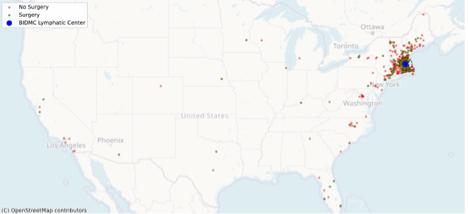
Methods This was a retrospective cohort study of patients presenting for lymphedema evaluation at the BIDMC Lymphatic Center between January 2018 and December 2023. The BIDMC Lymphatic Center includes members of cardiovascular medicine, radiology, plastic surgery, and physical/occupational therapy. Our dependent variable was surgical intervention and independent variables included demographics, comorbid conditions, and geospatial data. Variables with significant associations in adjusted analyses were included in the multivariate logistic regression model using SPSS™. Home ZIP codes were translated into latitude and longitude coordinates using R™ and plotted to create a spatial distribution map relative to the BIDMC Lymphatic Center using Python™ (Figure 1) with open-source geospatial libraries (GeoPandas, Matplotlib, Contextily).
Results A total of 2,031 participants were included in the initial cohort, of whom 1,312 (65%) were identified as having lymphedema at their initial vascular medicine visit. Overall, 354 patients (17.4% of the total cohort) were referred for surgical evaluation and 146 (7%) ultimately underwent surgical intervention. Among patients with lymphedema (N=1,312), increasing age (aOR 0.97, 95% CI 0.96 – 0.99) and higher BMI (aOR = 0.94, 95% CI 0.92 – 0.97) were independently associated with lower odds of undergoing surgery. Residence within Massachusetts was also associated with lower odds of surgery (aOR 0.39, 95% CI 0.25-0.61), while a history of malignancy increased the odds of surgical intervention (aOR 2.20 95% CI 1.41 – 3.44). Gender, a history of chronic venous disease, and etiology of lymphedema (primary vs secondary) were not significantly associated with surgical intervention after adjustment.
Conclusions Patient characteristics associated with lymphatic surgery in a multidisciplinary lymphatic center include those with secondary lymphedema from malignancy, younger age, and lower BMI. Additionally, patients traveling from afar are more likely to receive surgery, demonstrating the lack of access to lymphatic surgical centers.
Medline, Alexandra
(
BIDMC
, Brookline , Massachusetts , United States )
Hentati, Firas
(
BIDMC
, Brookline , Massachusetts , United States )
Sasankan, Prabhu
(
BIDMC
, Brookline , Massachusetts , United States )
Wadhwa, Sakshi
(
BIDMC
, Brookline , Massachusetts , United States )
Pettinato, Anthony
(
BIDMC
, Brookline , Massachusetts , United States )
Carroll, Brett
(
BIDMC
, Brookline , Massachusetts , United States )
Singhal, Dhruv
(
BIDMC
, Brookline , Massachusetts , United States )
Author Disclosures:
Alexandra Medline:DO NOT have relevant financial relationships
| Firas Hentati:DO NOT have relevant financial relationships
| Prabhu Sasankan:No Answer
| Sakshi Wadhwa:No Answer
| Anthony Pettinato:No Answer
| Brett Carroll:DO have relevant financial relationships
;
Consultant:Koya Medical:Active (exists now)
| Dhruv Singhal:No Answer