Determining the Impact of Long-term Ventricular Assist Device Use Prior to Heart Transplantation in Adolescents and Young Adults
Abstract Body (Do not enter title and authors here): Background Ventricular assist devices (VADs) are pivotal in advanced heart-failure care for adolescents and young adults (AYA), serving primarily as bridges to heart transplantation (HTx). In pediatrics, VADs increasingly replace extracorporeal membrane oxygenation (ECMO), improving hemodynamics, organ perfusion, survival, and recovery. The optimal support duration remains unclear; adult studies conflict, with some linking >1 year of support to poorer post-HTx survival and others finding no effect. This study evaluates whether VAD duration (<90 d vs ≥90 d) independently influences post-HTx outcomes in AYA.
Methods A retrospective review of the OPTN Standard Transplant Analysis Research dataset was done between May 2000 and June 2024. All AYA patients, between the ages of 10-30 years, that were at any time of VAD support prior to HTx, were isolated and compared based on length of time on support. AYA on VAD support for ≥90 days prior to HTx were considered long-term VADs, and AYA with VAD <90 days prior to HTx were considered short-term VADs. These populations were identified and compared for demographics and outcomes.
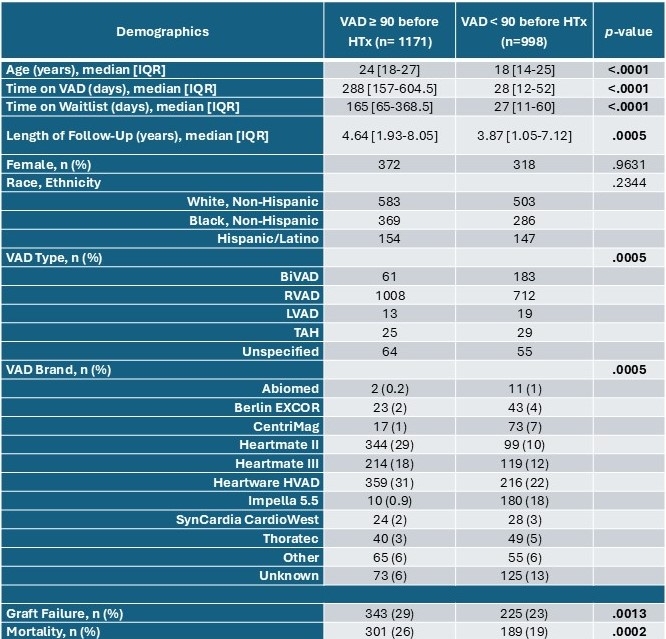
Results We were able to isolate 2,169 cases, 1,171 patients who were on VAD support for ≥90 days prior to HTx and 998 patients who were on VAD support for <90 days prior to HTx. Both cohorts showed similarities but were statistically significant in that AYA who had a VAD > 90 days were more likely to be older, have longer time on the waitlist, and have longer time of available follow-up (p < .0001, p <.0001, p = .0005 respectively). Our initial time-to-event analysis showed a statistically significant difference in outcomes, with AYA who had long-term VADs having a higher likelihood of mortality and graft failure. However, when controlling for age, VAD type, race, ethnicity, and gender our Cox variable regression model showed no significant difference between graft failure or mortality in these two cohorts (p = .2252, p = .2523, respectively).
Conclusions Optimal timing for heart transplant listing after VAD implant in AYA remains elusive. While post-HTx events were higher in those with longer days of support, VAD duration was not significant on multivariable analysis. Further study in specific populations is needed to determine optimal timing of listing in those with durable support.
Cook, Zoe
(
Texas A&M University School of Medicine
, College Station , Texas , United States )
Philip, Stephanie
(
Dell Medical School UT Austin
, Austin , Texas , United States )
Martinez, Hugo
(
Dell Medical School UT Austin
, Austin , Texas , United States )
Glass, Lauren
(
Dell Medical School UT Austin
, Austin , Texas , United States )
Castleberry, Chesney
(
Dell Medical School UT Austin
, Austin , Texas , United States )
Author Disclosures:
Zoe Cook:DO NOT have relevant financial relationships
| Stephanie Philip:DO NOT have relevant financial relationships
| Hugo Martinez:DO NOT have relevant financial relationships
| Lauren Glass:No Answer
| Chesney Castleberry:DO NOT have relevant financial relationships