Sex-Specific Differences in High-Frequency Heart Sounds
Abstract Body (Do not enter title and authors here): Introduction Women are disproportionately misdiagnosed with cardiovascular diseases like aortic stenosis (AS), partly due to sex-specific differences in symptoms and pathology. While men often present with calcific narrowing, women more commonly exhibit fibrotic remodelling, leading to underdiagnosis. Emerging sex-specific TAVR strategies underscore the importance of tailored diagnostics.
This study examines whether such differences are reflected in the high-frequency content of heart sounds, using a novel high-fidelity optical stethoscope, LightScope. Identifying acoustic markers may support more accurate and equitable diagnostics for women.
Research Questions We hypothesize that female subjects exhibit greater high-frequency energy in heart sounds, due to smaller cardiac dimensions. These differences may support improved diagnostic stratification. In an NHS study, we used the LightScope device to capture high-fidelity phonocardiogram (PCG) data, enabling reliable detection of high-frequency features relevant to valvular assessment and sex-specific characterisation.
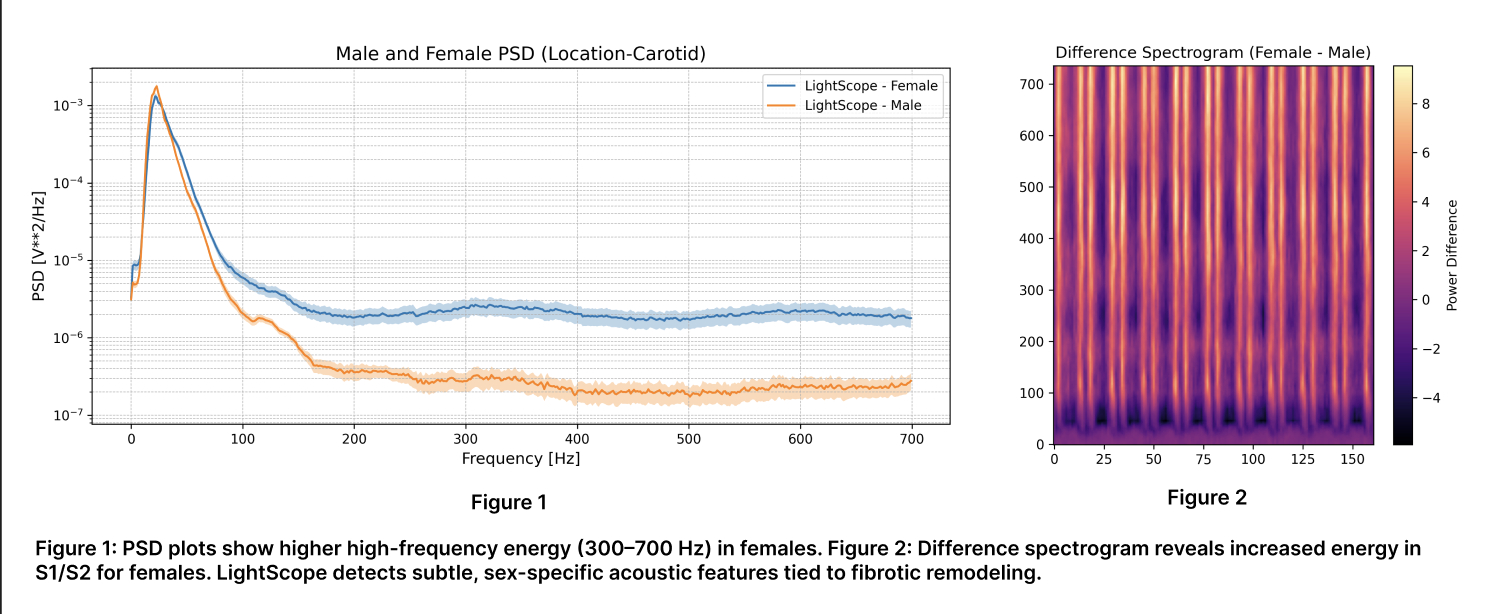
Methods The dataset, collected using LightScope, included 5046 PCG recordings from 25 participants (15 male, 9 female). We focused our analysis on the 300-700 Hz range, often associated with murmurs and turbulent flow [16-19], to assess sex-based differences in high-frequency spectrum. We applied statistical and visual methods, including energy band analysis, average spectrogram comparison between sexes, and power spectral density (PSD) estimation, to investigate these differences.
Results Female recordings showed higher median and upper-quartile power in the 300-700 Hz band. Spectrogram differences revealed that female PCGs had notably higher frequency content in the S1 and S2 regions, with enhanced spectral energy across high-frequency bands.
Conclusion(s) This study reveals consistent sex-specific differences in heart sound frequency profiles, with women showing elevated high-frequency spectral energy likely associated with smaller cardiac dimensions and fibrotic remodelling. These distinctions, captured using the LightScope, may be missed by conventional tools such as stethoscopes due to their low signal-to-noise ratio. Improved high-frequency signal acquisition can reduce diagnostic delays and support more accurate, sex-aware treatment decisions, particularly for interventions like TAVR.
Rajeswari, Dilip
(
LightHearted AI Health
, London , United Kingdom )
Cester, Lucrezia
(
LightHearted AI Health
, London , United Kingdom )
Dave, Maunish
(
LightHearted AI Health
, London , United Kingdom )
Murali Gopika Manoharan, Akshay Kumaar
(
LightHearted AI Health
, London , United Kingdom )
Padmanabhan, Sandosh
(
GLASGOW UNIVERSITY
, Glasgow , United Kingdom )
Author Disclosures:
Dilip Rajeswari:DO have relevant financial relationships
;
Executive Role:LightHearted AI Health Limited:Active (exists now)
; Executive Role:Numinous AI, Inc.:Past (completed)
| Lucrezia Cester:No Answer
| Maunish Dave:DO NOT have relevant financial relationships
| Akshay Kumaar Murali Gopika Manoharan:DO NOT have relevant financial relationships
| Sandosh Padmanabhan:DO have relevant financial relationships
;
Advisor:LightHearted.ai:Active (exists now)