
Logo

American Heart Association

  20
  0


Final ID: Su2132

FRAGILITY INDICES OF LIPID-LOWERING RANDOMIZED CONTROLLED TRIALS

Abstract Body (Do not enter title and authors here): Introduction:
Lipid lowering therapies have value in reducing adverse atherosclerotic cardiovascular disease (ASCVD) events and are recommended in primary and secondary prevention of ASCVD. Beyond p values, absolute risk reduction (ARR) and number needed to treat (NNT), the fragility index (FI) has emerged as a useful metric to assess robustness of clinical trial results. It describes the minimum number of participants whose event outcome would have to change to turn a statistically significant result into a nonsignificant one. Thus, the higher the FI, the more robust the trial.

Research Question:
What is the FI of the randomized controlled trials (RCTs) from which the 2019 ACC/AHA Guideline on Primary Prevention and 2022 Expert Consensus Decision Pathway (ECDP) derive their lipid-lowering therapy recommendations?

Methods:
All cited RCTs and those from meta-analyses referenced in the lipid portion of the 2019 Guideline on Primary Prevention and 2022 EDCP were eligible for inclusion. Exclusion criteria included primary endpoints other than all-cause mortality or cardiovascular events, nonpharmacological interventions, and the absence of published statistical analysis.

Results:
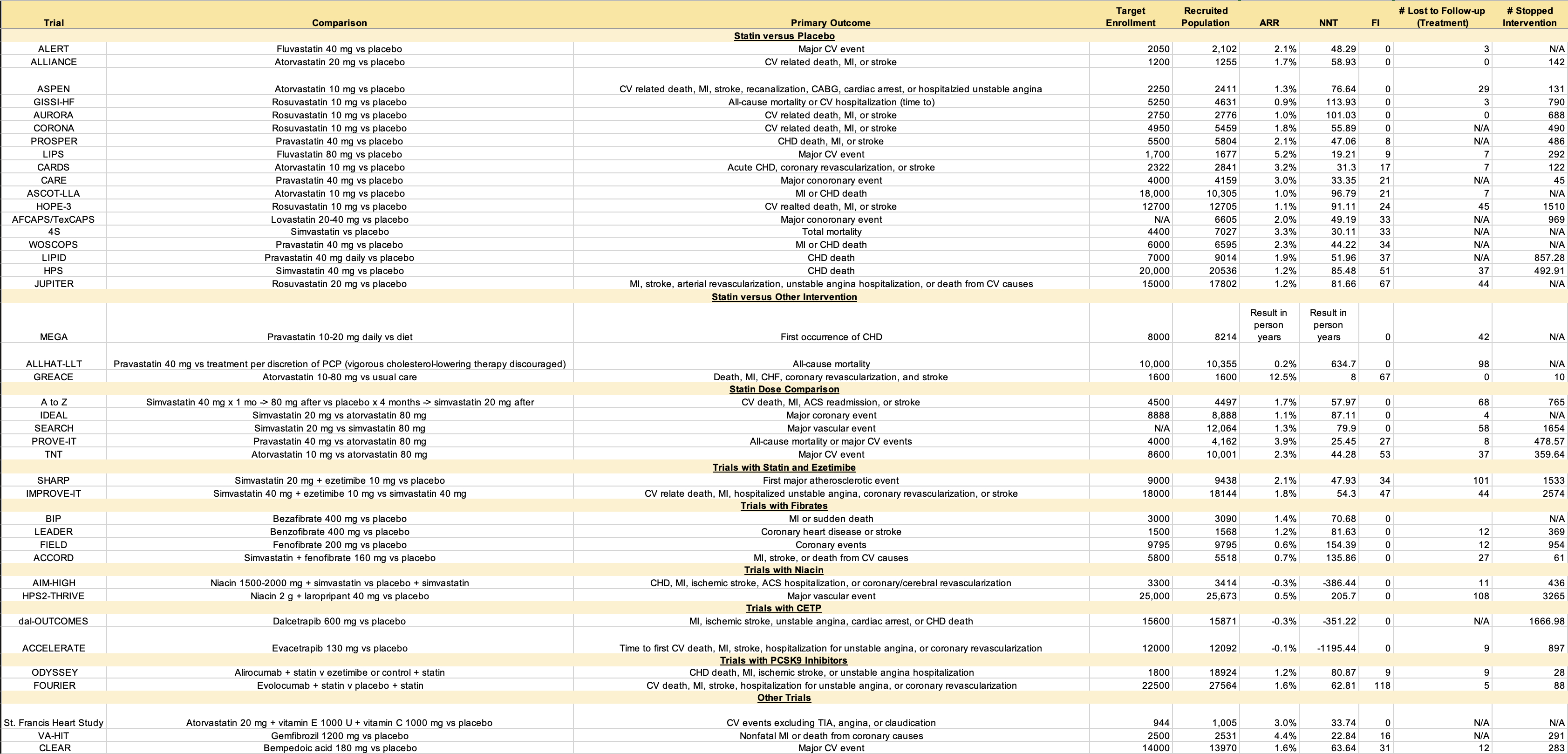
Forty-two trials were included. Twenty RCTs (47.6%) had an FI of 0. Of them, 16 met target enrollment, 3 underenrolled, and 1 did not report target enrollment. There were 11 studies (26.2%) with an FI greater than the number lost to follow up (median FI 47), suggesting that even if all these subjects were to have adverse events, the result would likely still be significant. Five of these studies were statin versus placebo (median FI 21); 1 was statin versus usual care (FI 67); 2 were moderate versus high intensity statin (median FI 40); 1 was statin versus statin and ezetimibe (FI 47); 1 was statin with PCSK9 inhibitor versus statin (FI 118); 1 was bempedoic acid versus placebo (FI 31). Seven studies had an FI>0 but did not report the number lost to follow-up, and 4 RCTs had a number lost to follow-up greater than the FI (Table).

Conclusion:
RCTs that include statins, ezetimibe, PCSK9 inhibitors, and bempedoic acid show higher FIs. However, there is variability within these trials, with some having an FI greater than zero and even fewer having a number lost to follow-up less than the FI. The diversity in this strength of evidence is particularly apparent at low or moderate intensity statin dosing.
  • Uppalapati, Lakshmi  ( Baylor College of Medicine , Houston , Texas , United States )
  • Nambi, Vijay  ( Baylor College of Medicine , Sugar Land , Texas , United States )
  • Mascarenhas, Lorraine  ( Baylor College of Medicine , Houston , Texas , United States )
  • Xiao, Emily  ( Baylor College of Medicine , Houston , Texas , United States )
  • Abushamat, Layla  ( Baylor College of Medicine , Houston , Texas , United States )
  • Minhas, Abdul Mannan Khan  ( Baylor College of Medicine , Houston , Texas , United States )
  • Levine, Glenn  ( Baylor College of Medicine , Pearland , Texas , United States )
  • Jia, Xiaoming  ( BAYLOR COLLEGE OF MEDICINE , Houston , Texas , United States )
  • Ballantyne, Christie  ( BAYLOR COLLEGE MEDICINE , Houston , Texas , United States )
  • Misra, Arunima  ( Baylor College of Medicine , Houston , Texas , United States )
  • Author Disclosures:
    Lakshmi Uppalapati: DO NOT have relevant financial relationships | VIJAY NAMBI: No Answer | Lorraine Mascarenhas: DO NOT have relevant financial relationships | Emily Xiao: DO NOT have relevant financial relationships | Layla Abushamat: No Answer | Abdul Mannan Khan Minhas: No Answer | Glenn Levine: DO NOT have relevant financial relationships | Xiaoming Jia: DO NOT have relevant financial relationships | Christie Ballantyne: DO have relevant financial relationships ; Researcher:merck:Active (exists now) ; Consultant:Novo Nordisk:Active (exists now) ; Researcher:Novo Nordisk:Active (exists now) ; Consultant:Arrowhead:Active (exists now) ; Researcher:Arrowhead:Active (exists now) ; Consultant:Ionis:Active (exists now) ; Researcher:Ionis:Active (exists now) ; Consultant:Amgen:Active (exists now) ; Researcher:Amgen:Active (exists now) ; Consultant:Eli Lilly:Active (exists now) ; Researcher:Eli Lilly:Active (exists now) ; Consultant:Novartis:Active (exists now) ; Researcher:Novartis:Active (exists now) ; Consultant:Merck:Active (exists now) | Arunima Misra: DO NOT have relevant financial relationships
Meeting Info:

Scientific Sessions 2025

2025

New Orleans, Louisiana

Session Info:

Lipid Management in the 21st Century: Progress and Promise in the Second Quarter

Sunday, 11/09/2025 , 03:15PM - 04:15PM

Abstract Poster Board Session

More abstracts on this topic:
A human cardiomyocyte model of CD36 haploinsufficiency uncovers fatty acid oxidation deficits driving dilated cardiomyopathy

Al Sayed Zeina, Klattenhoff Carla, Aragam Krishna, Ellinor Patrick, Willcox Jon, Zheng Alice, Koledova Vera, Srivastava Salil, Yin Xiaofei, Chaffin Mark, Rigaud Vagner, Kovacs-bogdan Erika

Abdominal Aortic Perivascular Adipose Tissue Lipolysis Is Activated In Hypertensive Dahl SS Rats Fed a High-Fat Diet

Chirivi Miguel, Rendon Javier, Lauver Adam, Fink Gregory, Watts Stephanie, Contreras Andres

More abstracts from these authors:
Mind-Heart-Body Interventions and Vascular Disease: From Mechanisms to Clinical Trials

Epel Elissa, Levine Glenn

Structural Cardiac Abnormalities Modify Atrial Fibrillation–Associated Heart Failure Risk and Identify a High-Risk Phenotype in Older Adults: The ARIC Study

Mousavi Idine, Selvin Elizabeth, Hoogeveen Ron, Nambi Vijay, Ballantyne Christie, Jia Xiaoming, Varughese Mini, Sun Caroline, Al Rifai Mahmoud, Pickett June, Chen Lin Yee, Alonso Alvaro, Ndumele Chiadi, Shah Amil

You have to be authorized to contact abstract author. Please, Login
Not Available