Outcomes of Expanded Criteria Donor Hearts in Adult Heart Retransplantation: A Propensity-Score Matched Analysis
Abstract Body (Do not enter title and authors here): Background Heart retransplantation is a complex procedure limited by donor organ availability. The use of expanded criteria donor (ECD) hearts, which are defined by older donor age, medical comorbidities and other factors, has recently increased to mitigate organ scarcity. However, the impact of these donors on retransplant outcomes is not well defined.
Methods We performed a retrospective cohort study using data from the United Network for Organ Sharing (UNOS) registry from 2013 to 2022. Inclusion criteria was defined as all adult retransplant recipients with follow-up data. Patients were stratified by donor type as ECD or standard criteria donors (SCD). To reduce confounding, 1:1 propensity score matching was performed based on characteristics including age, transplant era, circulatory support at listing and comorbidities. The primary outcome was all-cause mortality at one year and five years. Secondary outcomes included 30-day survival, rates of acute rejection, graft failure, and length of hospital stay. Survival analyses were performed using Kaplan-Meier estimates, and differences between groups were assessed using the log-rank test.
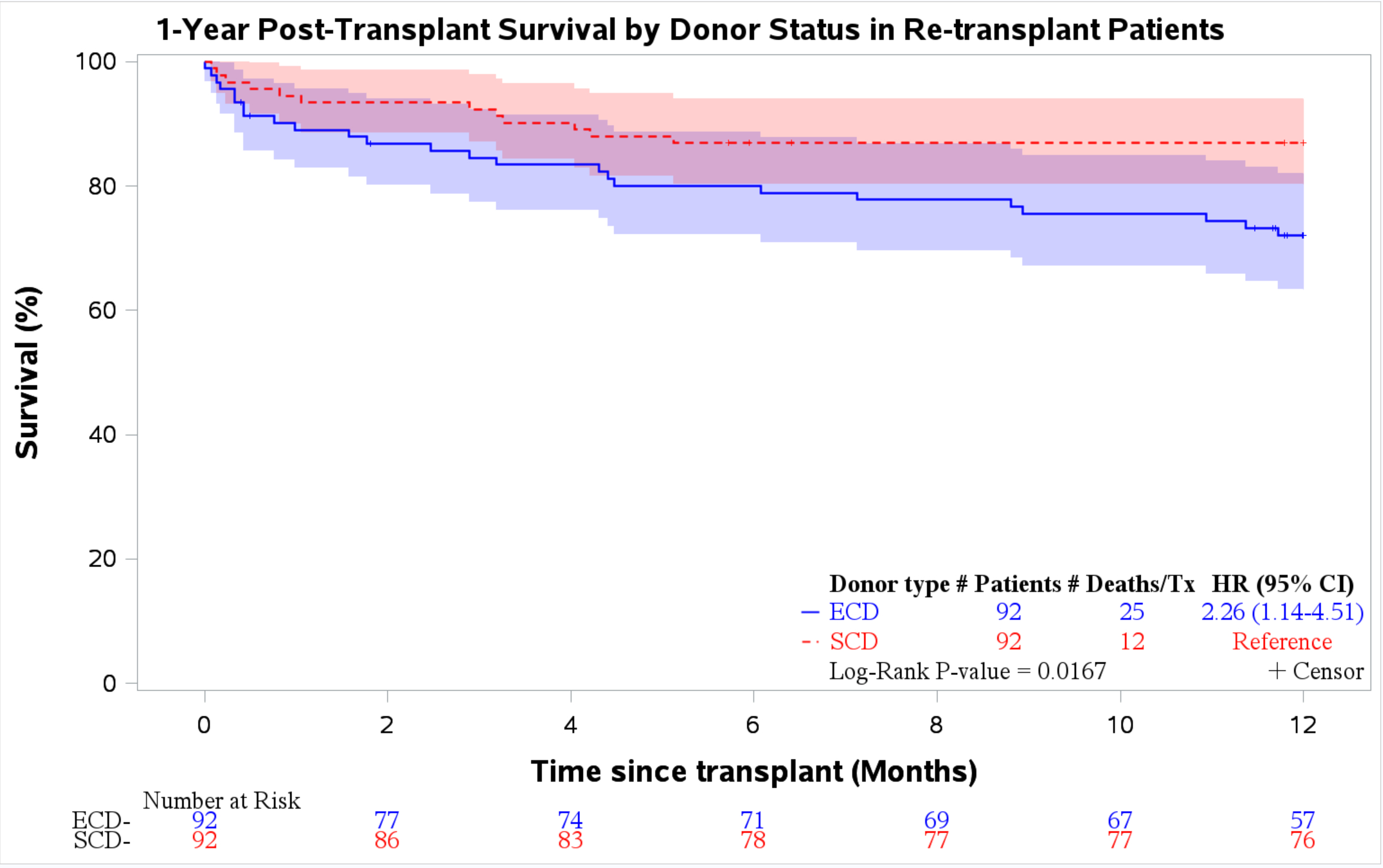
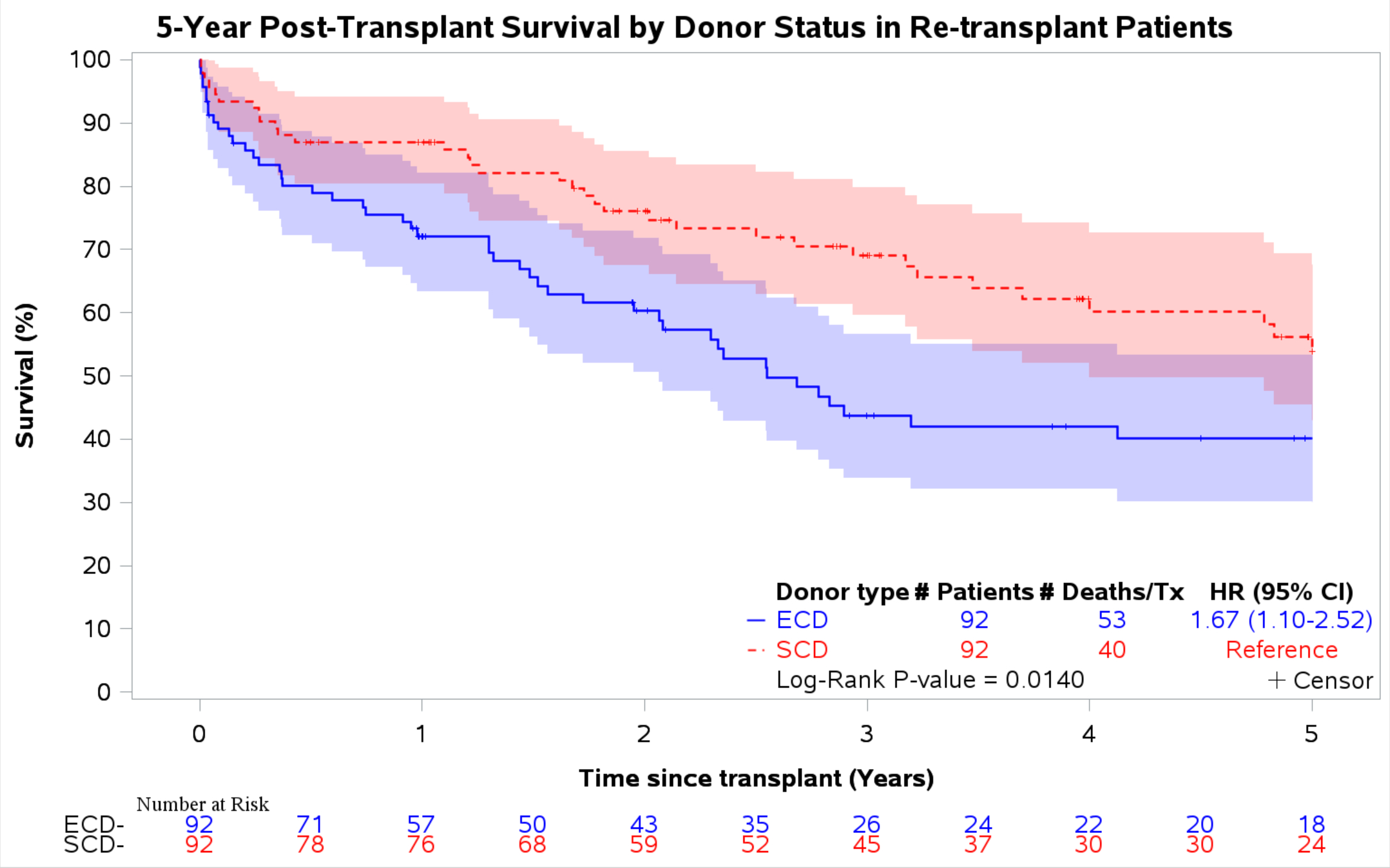
Results A total of 1,533 adult retransplant recipients met inclusion criteria. Among these, 92 patients received ECD hearts and 1,441 received SCD hearts. After 1:1 propensity score matching, the matched cohort included 184 individuals. Baseline characteristics, including age, gender, ECMO use, and inotropic support, were comparable between groups. At one year, the ECD group had more than twice the hazard of death compared to the SCD group (HR: 2.26; 95% CI: 1.14–4.51; p = 0.02). One-year survival was 89.1% (95% CI: 82.9–95.7%) in the ECD group vs 94.6% (95% CI: 90.0–99.3%) in the SCD group. At five years, survival remained lower in the ECD group at 40.1% vs 53.9% in the SCD group (HR: 1.67; 95% CI: 1.10–2.52). Median length of hospital stay was shorter and graft survival was significantly longer in the SCD group (p<0.05).
Conclusion In this matched cohort of adult heart retransplant recipients, the use of ECD hearts was associated with lower survival at both one and five years compared to SCD hearts. Despite these differences, ECD hearts may still offer a feasible alternative in select patients when standard donors are unavailable, especially in the face of ongoing donor shortages.
Zinyandu, Tawanda
(
Bridgeport Hospital
, Stratford , Connecticut , United States )
Adjei Opoku, Isaac
(
Bridgeport Hospital
, Stratford , Connecticut , United States )
Miftari, Rrezane
(
Bridgeport Hospital
, Bridgeport , Connecticut , United States )
Agberien, Vanessa
(
Bridgeport Hospital
, Bridgeport , Connecticut , United States )
Iyengar, Sumedh
(
Bridgeport Hospital
, Bridgeport , Connecticut , United States )
Ibe, Festus
(
Jefferson Einstein Medical Center
, Philadelphia , Pennsylvania , United States )
Issaka, Yussif
(
Bridgeport Hospital
, Bridgeport , Connecticut , United States )
Davila, Carlos
(
Yale School Of Medicine
, New Haven , Connecticut , United States )
Author Disclosures:
Tawanda Zinyandu:DO NOT have relevant financial relationships
| Isaac Adjei Opoku:No Answer
| Rrezane Miftari:DO NOT have relevant financial relationships
| Vanessa Agberien:DO NOT have relevant financial relationships
| Sumedh Iyengar:DO NOT have relevant financial relationships
| Festus Ibe:DO NOT have relevant financial relationships
| Yussif Issaka:DO NOT have relevant financial relationships
| Carlos Davila:No Answer