Imaging Sympathetic Stress in Peripheral Artery Disease: Insights from Preclinical Models
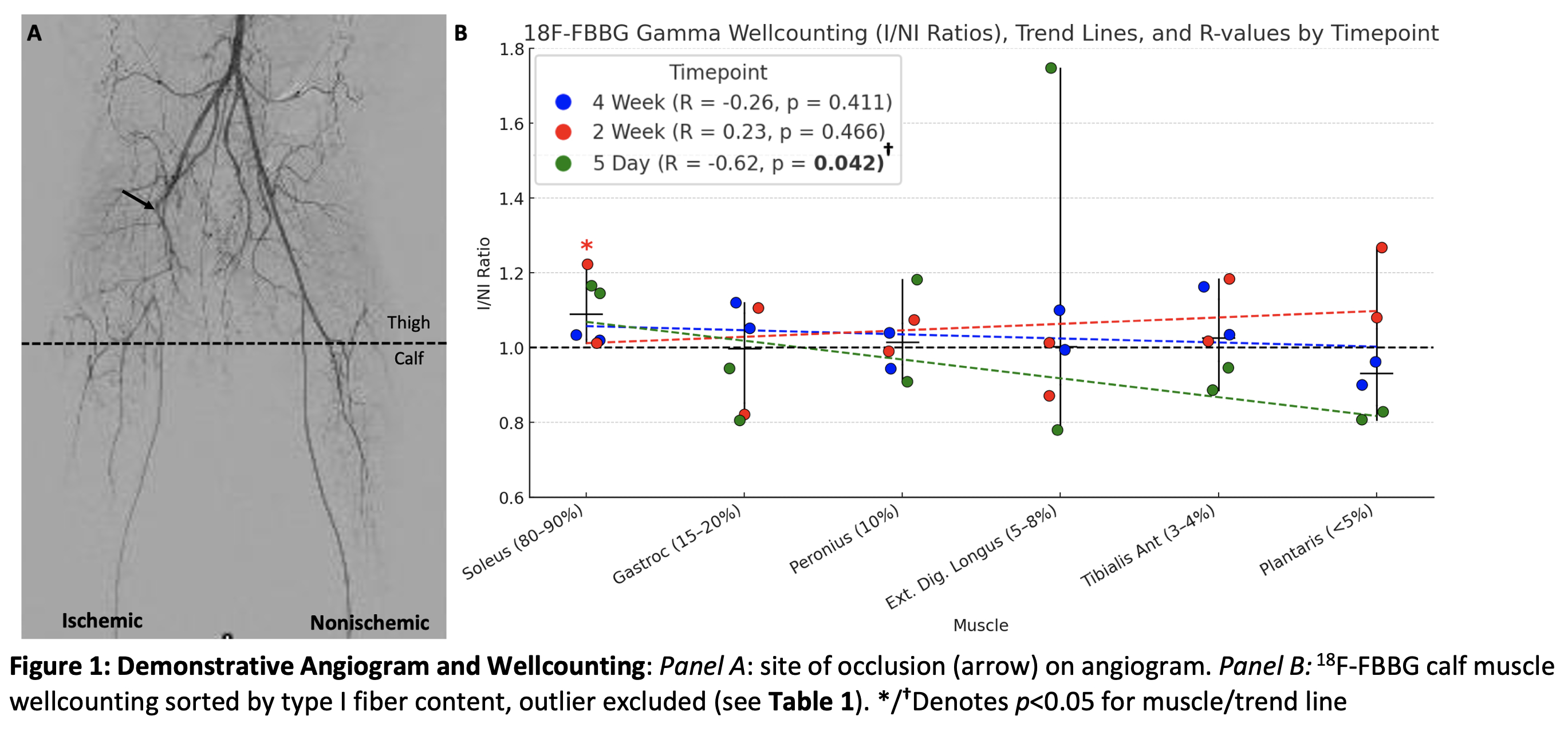
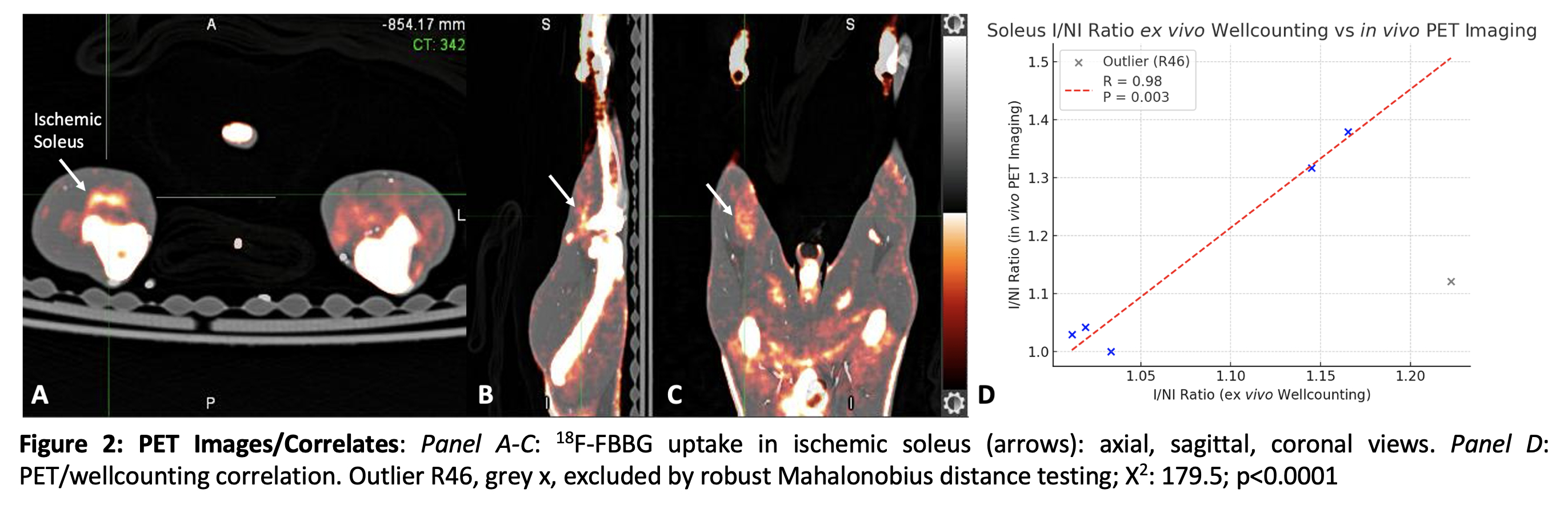
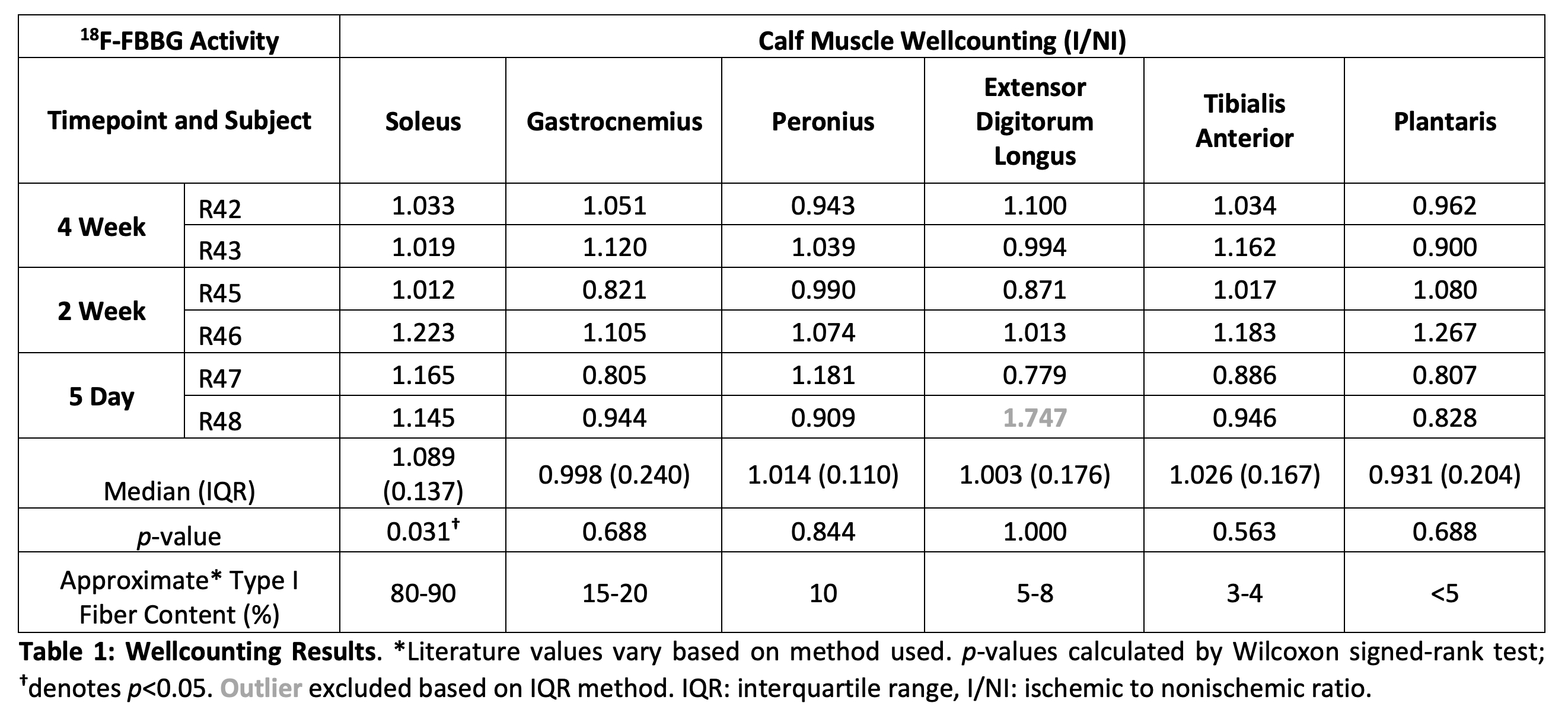
Abstract Body (Do not enter title and authors here): Background: Peripheral artery disease (PAD) portends significant morbidity (immobility, limb amputation, life-threatening infections, etc) and an up to 10-fold greater mortality, yet remains a largely ill-defined and poorly characterized disease. Lower extremity ischemia in PAD patients may lead to heightened sympathetic activity, stress, which may be imageable with novel high-resolution sympathetic radiotracers like 18F-labeled fluorobenguanane (18F-FBBG), a norepinephrine analogue. The ability to image ischemic stress may have diagnostic/prognostic implications for PAD patients. Methods/Approach: Sympathetic activity was evaluated in calf muscles in a rabbit model of hindlimb ischemia using 18F-FBBG. New Zealand rabbits (n=6) underwent 2D angiography, contrast CT angiography, and 18F-FBBG PET/CT 50-60 minutes post-injection on a high-resolution PET scanner (NX, United Imaging) with 18F-FBBG PET uptake expressed as mean SUVs (Figures 1 and 2). The animals were then euthanized at 5, 14, or 28 days post right femoral artery ligation. Calf muscles were then gamma well-counted for 18F-FBBG activity (Table 1). 18F-FBBG uptake in ischemic (I) and non-ischemic (NI) muscles was related to relative percentage of type I or slow twitch oxidative fibers. Results: In the calf the ischemic soleus (a muscle with up to 90% type I fiber content compared to all other calf muscles being ≤20%) demonstrated significant uptake of 18F-FBBG (I/NI median: 1.089, IQR: 0.137, p=0.031) an observation which trended with 18F-FBBG uptake on PET-imaging (R=0.98, p=0.003, Table 1 and Figures 1 and 2). Further, 18F-FBBG uptake trended with type I fiber content especially in the most acute, 5 day, timepoint in the calf (R=-0.62, p=0.022) with the greatest average I/NI uptake of all calf muscles, excluding the outlier, being the 5-day soleus. Conclusions: The most oxygen-dependent muscle, the soleus, demonstrates a significant and imageable uptake of the novel sympathetic tracer 18F-FBBG under acute and chronic ischemic conditions (Table 1, Figures 1 and 2). This suggests, that the ischemic stress response of skeletal muscle may relate to extent of type I fiber content and potentially the reliance on oxygen during acute ischemia, although less evident at chronic timepoints.
Nazari, Matthew
(
Yale University
, Middlebury , Connecticut , United States )
Jang, Sun-joo
(
Yale University
, New Haven , Connecticut , United States )
Cho, Sang-geon
(
Yale University
, Middlebury , Connecticut , United States )
Zohora, Fatema Tuj
(
Yale University
, Middlebury , Connecticut , United States )
Depino, Ana
(
Yale University
, Middlebury , Connecticut , United States )
Lima, Moroni
(
Yale University
, New Milford , Connecticut , United States )
Porcaro, Olivia
(
Yale University
, Middlebury , Connecticut , United States )
Burns, Rachel
(
Yale University
, Middlebury , Connecticut , United States )
Thorn, Stephanie
(
Yale University
, Middlebury , Connecticut , United States )
Sinusas, Albert
(
Yale University
, Middlebury , Connecticut , United States )
Author Disclosures:
Matthew Nazari:DO NOT have relevant financial relationships
| Albert Sinusas:DO have relevant financial relationships
;
Research Funding (PI or named investigator):Siemens:Active (exists now)
; Consultant:MicroVide:Active (exists now)
; Research Funding (PI or named investigator):Revalia:Active (exists now)
; Research Funding (PI or named investigator):Jubilant:Active (exists now)
| Sun-Joo Jang:DO NOT have relevant financial relationships
| Sang-Geon Cho:DO NOT have relevant financial relationships
| Fatema Tuj Zohora:DO NOT have relevant financial relationships
| Ana DePino:No Answer
| Moroni Lima:DO NOT have relevant financial relationships
| Olivia Porcaro:DO NOT have relevant financial relationships
| Rachel Burns:DO NOT have relevant financial relationships
| Stephanie Thorn:DO NOT have relevant financial relationships