Trends and Disparities in Malnutrition and Heart Failure-Related Deaths Among United States Adults: A CDC WONDER Analysis (1999-2020)
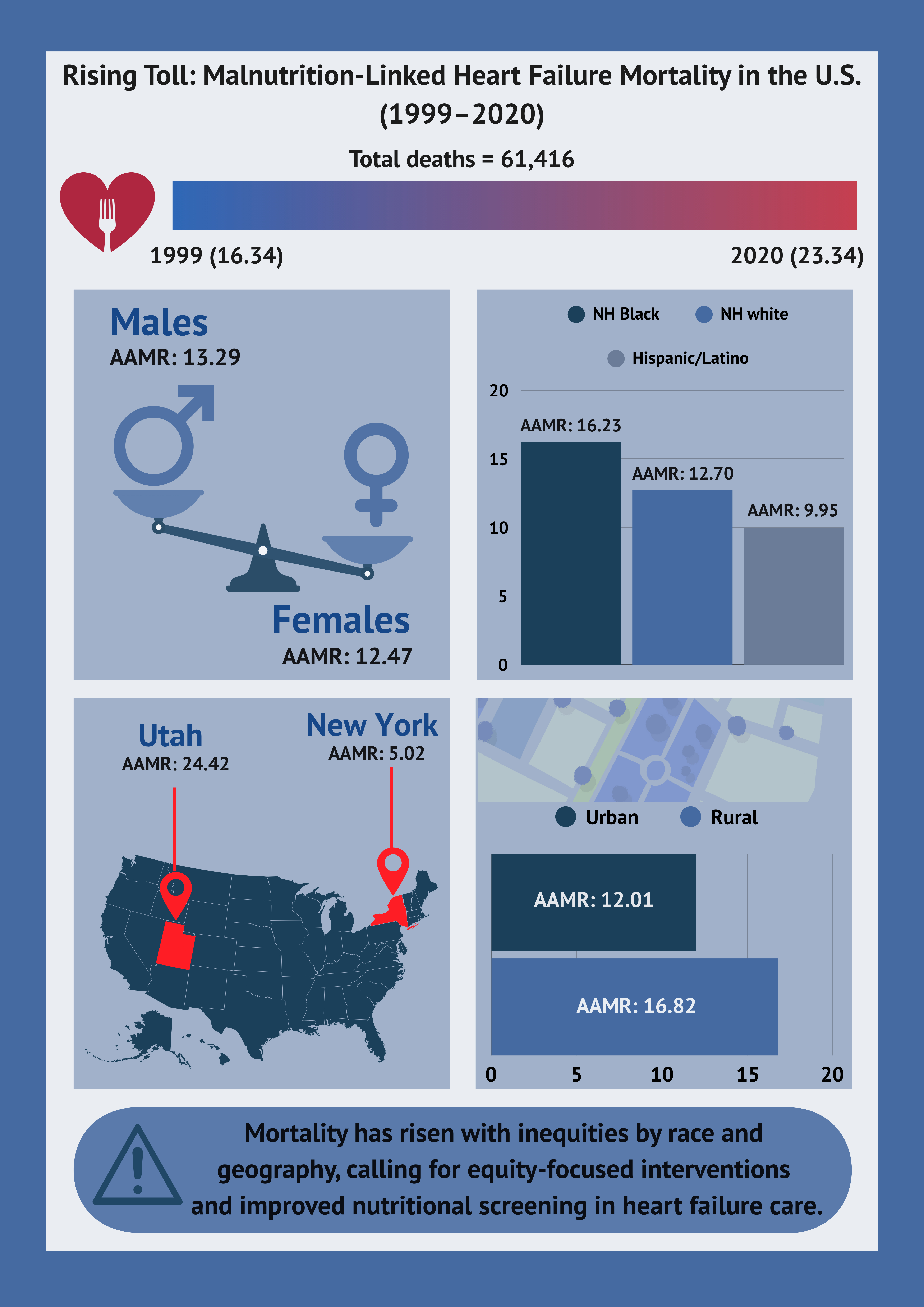
Abstract Body (Do not enter title and authors here): Background: Heart failure (HF), affecting approximately 6.2 million adults in the U.S., correlates strongly with malnutrition. The relationship between HF and malnutrition is well-documented, with studies indicating that nutritional deficits are common in this patient population and may result from both the disease itself and associated therapies. Malnutrition can complicate HF management and worsen clinical outcomes. Our study aims to assess the recent demographic based trends in malnutrition and heart failure mortalities. Hypothesis: We hypothesized that malnutrition and HF-related mortality among U.S. adults has increased over time, with disparities by sex, race/ethnicity, and geographic region. Methods: We analyzed mortality data from the CDC WONDER Multiple Cause-of-Death dataset, using ICD-10 Codes: I50.0; I50.1; I50.9 and E40-E46. We calculated age-adjusted mortality rates (AAMRs) per 1,000,000, stratified by sex, race/ethnicity, US states, and urban-rural classification. Joinpoint regression was used to estimate average annual percent change (AAPC) and annual percent change (APC) with 95% confidence intervals (CIs). Statistical significance was defined as p<0.05. Results: Between 1999 and 2020, 61,416 deaths occurred from malnutrition related HF. The AAMR per 1,000,000 raised from 16.34 in 1999 to 23.34 in 2020 (AAPC: 1.65%; 95% CI: 1.03-2.28). Males showed higher AAMR of 13.29 versus 12.47 in females. By race, non-Hispanic (NH) Black or African American individuals had the highest AAMR (16.23), followed by NH White (12.70) and Hispanic or Latino (9.95). Urbanization disparities revealed higher AAMRs in Non-Metropolitan (16.82) than Metropolitan areas (12.01). State-level differences were notable, with Utah having the highest AAMR (24.42) and New York the lowest (5.02). Conclusion: Mortality related to malnutrition and heart failure has risen significantly over the past two decades, disproportionately affecting non-Hispanic Black individuals, and residents of non-metropolitan areas. These findings underscore the need for equity-focused interventions and enhanced clinical recognition of demographic based risk factors.
Hashmi, Muhammad Saad
(
Jinnah Sindh Medical University
, Karachi , Pakistan )
Ibrahim, Alyaa
(
Alexandria Faculty of Medicine
, Alexandria , Egypt )
Kholeif, Zeyad
(
Baptist Hospital of SouthEast Texas
, Beaumont , Texas , United States )
Hemida, Mohamed Fawzi
(
Alexandria Faculty of Medicine
, Alexandria , Egypt )
Author Disclosures:
FNU Sahil:DO NOT have relevant financial relationships
| Alyaa Ibrahim:DO NOT have relevant financial relationships
| Zeyad Kholeif:DO NOT have relevant financial relationships
| Mohamed Fawzi Hemida:DO NOT have relevant financial relationships
| Nikil Kumar:DO NOT have relevant financial relationships
| Sahil Jairamani:DO NOT have relevant financial relationships
| Shehdev Meghwar:DO NOT have relevant financial relationships
| Fnu Urooba:No Answer
| Bismah Azam Ali:DO NOT have relevant financial relationships
| Hasnain Wajeeh Saqib:DO NOT have relevant financial relationships
| Dheeraj Kumar:DO NOT have relevant financial relationships
| Muhammad Saad Hashmi:DO NOT have relevant financial relationships
Hemida Mohamed Fawzi, Sarfraz Muhammad Raza, Abdelal Mayar, Ali Muhammad Faizan, Ibrahim Alyaa, Hussein Mirna, Abdelkhalek Ahmad, Jairamani Sahil, Filal Maryem, Arafa Amr, Sajjad Maha, Islam M Rafiqul
4371104_File000001.jpg
You have to be authorized to contact abstract author. Please, Login