
Logo

American Heart Association

  22
  0


Final ID: Su4076

Exploring the Genetics of Dilated Cardiomyopathy: A Case Report of a Novel Nonsense Mutation in the Ryanodine Receptor 2 Gene Causing Arrhythmogenic Dilated Cardiomyopathy

Abstract Body (Do not enter title and authors here):

Introduction:
Genetic mutations are a well-known cause of dilated cardiomyopathy (DCM), occurring in approximately 30% of the cases. Mutations in the ryanodine receptor 2 (RYR2) gene are shown to be associated with catecholaminergic polymorphic ventricular tachycardia (CPVT) and arrhythmogenic right ventricular cardiomyopathy (ARVC). Here, we present a rare case of a novel early nonsense mutation in the RYR2 gene associated with arrhythmogenic DCM.
Case Description:
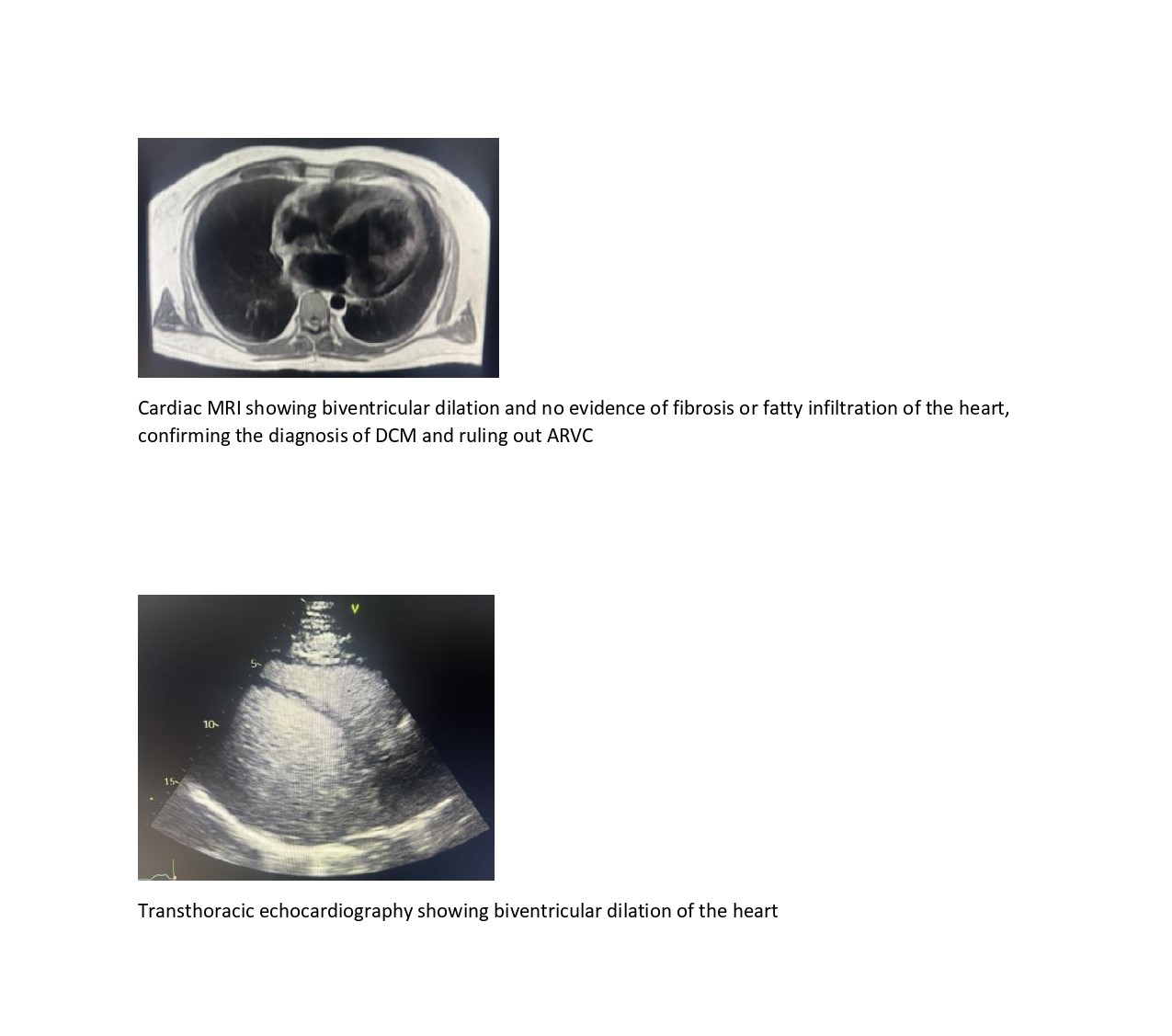
A 44-year-old male patient who presented with exertional dyspnea and volume overload was found to be in new-onset decompensated heart failure secondary to non-ischemic cardiomyopathy. His telemetry monitoring showed continuous runs of non-sustained ventricular tachycardia. His ejection fraction (EF) was <10%, with global hypokinesis, biventricular dilation, and severely reduced right ventricular function. He rapidly decompensated into cardiogenic shock and was placed on inotropic support and an Impella 5.5. Cardiac magnetic resonance imaging revealed severe biventricular dilation and global hypokinesis without any left ventricular delayed enhancement, suggesting DCM with no evidence of ARVC. His genetic testing revealed a novel disease-causing mutation in the RYR2 gene, which caused a premature stop codon. The patient was diagnosed to have arrhythmogenic genetic dilated cardiomyopathy. Given the severity of his heart failure, the patient is currently being evaluated for an orthotopic heart transplant.
Discussion:
RYR2 is the major sarcoplasmic reticulum calcium release channel responsible for the excitation-contraction coupling of cardiac myocytes. RYR2 mutations are a known cause of CPVT and ARVC, but the literature on the occurrence of DCM in the setting of RYR2 gene mutation is scant. Studies have shown that Lamin A/C (LMNA) and the sodium channel alpha-subunit 5a (SCN5a) are the most commonly associated genes with arrhythmogenic DCM. This case highlights a unique unreported nonsense mutation in the RYR2 gene presenting as arrhythmogenic DCM. Given the occurrence of these rare mutations, further research efforts are needed to determine the significance of these novel mutations and their effect on future clinical outcomes and management of DCM. Once genetic cardiomyopathy is diagnosed, generational family screening should be considered. Patients should also be educated on their disease and the risks of familial transmission and provided with extensive genetic counseling.
  • Molugu, Greeshma  ( Medical City Fortworth , Fortworth , Texas , United States )
  • Gaddam, Venkat  ( MEDICAL CITY MCKINNEY , McKinney , Texas , United States )
  • Molugu, Chaitra  ( KAMSRC , HYDERABAD , India )
  • Author Disclosures:
    Greeshma Molugu: DO NOT have relevant financial relationships | Venkat Gaddam: No Answer | Chaitra Molugu: No Answer
Meeting Info:

Scientific Sessions 2025

2025

New Orleans, Louisiana

Session Info:

Cross-System Drivers of Cardiac Disease: Immune, Metabolic, and Genetic Mechanisms

Sunday, 11/09/2025 , 03:15PM - 04:15PM

Abstract Poster Board Session

More abstracts on this topic:
A Cellular Mechanism Mediating Lipomatous Metaplasia In the Infarcted Heart.

Tuleta Izabela, Frangogiannis Nikolaos, Venugopal Harikrishnan, Huang Shuaibo, Humeres Claudio, Hernandez Velasco Silvia, Hanna Anis, Kubota Akihiko, O'leary Kevin, Zheng Deyou

A novel Notch and WNT signaling mechanism contribute to pediatric DCM: a pathway to new therapeutics

Nyarko Obed, Miyamoto Shelley, Stauffer Brian, Sucharov Carmen

You have to be authorized to contact abstract author. Please, Login
Not Available