Trends and Disparities in Heart Failure Mortality Among US Adult Females with Breast Cancer from 1999 to 2020: A 22-Year Retrospective Study
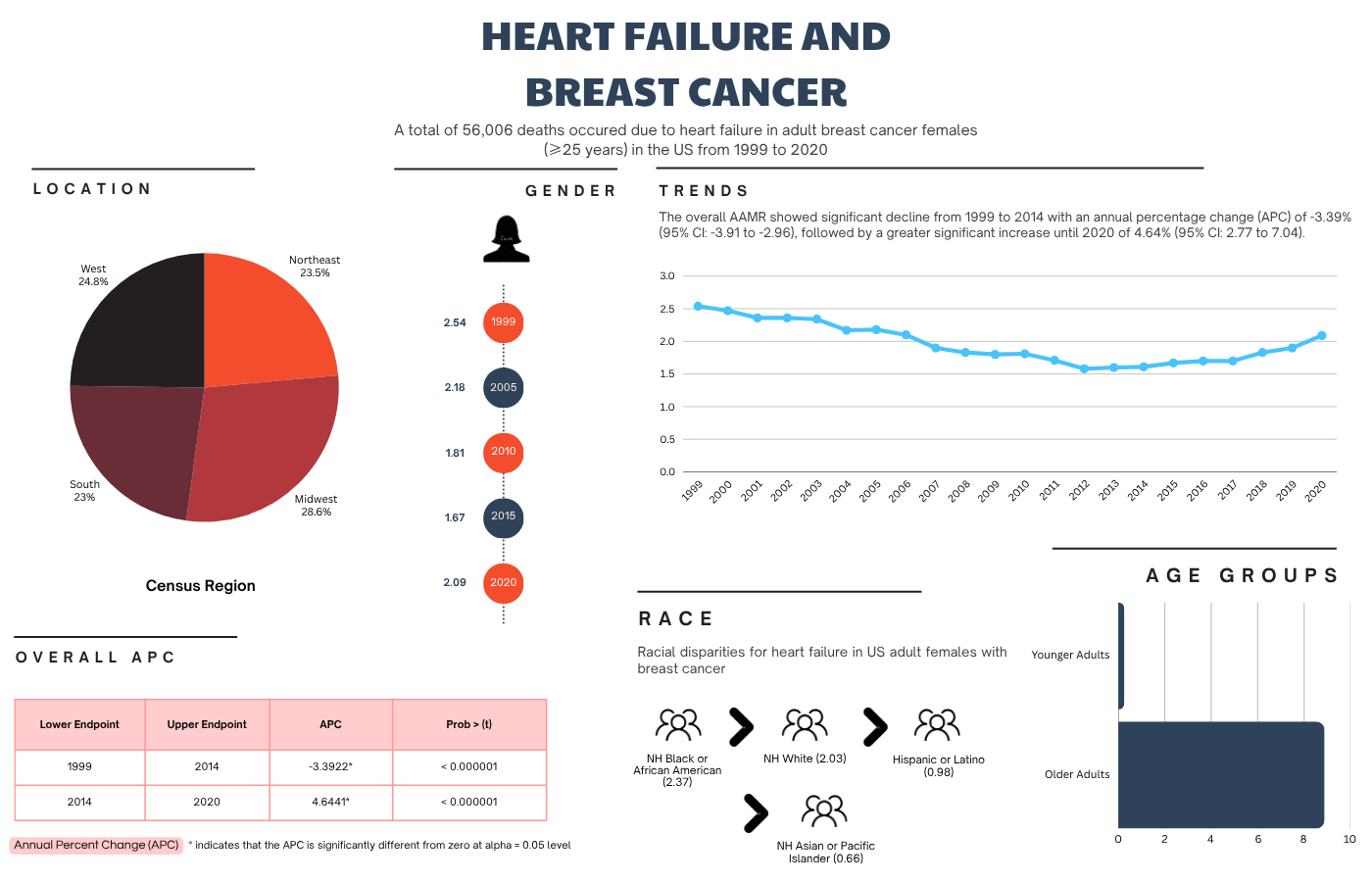
Abstract Body (Do not enter title and authors here): Background: Heart failure (HF) significantly impacts mortality among breast cancer patients. Studies indicate that breast cancer patients aged 65+ with HF have reduced long-term survival as HF poses a greater mortality risk than the cancer itself. Research Question: What are the trends and disparities in HF mortality among US women with breast cancer, and how do these patterns vary by race, age group, and region? Methods: We used the CDC WONDER mortality database to extract age-adjusted mortality rates (AAMRs) per 100,000 US women aged ≥25 years for breast cancer and HF mortality from 1999 to 2020. The Joinpoint Regression Program calculated the average annual percentage change (AAPC) in AAMRs. Results: From 1999 to 2020, HF caused 56,006 deaths in US breast cancer women, showing a decreasing trend with AAPC of -1.16% (95% CI: -1.5 to -0.86). The overall AAMR was 1.94 (1.93 – 1.96). Older adults (≥65 years) showed a significantly higher AAMR [8.88 (8.80 – 8.96)] with an AAPC of -1.17% (-1.45 to -0.93) than younger adults (25-64 years) [0.26 (0.25 – 0.27)] with an AAPC of -1.24% (-2.37 to -0.36). Among the racial and ethnic groups, the highest AAMR was observed in non-Hispanic (NH) Blacks [2.37 (2.31 – 2.43)], followed by NH Whites [2.03 (2.01 – 2.05)], Hispanics [0.98 (0.94 – 1.03)], and NH Asians or Pacific Islanders [0.66 (0.61 – 0.72)]. NH Blacks not only showed the highest mortality burden, but also exhibited a slight increase in AAMRs [AAPC: 0.15% (-0.48 to 0.66)]. NH Asians or Pacific Islanders showed the lowest mortality burden with the highest decline in AAMRs [AAPC: -1.47% (-2.71 to -0.28)], followed by Hispanics or Latinos (-1.27%) and NH Whites (-1.01%). Regionally, the Midwest showed the highest AAMR [2.25 (2.21 – 2.29)], followed by the West [1.95 (1.92 – 1.99)], the Northeast [1.85 (1.81 – 1.88)], and the South [1.81 (1.78 – 1.83)]. The Northeast showed the highest decline in AAMRs [AAPC: -1.48% (-2.06 to -0.98)], and the South showed the lowest [-0.59% (-0.99 to -0.20)]. Women in non-metropolitan areas had higher AAMRs [2.36 (2.32 – 2.41)] than those in metropolitan areas [1.87 (1.85 – 1.88)]. Metro and non-metropolitan areas showed a similar decline in AAMRs over the study period (-1.05% vs. -1.20%). Conclusion: HF mortality in US breast cancer females declined over the past 22 years; however, older adults, NH Blacks, the Midwest, and non-metropolitan areas experienced higher mortality burdens, highlighting the need for targeted interventions.
Raza, Ahmed
(
Services Institute of Medical Sciences
, Lahore , Pakistan )
Zannatun, Naeim
(
Brunel University of London
, London , United Kingdom )
Kassahun, Milan
(
Marian University
, Indianapolis , Indiana , United States )
Khan, Ubaid
(
University of Maryland
, Baltimore , Maryland , United States )
Author Disclosures:
Ahmed Raza:DO NOT have relevant financial relationships
| Naeim Zannatun:DO NOT have relevant financial relationships
| Milan Kassahun:DO NOT have relevant financial relationships
| Ubaid Khan:DO NOT have relevant financial relationships