Logo

American Heart Association

  13
  0


Final ID: Su3106

Evaluating the potential for SPAR analysis of ECGs with time matched disease progression to create a remote disease monitoring tool for patients with ATTR-Cardiac Myopathy aiming to reduce patient burden by avoiding frequent complex imaging

Abstract Body (Do not enter title and authors here): Background: Transthyretin amyloid cardiomyopathy (ATTR-CM) is a life-threatening condition, disease progression is currently measured using a combination of clinical, laboratory, MRI Imaging and ECG investigations multiple times a year, causing a significant disease burden to the patients. Simplifying investigations offers the potential to reducing disease burden, improve access and reduce health inequalities. Our novel mathematical method, Symmetric Projection Attractor Reconstruction (SPAR) analyses the complete morphology and variability of waveforms, This method has been shown to non-invasively assess vascular aging using PPG signals. SPAR amplifies small morphology changes on ECG which may be missed if focus resides on single points such as PQRST intervals or amplitudes, producing SPAR attractor images which can be readily interpreted by clinicians.
Hypothesis: We hypothesised that SPAR analysis of ECG can sensitively detect aberrant changes on ECGs overtime to provide a new method to differentiate patients between stable and progression of their heart failure and to distinguish a threshold for significant progression.
Methods: Longitudinal ECG and medical histories were collected and anonymised for ATTR-CM patients. ECG Waveform analysis was performed using a bespoke MATLAB software tool to transform ECG time-series into corresponding attractors.
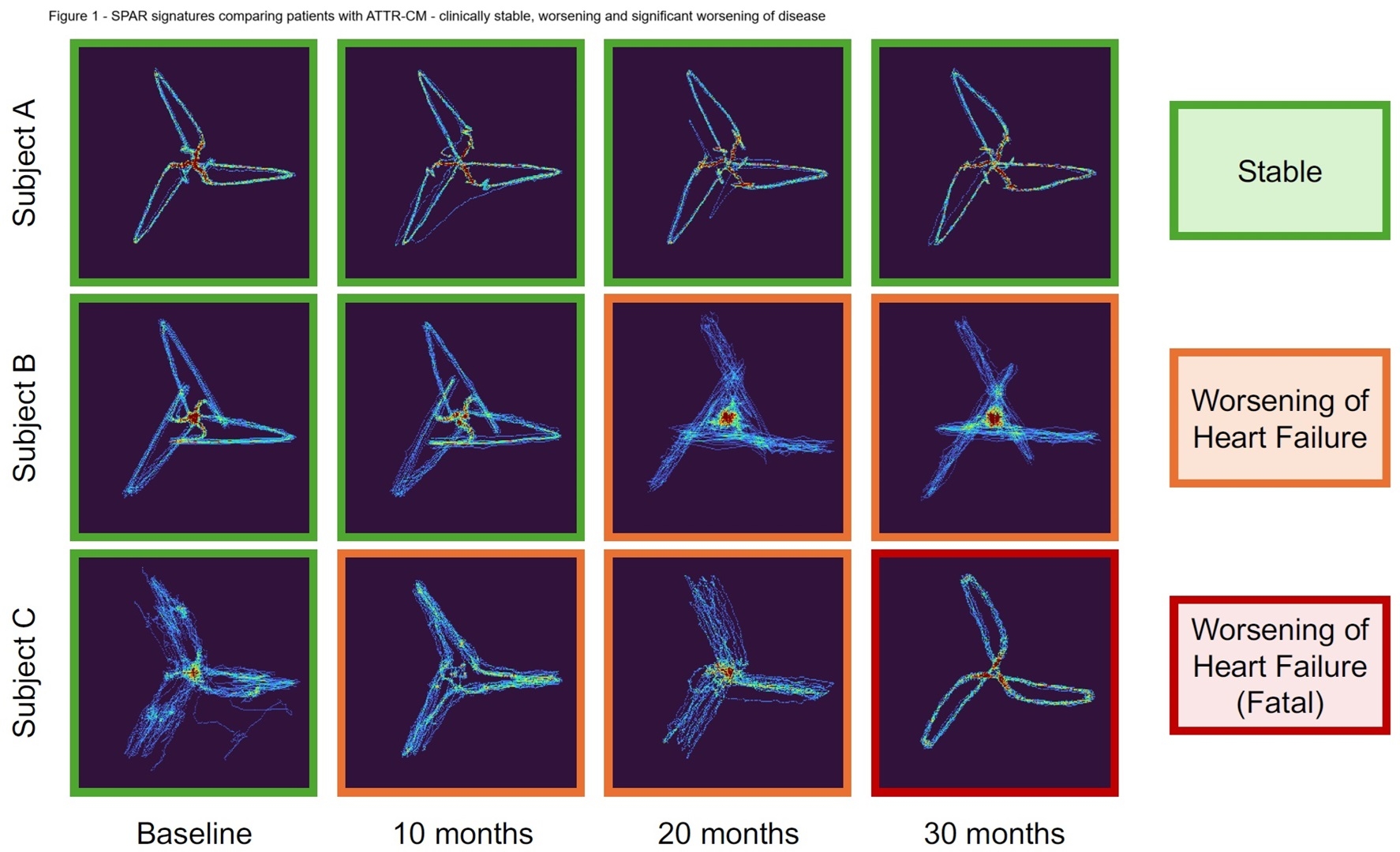
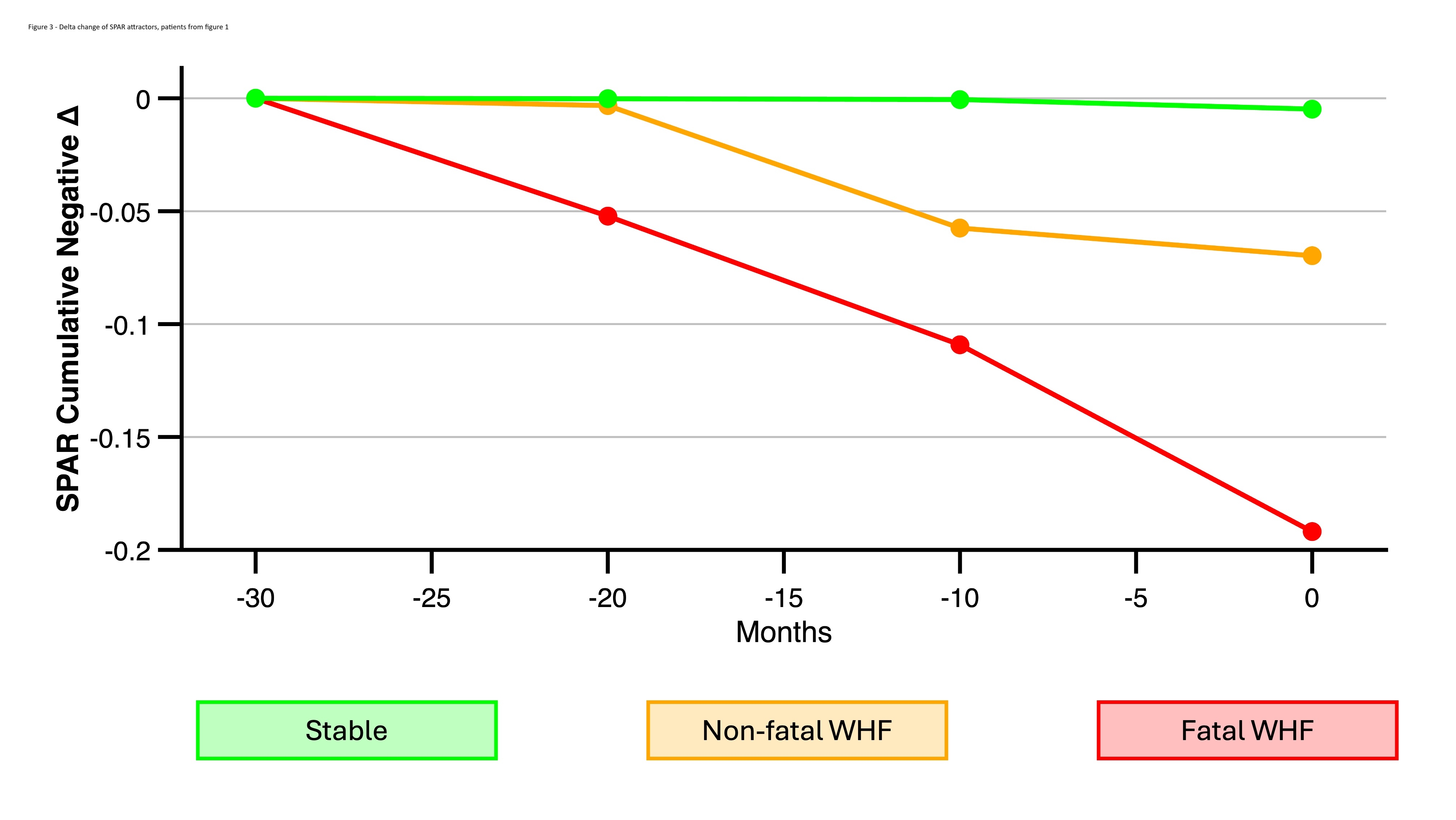
Results: Initial evaluation of a pilot analysis of a sub-set of the available data revealed attractors were able to see a stable attractor for patients who remained stable over 40 months. In contrast, patients who deteriorated, showed large attractor feature changes (fig1). Quantifying delta changes from the last ECG produces a cumulative graph indication a threshold for clinically concerning changes is possible(fig2).
Conclusion: This pilot study illustrates that SPAR attractors highlight changes on the ECG that were consistent with deterioration in the patient’s clinical condition. Additional analysis for delta changes between attractor time points showed a disease trajectory. Further evaluation of the whole dataset to create a simplified diagnostic where patients could provide an ECG at home allowing more frequent clinical monitoring remotely negating the need for patients to undergo complex imagining and laboratory testing. Offering remote monitoring of patients to only bring deteriorating patients to clinic, reducing unecessary investigations and travel to health centres.
  • Serna Pascual, Miquel  ( King's College London , London , United Kingdom )
  • Nandi, Manasi  ( King's College London , London , United Kingdom )
  • Taubel, Jorg  ( Richmond Pharmacology , London , United Kingdom )
  • Lorch, Ulrike  ( Richmond Pharmacology , London , United Kingdom )
  • Krakowiak, Aga  ( Richmond Pharmacology , London , United Kingdom )
  • Rickard, James  ( Richmond Research Institute , Tooting, London , United Kingdom )
  • Author Disclosures:
    Miquel Serna Pascual: DO NOT have relevant financial relationships | Manasi Nandi: DO NOT have relevant financial relationships | Jorg Taubel: DO NOT have relevant financial relationships | Ulrike Lorch: DO NOT have relevant financial relationships | Agnieszka Krakowiak: No Answer | James Rickard: No Answer
Meeting Info:

Scientific Sessions 2025

2025

New Orleans, Louisiana

Session Info:

AI, Digital Health and Remote Monitoring on the HF Horizon

Sunday, 11/09/2025 , 11:30AM - 12:30PM

Abstract Poster Board Session

More abstracts on this topic:
Acoramidis Lowers NT-proBNP in a Larger Proportion of ATTRibute-CM Study Participants With Transthyretin Amyloid Cardiomyopathy Compared with Placebo, Independent of Atrial Fibrillation Status

Maurer Mathew, Castano Adam, Tamby Jean-francois, Fox Jonathan, Mitter Sumeet, Hanna Mazen, Sperry Brett, Alexander Kevin, Obici Laura, Poulsen Steen, Januzzi James, Witteles Ronald, Jaber Wael, Brailovsky Yevgeniy, Vogtlaender Kai

A-band titin-truncating variant promotes the development of arrhythmia-induced cardiomyopathy in a novel genetically-engineered porcine model

Lee Kwonjae, Del Rio Carlos, Mcnally Elizabeth, Pfenniger Anna, Bhatnagar Ashita, Glinton Kristofor, Burrell Amy, Ober Rebecca, Mcluckie Alicia, Bishop Brian, Rogers Christopher, Geist Gail

More abstracts from these authors:
Nexiguran ziclumeran (nex-z, also known as NTLA-2001), an investigational in vivo CRISPR-based therapy for patients with transthyretin amyloidosis with cardiomyopathy (ATTR-CM): interim report of the Phase 1 study

Fontana Marianna, Olbertz Joy, Zhu Peijuan, Boiselle Carri, Smith Derek, Leung Adia, Gutstein David, Sonderfan Alison, Walsh Liron, Gillmore Julian, Taubel Jorg, Gane Edward, Pilebro Bjorn, Adams David, Solomon Scott, Claggett Brian, Kachadourian Jessica, Rocha Ricardo

Advanced waveform analysis of the electrocardiogram signals using complementary signal processing techniques to investigate the response to a QTc prolonging drug vs control including food effect.

Serna Pascual Miquel, Nandi Manasi, Taubel Jorg, Lorch Ulrike, Djumanov Dilshat, Sadsad Tyrone-joshua, Mejia Elisa, Rickard James

You have to be authorized to contact abstract author. Please, Login
Not Available