
Logo

American Heart Association

  16
  0


Final ID: Sa3079

Cannabidiol alleviates fibrosis through AGE-RAGE axis inhibition in a Non-Ischemic Mouse Model of Heart Failure

Abstract Body (Do not enter title and authors here): Background
Cannabidiol has been shown recently to improve cardiac function in mouse models of heart failure with a potential mechanism through influencing mitochondrial bioenergetics. Specific mechanisms of this beneficial impact have not been clearly elucidated. In this study, we aimed to utilize gene expression data to study Cannabidiol’s benefit in a murine model of non-ischemic heart failure (HF).
Hypothesis
Cannabidiol ameliorates HF through genetic regulation of cardiometabolic pathways.
Methods
HF was induced in 3-month-old male C57BL/6 mice by administering drinking water containing 1% NaCl and 0.3 mg/mL L-NAME for one week. Subsequently, subcutaneous osmotic mini pumps were implanted to deliver angiotensin II (0.7 mg/kg/day) for 4 weeks. Pharmaceutical grade Cannabidiol was administered subcutaneously twice weekly (1 mg/kg). At week 5, myocardial tissue was harvested for transcriptomics. Bulk RNA sequencing was performed on cardiac tissue (3 mice per group) using an Illumina HiSeq 4000 platform. Paired-end reads were assembled and counted with StringTie. Differential expression analysis was performed with DESeq2. Gene set enrichment analysis (GSEA) was done with gseKEGG of the clusterProfiler 4.0. Visualization was carried out with enrichplot and GOPlot in R version 4.2.2.
Results
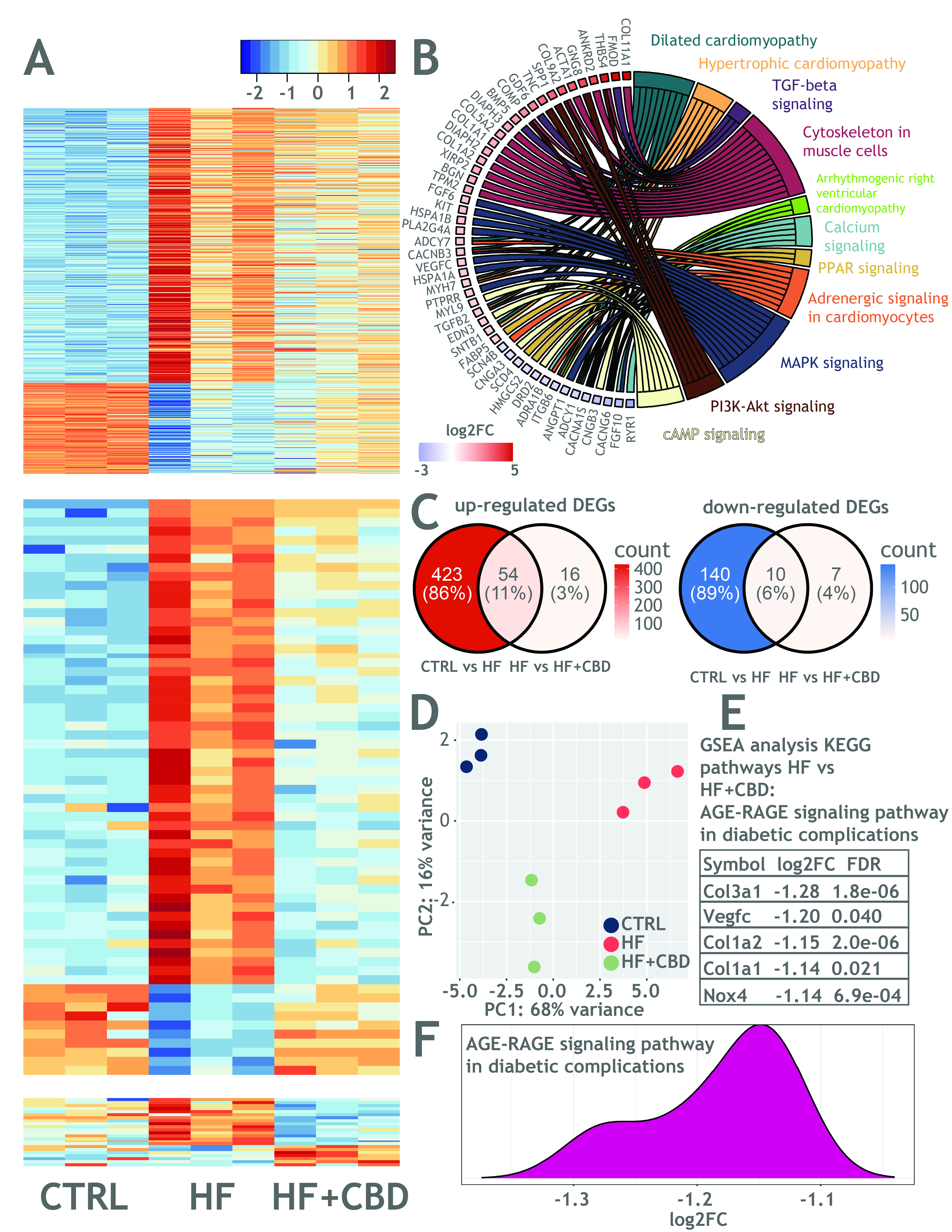
Relative to controls (CTRL), the heart of HF animals exhibited 627 differentially expressed genes (DEGs) (Fig1A top), involved in pathways such as dilated and hypertrophic cardiomyopathy, TGFβ signaling, cytoskeleton in muscle cells (chord plot in Fig1B), confirming the HF remodeling response. Intriguingly, 54 of the up-regulated and 10 of the down-regulated DEGs went back to CTRL expression levels after Cannabidiol administration (Fig1A middle, Fig1C). Overall, the transcriptomic profile of HF+ Cannabidiol animals was closer to the CTRL than to HF group, as evidenced by PCA analysis (Fig1D). Notably, twelve collagen-encoding genes were down-regulated in HF+ Cannabidiol relative to HF. GSEA revealed the AGE-RAGE pathway to be enriched in HF+ Cannabidiol vs. HF. DEGs contained in the AGE-RAGE pathway displayed negative FCs (Fig1E, F), possibly meaning a Cannabidiol-driven inhibition of the AGE-RAGE axis, a pathway known to be involved in chronic inflammation and aging.
Conclusion
Cannabidiol down-regulated genes related to extracellular matrix collagen fibers and the AGE-RAGE axis, possibly related to the alleviated fibrosis and inflammation in the HF+ Cannabidiol mice.
  • Mendez-fernandez, Abraham  ( Tecnológico de Monterrey , Monterrey , Mexico )
  • Krishnamoorthi, Muthu Kumar  ( Houston Methodist Hospital , Houston , Texas , United States )
  • Lozano, Omar  ( Tecnologico de Monterrey , Monterrey , Mexico )
  • Torre-amione, Guillermo  ( Tecnologico de Monterrey , Monterrey , Mexico )
  • Garcia Rivas, Gerardo  ( Tecnológico de Monterrey , Monterrey , Mexico )
  • Trevino, Victor  ( Tecnológico de Monterrey , Monterrey , Mexico )
  • Bhimaraj, Arvind  ( HOUSTON METHODIST HOSPITAL , Houston , Texas , United States )
  • Author Disclosures:
    Abraham Mendez-Fernandez: DO NOT have relevant financial relationships | Muthu Kumar Krishnamoorthi: DO NOT have relevant financial relationships | Omar Lozano: DO have relevant financial relationships ; Research Funding (PI or named investigator):Cardiol Therapeutics:Active (exists now) ; Executive Role:Nano 4 Heart:Active (exists now) ; Individual Stocks/Stock Options:Cardiol Therapeutics:Active (exists now) | Guillermo Torre-Amione: No Answer | Gerardo Garcia Rivas: No Answer | Victor Trevino: No Answer | Arvind Bhimaraj: DO have relevant financial relationships ; Consultant:Abiomed:Active (exists now) ; Advisor:CareDx:Past (completed) ; Research Funding (PI or named investigator):Cardiol Therapeutics:Active (exists now) ; Consultant:Pfizer:Past (completed) ; Speaker:Bridgebio:Past (completed) ; Speaker:Abbott:Active (exists now)
Meeting Info:

Scientific Sessions 2025

2025

New Orleans, Louisiana

Session Info:

Signals Under Pressure: Molecular Pathways in Pulmonary Hypertension

Saturday, 11/08/2025 , 10:30AM - 11:30AM

Abstract Poster Board Session

More abstracts on this topic:
A CRISPR-Activation CROP-seq Screen Identifies HMGN1 as a Dosage-Sensitive Regulator of Heart Defects in Down Syndrome

Ranade Sanjeev, Mital Rahul, Boileau Ryan, Koback Frances, Padmanabhan Arun, Merriman Alexander, Wallace Langley, Nguyen Annie, Poulis Nikolaus, Gifford Casey, Pollard Katherine, Li Feiya, Srivastava Deepak, Whalen Sean, Angelo Pelonero, Ye Lin, Huang Yu, Brand Abigail, Nishino Tomohiro, Costa Mauro

A Case of Steroid-Refractory Immune-checkpoint-inhibitor Induced Myocarditis Responsive to Mycophenolate and Anti-thymocyte globulin

Dabdoub Jorge, Wilson Michael, Gottbrecht Matthew, Salazar Ryan, Shih Jeffrey

More abstracts from these authors:
Depressive symptoms have a differential expression in two models of heart failure

Maldonado-ruiz Roger, Palafox Sanchez Victoria, Bernal-ramirez Judith, Lozano Omar, Garcia Rivas Gerardo

Temporary Mechanical Circulatory Support Modulates Inflammation And Fibrosis In Cardiogenic Shock Patients Bridged To Cardiac Replacement.

Krishnamoorthi Muthu Kumar, Patel Khush, Bhimaraj Arvind

You have to be authorized to contact abstract author. Please, Login
Not Available