
Logo

American Heart Association

  11
  0


Final ID: MP1775

Association Between Elevated Lipoprotein(a) and New-Onset Atrial Fibrillation: A Retrospective Analysis Using the TriNetX Research Network

Abstract Body (Do not enter title and authors here): Background:
Atrial fibrillation (AF) is the most prevalent clinically encountered cardiac arrhythmia and is associated with an increased risk of heart failure, stroke, and all-cause mortality. Lipoprotein(a) [Lp(a)] is a recognized risk factor for atherosclerotic cardiovascular disease (ASCVD), yet its independent role in the onset of AF remains uncertain.

Objective:
Understanding the relationship between Lp(a) levels and incident AF could offer new insights into cardiovascular risk stratification beyond traditional ASCVD pathways.

Methods:
This retrospective cohort study utilized data from the TriNetX Research Network health records from 100 healthcare organizations. Adults aged ≥18 years with documented lipoprotein(a) [Lp(a)] levels and no history of atrial fibrillation (AF) or cardiac devices were included. Two groups were defined: Elevated Lp(a) (≥125 nmol/L or ≥50 mg/dL) and Normal Lp(a) (<125 nmol/L or <50 mg/dL). The index date was the first qualifying Lp(a) result. Propensity score matching (1:1) was applied to 74 characteristics. The primary outcome was new-onset AF; secondary outcomes included hospitalizations and emergency department visits. Statistical analysis included risk estimates and t-tests with significance set at p < 0.05.
Results:
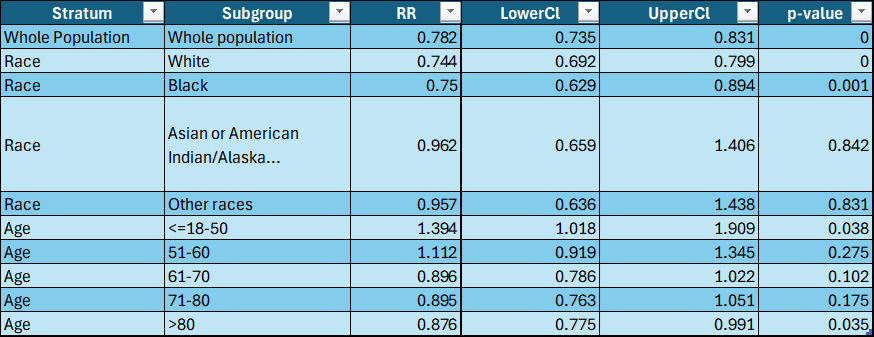
After matching, 43,989 patients were included in each cohort. The median follow-up was 817 days (elevated Lp(a)) vs. 899 days (normal Lp(a)). New-onset AF occurred in 3.9% of the elevated Lp(a) group vs. 4.9% of the normal group (risk ratio 0.785, 95% CI: 0.738–0.835, p < 0.001). Hospitalization or emergency visits occurred in 41.1% vs. 43.0% of patients, respectively (risk ratio 0.956, p < 0.001). The average number of visits was also lower in the elevated group (7.5 vs. 11.2, p < 0.001). Elevated Lp(a) was unexpectedly associated with a reduced risk of AF and lower healthcare utilization. Elevated Lp(a) in race and age subgroups yielded different results.(Table 1)


Conclusion:
In this large propensity score-matched cohort study, elevated [Lp(a)] levels were associated with a significantly lower risk of new-onset atrial fibrillation compared to normal Lp(a) levels. Additionally, patients with elevated Lp(a) experienced slightly fewer hospitalizations and emergency visits. These findings suggest a complex and potentially protective role of Lp(a) in atrial arrhythmogenesis, warranting further investigation into its underlying mechanisms and clinical implications.
  • Qadeer, Abdul  ( University of Texas Medical Branch , Galveston , Texas , United States )
  • Akbar, Usman  ( WVU Camden Clark , Parkersburg , West Virginia , United States )
  • Ahmed, Faizan  ( Jersey Shore University Medical Center , Brooklyn , New York , United States )
  • Shabbir, Muhammad Raffey  ( Marshfield Clinic , Marshfield , Wisconsin , United States )
  • Aamir, Muhammad  ( Lehigh Valley Hospital Network , Macungie , Pennsylvania , United States )
  • Fouad, Michele  ( Alexandria Faculty of Medicine , Alexandria , Egypt )
  • Khan, Allahdad  ( Nishtar Medical University , Multan , Pakistan )
  • Khawar, Muneeb  ( King Edward Medical University , Lahore , Pakistan )
  • Pathak, Prutha  ( North Alabama Medical Center , Muscle Shoals , Alabama , United States )
  • Hassan, Furqan  ( Nishtar Medical University , Multan , Pakistan )
  • Hotwani, Priya  ( parkview heath , Fort wayne , Indiana , United States )
  • Khan, Sardar Muhammad Imran  ( NUMS , Rawalpindi , Pakistan )
  • Shafique, Nouman  ( AdventHealth Orlando , Orlando , Florida , United States )
  • Author Disclosures:
    Abdul Qadeer: DO NOT have relevant financial relationships | Usman Akbar: DO NOT have relevant financial relationships | Faizan Ahmed: DO NOT have relevant financial relationships | Muhammad Raffey Shabbir: DO have relevant financial relationships ; Individual Stocks/Stock Options:NOVO NORDISK:Active (exists now) ; Individual Stocks/Stock Options:Eli Lilly:Active (exists now) ; Individual Stocks/Stock Options:BOSTON SCIENTIFIC:Expected (by end of conference) | Muhammad Aamir: No Answer | Michele Fouad: DO NOT have relevant financial relationships | Allahdad Khan: DO NOT have relevant financial relationships | Muneeb Khawar: DO NOT have relevant financial relationships | Prutha Pathak: DO NOT have relevant financial relationships | Furqan Hassan: DO NOT have relevant financial relationships | Priya Hotwani: DO NOT have relevant financial relationships | Sardar Muhammad Imran Khan: DO NOT have relevant financial relationships | Nouman Shafique: DO NOT have relevant financial relationships
Meeting Info:

Scientific Sessions 2025

2025

New Orleans, Louisiana

Session Info:

Improving Arrhythmia Care for Vulnerable Populations: How Can We Do Better?

Sunday, 11/09/2025 , 11:50AM - 01:05PM

Moderated Digital Poster Session

More abstracts on this topic:
A-band titin-truncating variant promotes the development of arrhythmia-induced cardiomyopathy in a novel genetically-engineered porcine model

Lee Kwonjae, Del Rio Carlos, Mcnally Elizabeth, Pfenniger Anna, Bhatnagar Ashita, Glinton Kristofor, Burrell Amy, Ober Rebecca, Mcluckie Alicia, Bishop Brian, Rogers Christopher, Geist Gail

A Fat Chance: Paradoxical Embolic Stroke from Lipomatous Hypertrophy of the Interatrial Septum

Kalathoor Abraham

More abstracts from these authors:
Intra-Procedural Cardiac Arrest in Patients Undergoing Percutaneous Coronary Intervention: A Comparative Outcomes Analysis Using a Large Scale Health Research Network

Qadeer Abdul, Pathak Prutha, Zain Sarmad, Bukhari Syed Muhammad Awais, Patel Siddharth

Efficacy of Mavacamten Combined with Standard Therapy in Hypertrophic Obstructive Cardiomyopathy: A Retrospective Cohort Study

Qadeer Abdul, Shehryar Muhammad, Malik Muhammad Jehangir Ameen, Usman Muhammad, Khan Sardar Muhammad Imran, Hamza Mohammad, Fouad Michele, Khawar Muneeb, Pathak Prutha, Nadeem Ali Ahmad, Muhammad Awon, Hadeed Khawar Mirza Muhammad, Bista Roshani, Twayana Anu

You have to be authorized to contact abstract author. Please, Login
Not Available