Diagnostic Accuracy of AI Algorithms for Detecting Left Ventricular Diastolic Dysfunction on ECG: A Systematic Review and Meta-Analysis
Abstract Body (Do not enter title and authors here): Background: Left ventricular diastolic dysfunction (LVDD), a key precursor to heart failure with preserved ejection fraction, is frequently underdiagnosed using on routine electrocardiography (ECG). Recent studies have explored artificial intelligence (AI) algorithms to improve detection of LVDD, but their diagnostic performance across studies remains unclear and no prior meta-analysis has comprehensively evaluated their pooled accuracy.
Objective: We conducted a systematic review and meta-analysis to assess the overall diagnostic performance of existing AI-based models for detecting LVDD using standard 12-lead ECG as the reference standard.
Methods: We systematically searched six databases (Cochrane Library, Embase, Google Scholar, Medline, Scopus, and Web of Science) through March 2025 for studies evaluating the diagnostic accuracy of AI algorithms to detect LVDD from 12-lead ECG to echocardiography as the reference standard. Pooled analyses of sensitivity, specificity, and area under the summary receiver operating characteristic curve (AUC) and their 95% confidence intervals (CI) were determined using a bivariate random-effects model. Heterogeneity was quantified using I2 statistics. Statistical analysis was performed using Stata BE 18.0.
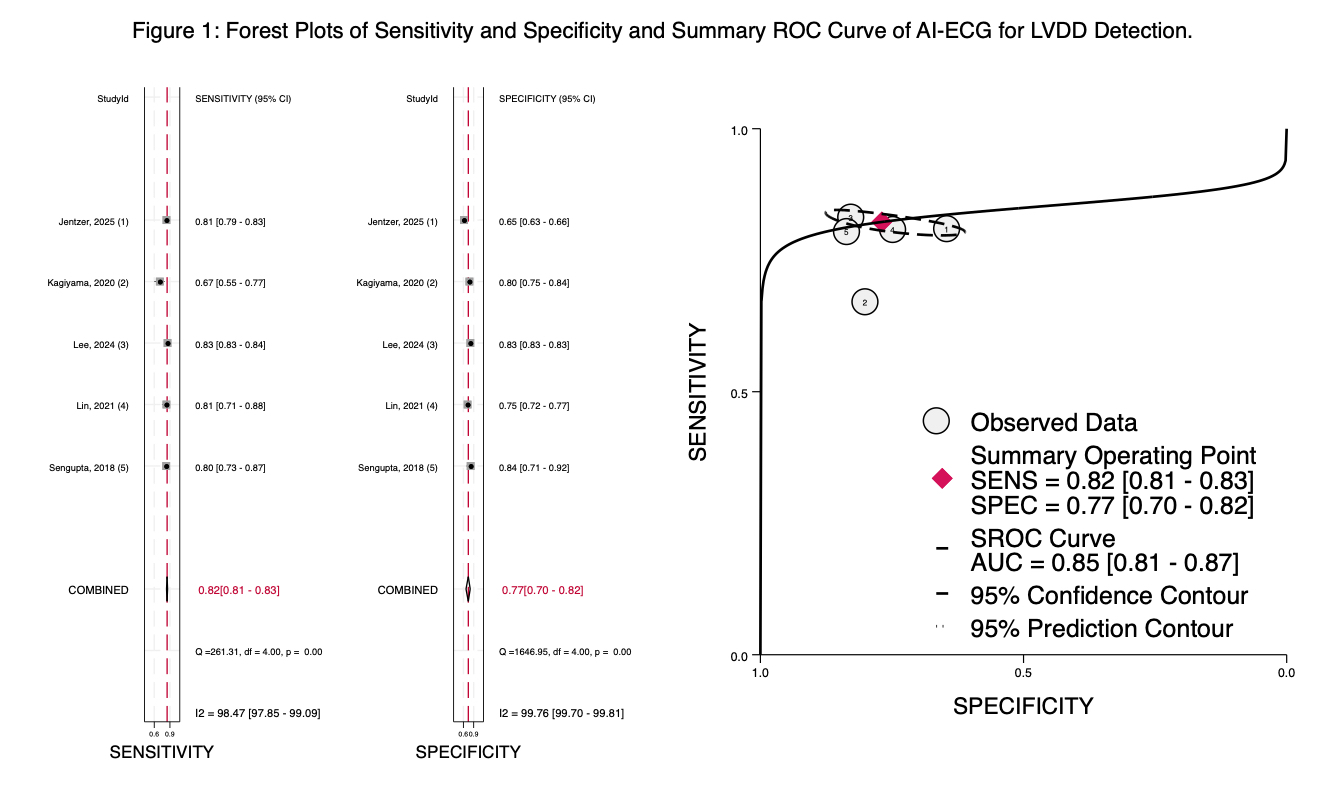
Results: Out of 4896 studies screened, five studies (n =105,554 participants) met the inclusion criteria. The mean age was 66.0 ± 11.4 years, and 52.7% were male. The pooled sensitivity for AI-enhanced ECG for detecting LVDD was 0.82 (95% CI: 0.81–0.83, I2 = 98.47%), and pooled specificity was 0.77 (95% CI: 0.70–0.82, I2 = 99.76%). The summary AUC was 0.85 (95% CI: 0.81–0.87), indicating good overall diagnostic performance. Leave-one-out sensitivity analyses showed stable pooled estimates (sensitivity, specificity, and AUC), suggesting no single study unduly influenced our findings.
Conclusion: AI-enhanced ECG demonstrates good diagnostic accuracy for detecting LVDD, offering potential for earlier identification in routine clinical settings.
Edjimbi, Johann Alexandre Chafa
( Sinai Hospital of Baltimore
, Baltimore
, Maryland
, United States
)
Marijon, Eloi
( European Georges Pompidou Hospital
, Paris
, France
)
Gaye, Bamba
( Alliance of Medical Research in Africa
, Dakar
, Senegal
)
Gajjar, Aryan
( University of California
, Los Angeles
, California
, United States
)
Shah, Nisarg
( Yale School of Medicine
, New Haven
, Connecticut
, United States
)
Ribeiro, Antonio
( Federal University of Minas Gerais
, Belo Horizonte
, Brazil
)
Carter, Jennifer
( Health Data Research UK, University of Oxford (HDRUK-Oxford), Oxford, UK
, Oxford
, United Kingdom
)
Sattler, Elisabeth
( UNIVERSITY OF GEORGIA
, Athens
, Georgia
, United States
)
Dani, Sourbha
( LAHEY HOSPITAL MEDICAL CENTER
, Burlington
, Massachusetts
, United States
)
Clifford, Gari
( Department of Biomedical Informatics, Emory University School of Medicine
, Atlanta
, Georgia
, United States
)
Author Disclosures:
JOHANN ALEXANDRE CHAFA EDJIMBI:DO NOT have relevant financial relationships
| Eloi Marijon:DO NOT have relevant financial relationships
| Bamba Gaye:No Answer
| Aryan Gajjar:DO NOT have relevant financial relationships
| Nisarg Shah:DO NOT have relevant financial relationships
| Antonio Ribeiro:No Answer
| Ngone GAYE:No Answer
| Jennifer Carter:No Answer
| Elisabeth Sattler:DO NOT have relevant financial relationships
| Sourbha Dani:DO NOT have relevant financial relationships
| Gari Clifford:No Answer