Cultural Identity and Cardiovascular Risk Factors in South Asian Young Adults in the United States: The MASALA-2G Second Generation Study
Abstract Body (Do not enter title and authors here): Introduction: South Asian populations experience excess atherosclerotic cardiovascular disease (ASCVD) risk. Social determinants of ASCVD risk factors in second generation, young adult South Asians have not previously been investigated. Cultural identity is one factor that may reflect health behaviors.
Research Question: Is cultural self-identity associated with ASCVD risk factors in second generation, young adult South Asians?
Methods: Among US South Asian adults age ≥18 years who are children of participants in the MASALA (Mediators of Atherosclerosis in South Asians Living in America) Study from the Chicago area, we evaluated the association of cultural self-identity (on a scale of very or mostly South Asian, bicultural, or very or mostly Western) with ASCVD risk factors including fasting glucose and lipids, blood pressure, body composition, and sleep duration, using multivariable linear regression adjusted for age, sex, educational attainment, and place of birth (in versus outside the United States).
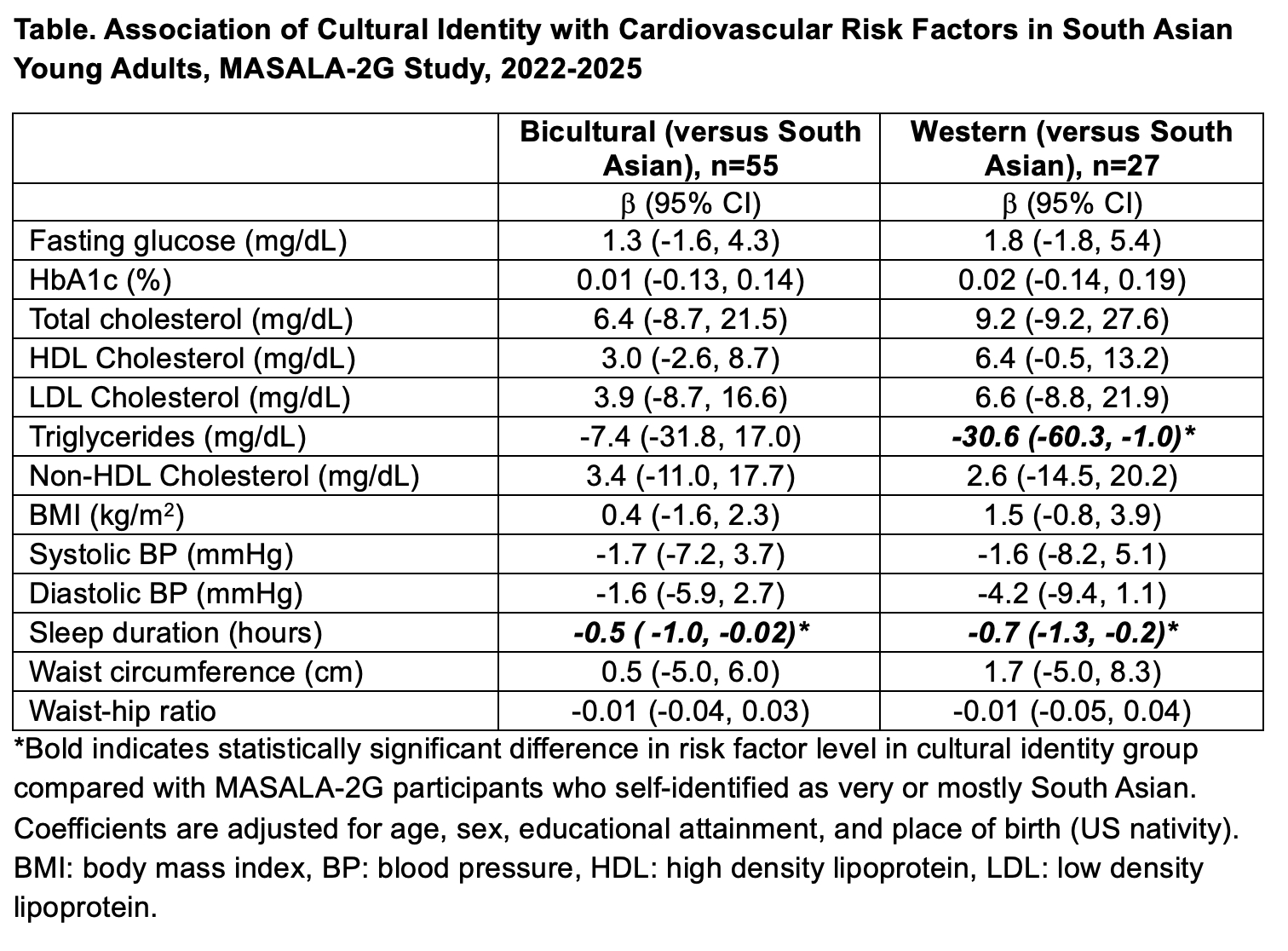
Results: Among 116 second generation South Asian Americans (mean age 34.3 [SD 9.3] years; 49% female, 51% male), 28% self-identified cultural identity as South Asian, 48% as bicultural, and 24% as Western. Mean (standard deviation) values of ASCVD risk factors in the overall sample were: fasting glucose 91 (7) mg/dL, hemoglobin A1c 5.3% (0.3), total cholesterol 180 (32) mg/dL, non-high density lipoprotein cholesterol 127 (31) mg/dL, triglycerides 103 (53) mg/dL, body mass index 23.5 (4.3) kg/m2, waist circumference 89 (13) cm, systolic blood pressure 115 (12) mmHg, diastolic blood pressure 73 (9) mmHg, and sleep duration 7.1 (1.1) hours. Compared to participants with South Asian identity (Table), young South Asian adults identifying as bicultural had a 0.5-hour lower sleep duration (95% CI -1.0, -0.02) and those identifying as Western had a 0.7-hour lower sleep duration (95% CI -1.3, -0.2). Young South Asian adults identifying as Western had a 31 mg/dL lower triglyceride level (95% CI -60, -1).
Conclusions: Among South Asian young adult participants in the MASALA-2G Second Generation Study, those who identified as Western had lower triglyceride levels and shorter sleep duration, and those who identified as bicultural had shorter sleep duration, compared to those who identified as South Asian. Future research should investigate how cultural identity influences health behaviors related to sleep and other ASCVD risk factors.
Shah, Nilay
(
Northwestern University
, Chicago , Illinois , United States )
Zafar, Nausheen
(
Northwestern University
, Chicago , Illinois , United States )
Lancki, Nicola
(
Northwestern University
, Chicago , Illinois , United States )
Mammoottil, Bjoe
(
Northwestern University
, Chicago , Illinois , United States )
Finch, Emily
(
Northwestern University
, Chicago , Illinois , United States )
Siddique, Juned
(
Northwestern University
, Chicago , Illinois , United States )
Kanaya, Alka
(
UCSF
, San Francisco , California , United States )
Huffman, Mark
(
Washington University in St. Louis
, Saint Louis , Missouri , United States )
Kandula, Namratha
(
Northwestern University
, Chicago , Illinois , United States )
Author Disclosures:
Nilay Shah:DO NOT have relevant financial relationships
| Nausheen Zafar:DO NOT have relevant financial relationships
| Nicola Lancki:DO NOT have relevant financial relationships
| BJoe Mammoottil:No Answer
| Emily Finch:DO NOT have relevant financial relationships
| Juned Siddique:DO NOT have relevant financial relationships
| Alka Kanaya:DO NOT have relevant financial relationships
| Mark Huffman:DO have relevant financial relationships
;
Consultant:The George Institute for Global Health:Active (exists now)
; Consultant:PwC Switzerland:Past (completed)
| Namratha Kandula:DO have relevant financial relationships
;
Research Funding (PI or named investigator):NIH:Active (exists now)
; Other (please indicate in the box next to the company name):PCORI- honorarium for Chairing Grant review:Active (exists now)
; Other (please indicate in the box next to the company name):ADA-honorarium as Associate Editor:Active (exists now)