Logo

American Heart Association

  16
  0


Final ID: MP677

Identifying optimum ECG features to predict sudden cardiac arrest at varying time points before the event

Abstract Body (Do not enter title and authors here): Background
Prediction of sudden cardiac arrest (SCA) from the ECG is of great importance, but is complicated by the uncertainty introduced by dynamic remodeling of the ECG over time. Traditional machine learning models trained on ECG snapshots have not captured this dynamic remodeling.
Hypothesis
Artificial intelligence (AI)- models trained on temporal ECG feature sequences will reveal dynamic biomarkers of cardiac arrest. .
Methods
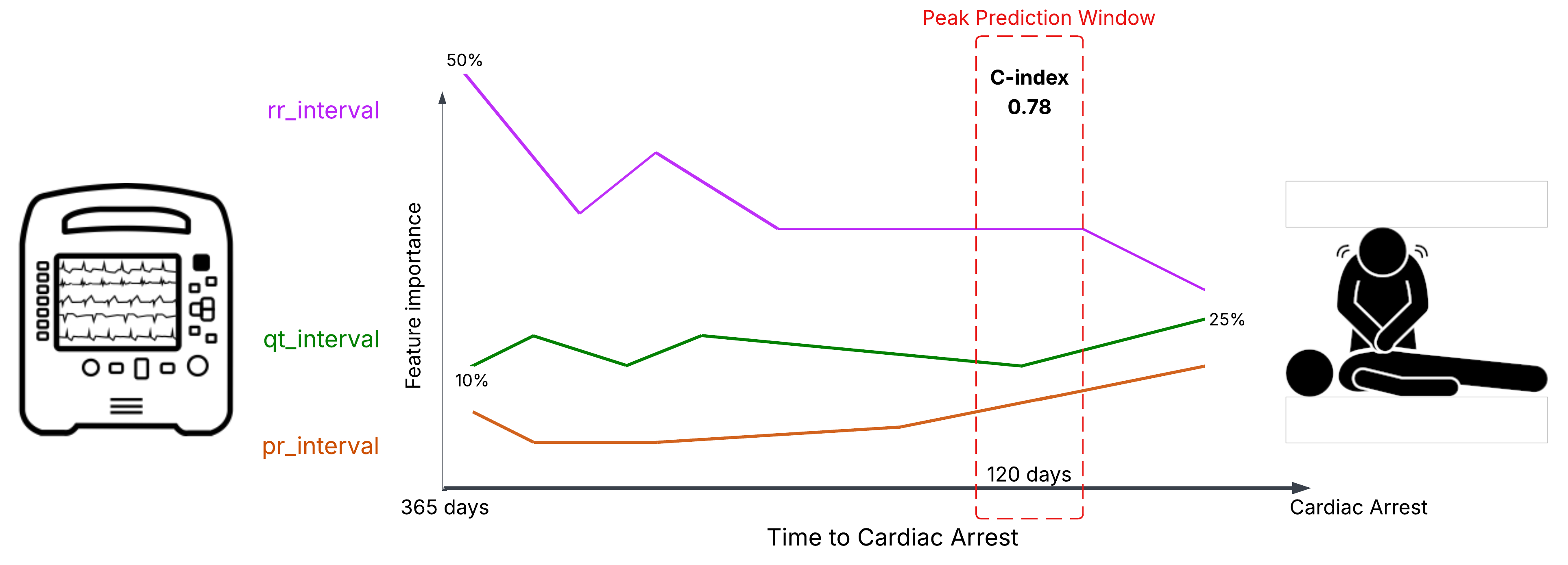
Our registry consisted of 108,704 12-lead ECG recordings from 2,837 patients (age=61 ± 14 years, 34% female, 46% white) who experienced cardiac arrest within 1 year. Routine ECG features (e.g. P-duration, QRS-duration, QT-interval) were indexed by “time to arrest”. Training, test and validation cohorts were created using patient-stratified splitting, and training data was augmented to make the transformer model robust against noisy timestamps and data sparsity. We calculated the importance of features dynamically over time using Harrell’s Concordance Index (C-Index) and global SHAP values at multiple prediction horizons (30-360 days). (Fig 1)
Results
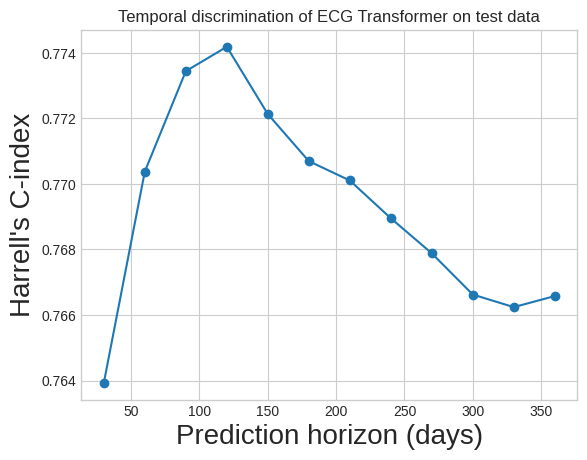
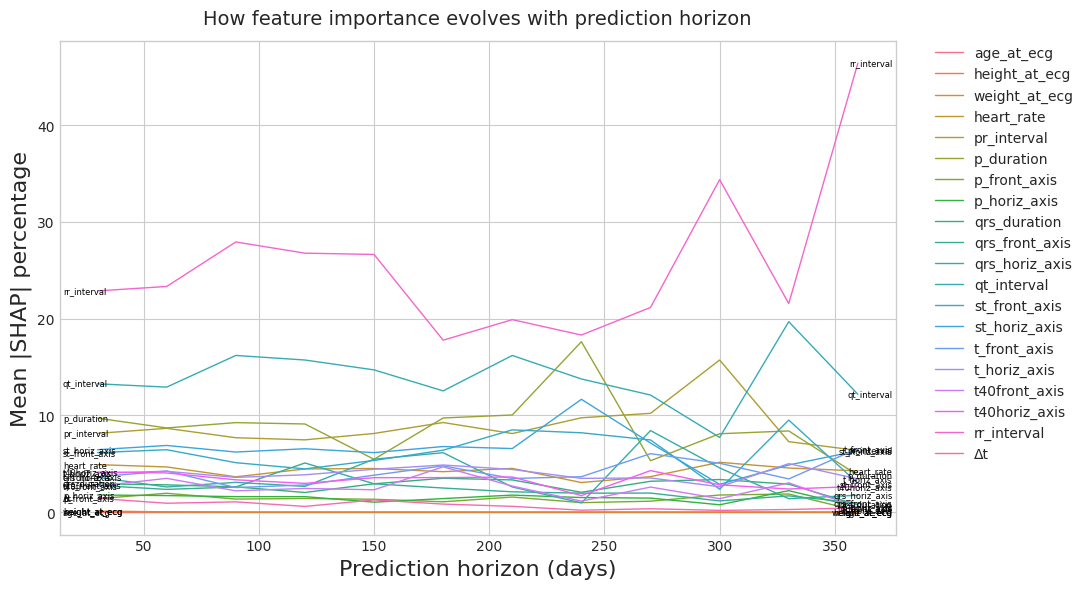
In the training cohort, SCA prediction performance peaked at 60 days before arrest (C-index = 0.89) and tapered monotonically thereafter. In the hold-out test cohort, SCA prediction peaked at 120 days (C-index = 0.78) and fell only slightly to 0.76 at 365 days (Fig 2). Features most important for long-term prediction were the RR-interval (importance ~50%), with an emergence of QT-interval, P-duration and PR-interval as additional co-predictors at timepoints closer to the SCA event (cumulative importance ~ 32%) (Fig 3).
Conclusion
ECG-features’ vary in their importance to predicting SCA over a one-year period. Using time-aware AI-transformer models, RR interval was the strongest predictor from 1 year preceding the event, with other features emerging as the event draws closer. This study shows the importance of using repeated 12-lead ECGs in at-risk patients, and combining them into dynamic-predictive indices.
  • Bandyopadhyay, Sabyasachi  ( Stanford University , Palo Alto , California , United States )
  • Perez, Marco  ( STANFORD UNIV HOSPITAL , Stanford , California , United States )
  • Narayan, Sanjiv  ( STANFORD MEDICINE , Stanford , California , United States )
  • Rogers, Albert  ( Stanford University , Redwood City , California , United States )
  • Ganesan, Prash  ( Stanford University , Palo Alto , California , United States )
  • Brennan, Kelly  ( Stanford University , San Francisco , California , United States )
  • Ruiperez-campillo, Samuel  ( ETH Zurich , Zurich , Switzerland )
  • Ansari, Rayan  ( Stanford University , Chatsworth , California , United States )
  • Clopton, Paul  ( Stanford University , Palo Alto , California , United States )
  • Perino, Alexander  ( Stanford University , Stanford , California , United States )
  • Wang, Paul  ( Stanford University , Stanford , California , United States )
  • Ashley, Euan  ( Stanford University , Palo Alto , California , United States )
  • Author Disclosures:
    Sabyasachi Bandyopadhyay: DO have relevant financial relationships ; Consultant:Linus Health Inc.:Past (completed) | Marco Perez: DO have relevant financial relationships ; Research Funding (PI or named investigator):NIH/NHLBI:Active (exists now) ; Ownership Interest:QALY Inc.:Active (exists now) ; Ownership Interest:Pacegenix:Active (exists now) ; Consultant:Pacegenix:Active (exists now) ; Consultant:Simplex Quantum:Active (exists now) ; Consultant:Thryv:Active (exists now) ; Consultant:Boston Scientific:Active (exists now) ; Consultant:Johnson and Johnson:Active (exists now) ; Consultant:Apple Inc.:Active (exists now) ; Research Funding (PI or named investigator):Johnson and Johnson:Active (exists now) ; Research Funding (PI or named investigator):Lexeo Therapeutics:Active (exists now) ; Research Funding (PI or named investigator):Apple Inc.:Active (exists now) | Sanjiv Narayan: DO have relevant financial relationships ; Consultant:Lifesignals.ai:Active (exists now) ; Consultant:Abbott, Inc.:Past (completed) ; Consultant:PhysCade, Inc.:Active (exists now) | Albert Rogers: DO have relevant financial relationships ; Research Funding (PI or named investigator):National Institutes of Health:Active (exists now) ; Advisor:YorLabs Inc:Active (exists now) ; Advisor:WearLinq Inc.:Active (exists now) ; Research Funding (PI or named investigator):American Heart Association:Active (exists now) | Prash Ganesan: No Answer | Kelly Brennan: DO NOT have relevant financial relationships | Samuel Ruiperez-Campillo: DO have relevant financial relationships ; Consultant:Physcade Inc:Active (exists now) ; Individual Stocks/Stock Options:Physcade Inc:Active (exists now) | Rayan Ansari: DO NOT have relevant financial relationships | Paul Clopton: No Answer | Alexander Perino: DO have relevant financial relationships ; Consultant:J&J Medtech:Active (exists now) ; Research Funding (PI or named investigator):Orchestra Med:Active (exists now) ; Research Funding (PI or named investigator):Boston Scientific:Active (exists now) ; Consultant:Biotronik:Past (completed) ; Other (please indicate in the box next to the company name):Medtronic: Episode Review Committee:Past (completed) ; Other (please indicate in the box next to the company name):Abbott: Speaker, Research funding:Active (exists now) | Paul Wang: DO have relevant financial relationships ; Individual Stocks/Stock Options:Soneira:Active (exists now) ; Ownership Interest:EndoEpiAF:Active (exists now) ; Ownership Interest:HrtEx:Active (exists now) | Euan Ashley: No Answer
Meeting Info:

Scientific Sessions 2025

2025

New Orleans, Louisiana

Session Info:

The ECG and Beyond: The Expanding Role of Imaging in Electrophysiology

Saturday, 11/08/2025 , 12:15PM - 01:30PM

Moderated Digital Poster Session

More abstracts on this topic:
A Multicentre Study for Hands Only CPR (HOCPR) training assessment towards building a ‘Nation of Life Savers” in India

Ravikumar Thanjavur, Sarma Kvs, Ravikumar Thanjavur, Sarkar Manuj, Debnath Dhrubajyoti, Behera Priyamadhaba, Ghate Jayshri, Trikha Divay, Samantaray A, Madhavi K

Age-Related Differences in Aortic Valve Calcium Progression and the Risk for Aortic Stenosis: Multi-Ethnic Study of Atherosclerosis

Marrero Natalie, Thanassoulis George, Rotter Jerome, Blaha Michael, Whelton Seamus, Jha Kunal, Grant Jelani, Razavi Alexander, Budoff Matthew, Shah Sanjiv, Blumenthal Roger, Post Wendy, Shaw Leslee

More abstracts from these authors:
AI-based prediction of mortality in patients with ventricular tachycardia

Bandyopadhyay Sabyasachi, Narayan Sanjiv, Sadri Shirin, Brennan Kelly, Ganesan Prash, Clopton Paul, Ruiperez-campillo Samuel, Peralta Esteban, Sillett Charlie, Rogers Albert

Automated End-to-End Framework for Extracting Raw ECG Waveforms and ST Segment Values from ECG Reports and Predicting ST Elevation by Machine Learning

Ganesan Prasanth, Wang Paul, Ashley Euan, Perez Marco, Narayan Sanjiv, Rogers Albert, Liu Xichong, Bandyopadhyay Sabyasachi, Ansari Rayan, Somani Sulaiman, Brennan Kelly, Karius Alexander, Baykaner Tina, Perino Alexander

You have to be authorized to contact abstract author. Please, Login
Not Available