Impact of Diagnosis-to-Ablation Time on Clinical Outcomes in Patients with Atrial Fibrillation after Catheter Ablation: A US Retrospective Cohort Analysis
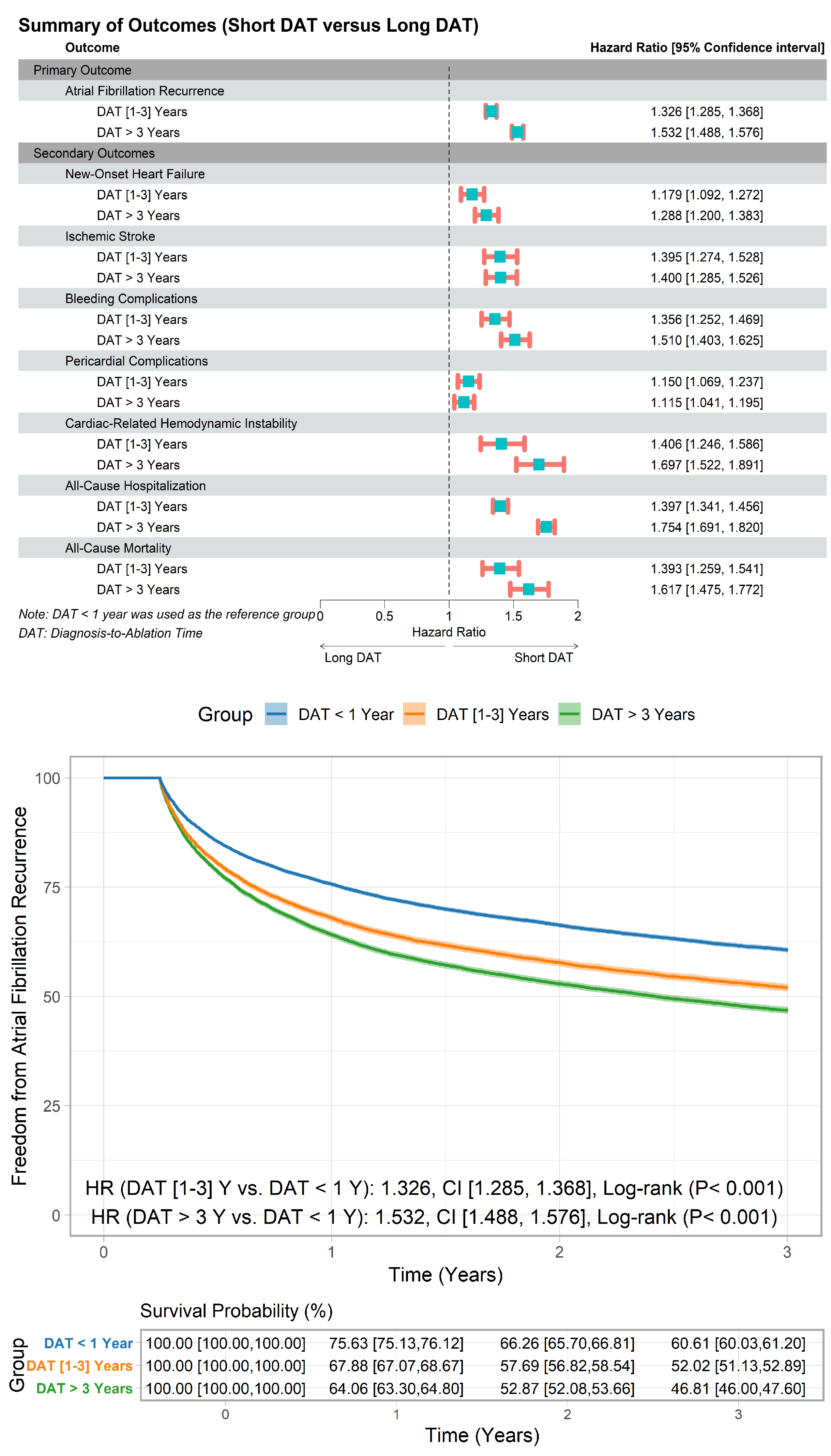
Abstract Body (Do not enter title and authors here): Background. Current clinical guidelines underscore the importance of rhythm control using catheter ablation but lack guidance regarding the timing of atrial fibrillation (AF) ablation in relation to the diagnosis time. Purpose. This study aims to assess the impact of diagnosis-to-ablation time (DAT) on clinical outcomes in patients with AF who underwent their first catheter ablation. Methods. This study utilized the TriNetX database (January 2016 to April 2022). We identified 62,548 adult patients (≥18 years) with AF who underwent their first catheter ablation. Our primary outcome was the recurrence of AF at a three-year follow-up following a three-month blanking period. All outcomes were evaluated at three-year follow-up using the hazard ratio (HR) and 95% confidence interval (CI). Results. Our study included 32,449 patients with DAT < 1 year, 13,662 patients with DAT 1–3 years, and 16,437 patients with DAT > 3 years. Compared to DAT < 1 year, DAT 1–3 years was significantly associated with an increased risk of AF recurrence (HR: 1.326, 95% CI [1.285, 1.368], p < 0.001). However, DAT > 3 years was significantly associated with an even greater risk of AF recurrence (HR: 1.532, 95% CI [1.488, 1.576], p < 0.001). Compared to DAT < 1 year, both DAT 1–3 years and DAT > 3 years were significantly associated with an increased risk of ischemic stroke (HR: 1.395, 95% CI [1.274, 1.528], p < 0.001) and (HR: 1.400, 95% CI [1.285, 1.526], p < 0.001), respectively. Additionally, compared to DAT < 1 year, DAT 1–3 years was significantly associated with an increased risk of all-cause mortality (HR: 1.393, 95% CI [1.259, 1.541], p < 0.001). However, DAT > 3 years was significantly associated with an even greater risk of all-cause mortality (HR: 1.617, 95% CI [1.475, 1.772], p < 0.001). Moreover, compared to DAT < 1 year, both DAT 1–3 years and DAT > 3 years were significantly associated with an increased risk of new-onset heart failure, bleeding complications, pericardial complications, cardiac-related hemodynamic instability, and all-cause hospitalizations. Conclusion. Delayed ablation was significantly associated with an increased risk of AF recurrence, new-onset heart failure, ischemic stroke, bleeding complications, pericardial complications, cardiac-related hemodynamic instability, all-cause hospitalizations, and all-cause mortality. This underscores the importance of early ablation within one year of AF diagnosis.
Amin, Ahmed Mazen
(
Mansoura university
, Mansoura , Egypt )
Ibrahim, Mahmoud
(
McLaren Health Care
, Flint , Michigan , United States )
Abdelazeem, Basel
(
West Virginia University
, Morgantown , West Virginia , United States )
Author Disclosures:
Ahmed Mazen Amin:DO NOT have relevant financial relationshipsBasel Abdelazeem:DO NOT have relevant financial relationships