
Logo

American Heart Association

  27
  0


Final ID: Su3050

Aortic Valve Neocuspidization Using Autologous Insertion Of Pulmonary SinusTm: A Proof Of Concept

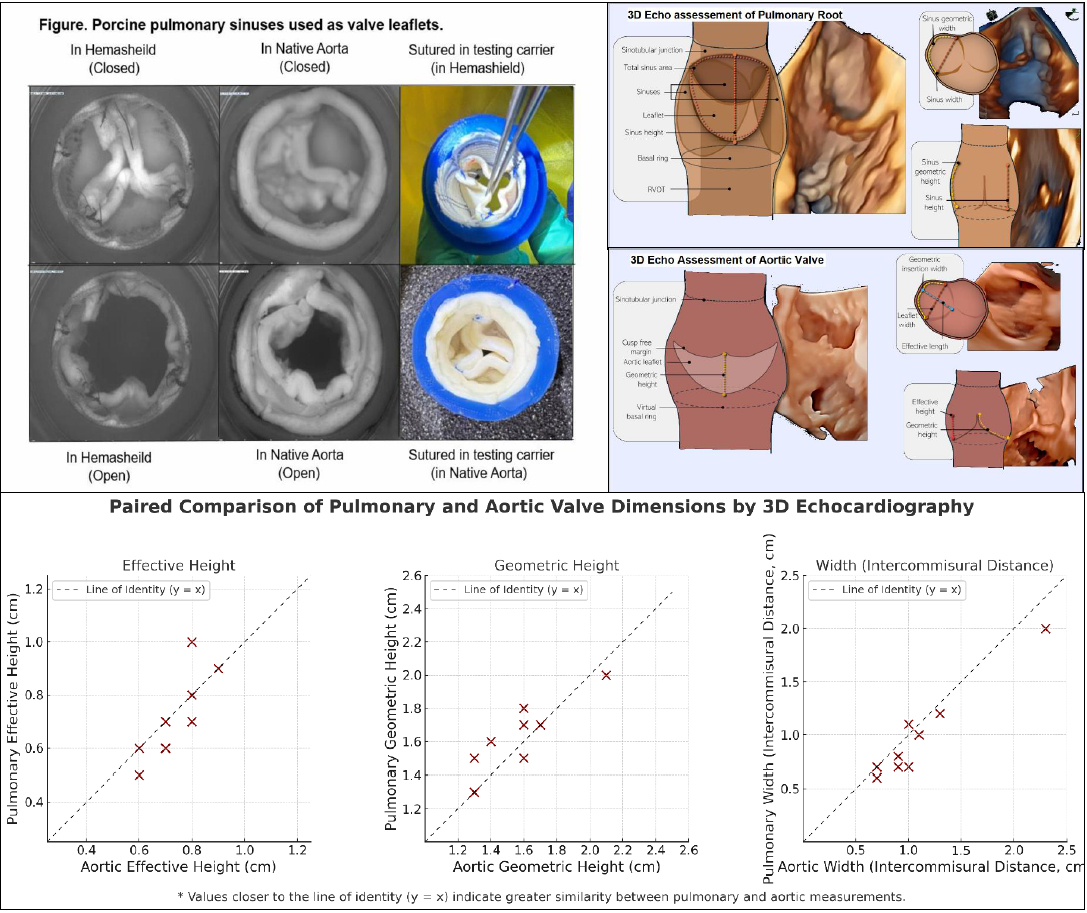
Abstract Body (Do not enter title and authors here): Objectives: We developed and evaluated a novel aortic valve neocuspidization technique using autologous pulmonary sinuses in an ex-vivo porcine model. Human anatomical feasibility was assessed using retrospective 3D-echocardiographic data from children.
Methods: Pulmonary sinuses harvested from porcine hearts were used to construct tri-leaflet valves, within native aortas (n=2, 26-28mm) or a Hemashield conduit (n=1, 26mm). Valves were subjected to hydrodynamic testing at varying cardiac outputs (CO) to simulate physiological aortic conditions. Separately, pulmonary sinus and aortic cusp dimensions were compared in 9 children (3-15y) with structurally normal valves using 3D-echocardiography to confirm anatomical feasibility.
Results: All valves were able to sustain goal CO and MAP (100mmHg). The regurgitation fraction in Hemashield was 9-15% at 5L/min and 6-12% at 7L/min and in aorta, it was 11-21% and 5-15% at 5 and 7L/min, respectively, consistent with non-clinically significant regurgitation. Effective orifice area was 2.44cm2 in Hemashield and 1.05-1.07cm2 in native aortas. Peak pressure was 11-21mmHg (Hemashield) and 49-103mmHg (aorta). On pediatric 3D-echocardiographic analysis, there was a strong to excellent correlation between pulmonary sinus and aortic cusp dimensions: effective height (Correlation coefficient, r=0.83, p=0.006), geometric height (r =0.88, p=0.002), and intercommissural width (r=0.97, p<0.001).
Conclusions: In an ex-vivo model, pulmonary sinuses functioned effectively as aortic neocusps with the expected afterload and CO. Pediatric 3D-echocardiography confirmed anatomical suitability. Given limited options in children, this technique may offer an alternative for aortic valve reconstruction using autologous tissue.
  • Faateh, Muhammad  ( Cincinnati Childrens Hospital , Cincinnati , Ohio , United States )
  • Raees, Muhammad Aanish  ( Cincinnati Childrens Hospital , Cincinnati , Ohio , United States )
  • Ahmed, Hosam  ( Cincinnati Childrens Hospital , Cincinnati , Ohio , United States )
  • Almiqlash, Bushray  ( Cincinnati Childrens Hospital , Cincinnati , Ohio , United States )
  • Villalobos Lizardi, Jose  ( Cincinnati Children's Hospital , Cincinnati , Ohio , United States )
  • Ricci, Marco  ( Cincinnati Childrens Hospital , Cincinnati , Ohio , United States )
  • Ashfaq, Awais  ( Cincinnati Childrens Hospital , Cincinnati , Ohio , United States )
  • Author Disclosures:
    Muhammad Faateh: No Answer | Muhammad Aanish Raees: No Answer | Hosam Ahmed: No Answer | Bushray Almiqlash: DO NOT have relevant financial relationships | Jose Villalobos Lizardi: DO NOT have relevant financial relationships | Marco Ricci: DO NOT have relevant financial relationships | Awais Ashfaq: DO NOT have relevant financial relationships
Meeting Info:

Scientific Sessions 2025

2025

New Orleans, Louisiana

Session Info:

Technologic and Clinical Advances in CHD Care

Sunday, 11/09/2025 , 11:30AM - 12:30PM

Abstract Poster Board Session

More abstracts on this topic:
Air pollutants, road traffic noise, and risk of valvular heart disease: a UK Biobank-based prospective study

Song Yanjun, Lin Zhangyu, Zheng Zhihao, Chen Xinyue, Bian Xiaohui

A Rare Cause of Recurrent Heart Failure Exacerbations After Transcatheter Aortic Valve Replacement: Ventricular Septal Defect and Significant Paravalvular Leak

Medina Jesse, Vincent Louis, Rodriguez Ferreira Esteban, Spence-miller Shanice, Fernandez Joel, Colombo Rosario, Calfa Marian

You have to be authorized to contact abstract author. Please, Login
Not Available