
Logo

American Heart Association

  18
  0


Final ID: MP142

Artificial Intelligence (AI) empowered Fetal Echocardiography - A Meta-Analysis Exploring its Image Processing and Diagnostic Prowess

Abstract Body (Do not enter title and authors here): Artificial Intelligence (AI) models have the potential to revolutionize fetal echocardiography, enhancing image processing and diagnostic capabilities. There is promise in AI's potential to improve the accuracy and efficiency of congenital heart defect detection in utero. There is significant interest towards Machine learning’s enhanced capabilities in automated segmentation of fetal cardiac structures, reducing inter-observer variability, enhancing image quality and early detection of congenital heart diseases (CHD). Deep learning models have exhibited high sensitivity and specificity in identifying various cardiac anomalies. AI-assisted fetal echocardiography has also demonstrated potential in reducing false-positive rates and minimizing unnecessary interventions, improving fetal survival rates. Traditional fetal echocardiogram has been shown to struggle from limitations such as fetal, maternal and equipment factors, which paves the way for advanced AI models to step-in.

This review was conducted in accordance with the “Preferred Reporting Items for Systematic Reviews and Meta-analysis” (PRISMA) guidelines. An extensive search was conducted in all the major medical databases for relevant articles concerning machine learning algorithms and its application in fetal echocardiography. This was followed by a detailed systematic review to derive and analyse the relevant qualitative and quantitative data. The statistical analysis was performed in R-Studio. Pooled accuracy was assessed using the metaprop function. The heterogeneity of the papers was assessed using Higgins' I^2 test.

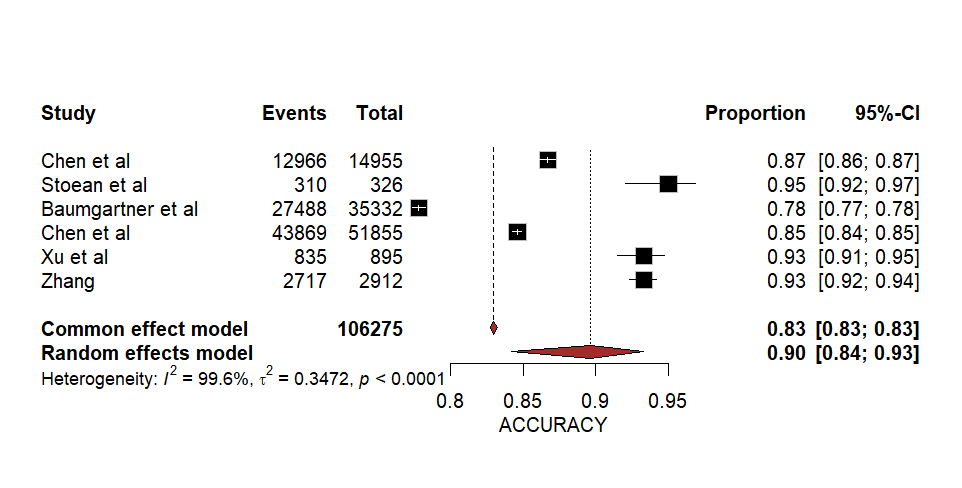
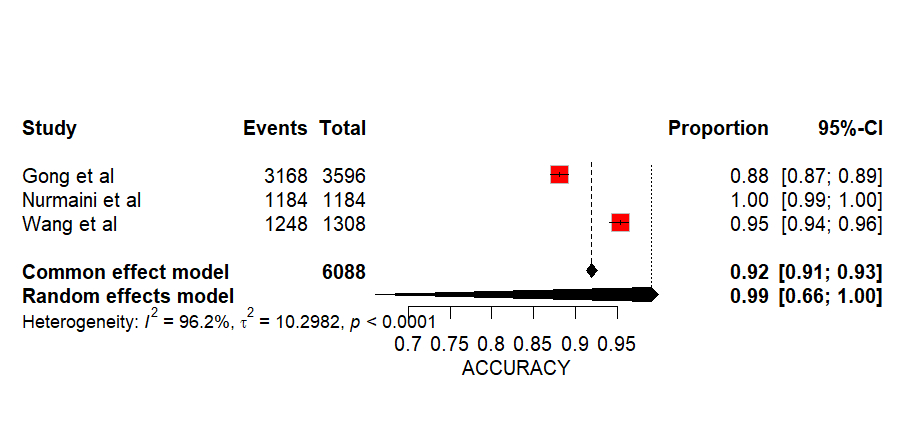
The meta-analysis included a total of 9 papers, amounting to 106275 quantitative elements concerning image processing and 6088 elements on the diagnostic and predictive faculties of the AI algorithms, resulting in a pooled accuracy of 0.90 [0.84;0.93, 95% CI, p<0.0001] and 0.99 [0.66;1.00, 95% CI, p<0.0001] respectively. The highest individual accuracy amounted to 93.32% by Zhang et al for image processing, while an accuracy of 100% by Nurmaini et al was the highest for diagnostic prediction. The random effects model was used to compare and assess the quantitative data. The review also highlighted the individual qualitative characteristics of the AI models.

AI's utility in terms of fortifying fetal echocardiography has been statistically shown to be clinically significant, as evident by its high accuracy. AI's adoption into various clinical aspects has been shown to be promising.
  • Ravisha, Chiraant  ( Bangalore Medical College , Bangalore , India )
  • Gupta, Aryan  ( BMCRI , Bangalore , India )
  • Prasad, Kushal  ( BMCRI , Bangalore , India )
  • Chandramouli Bellur, Vinay  ( Ramiah Medical College , Bangalore , India )
  • Iyer, Vardhini Ganesh  ( BGS Global Institute of Medical Sciences , Bangalore , India )
  • Prasad, Ananya  ( Ramaiah Medical College , Bangalore , India )
  • Bhat, Valleesh  ( BMCRI , Bangalore , India )
  • S, Akhil  ( BMCRI , Bangalore , India )
  • Varma K R, Swaroop Raj  ( Bangalore Medical College and Resea , Bangalore , India )
  • Author Disclosures:
    Chiraant Ravisha: DO NOT have relevant financial relationships | Aryan Gupta: DO NOT have relevant financial relationships | Kushal Prasad: No Answer | Vinay Chandramouli Bellur: DO NOT have relevant financial relationships | Vardhini Ganesh Iyer: No Answer | Ananya Prasad: DO NOT have relevant financial relationships | Valleesh Bhat: No Answer | AKHIL S: No Answer | Swaroop Raj Varma K R: DO NOT have relevant financial relationships
Meeting Info:

Scientific Sessions 2025

2025

New Orleans, Louisiana

Session Info:

Transforming Cardiac Imaging and Risk Assessment Through AI

Saturday, 11/08/2025 , 12:15PM - 01:25PM

Moderated Digital Poster Session

More abstracts on this topic:
A large-scale multi-view deep learning-based assessment of left ventricular ejection fraction in echocardiography

Jing Linyuan, Metser Gil, Mawson Thomas, Tat Emily, Jiang Nona, Duffy Eamon, Hahn Rebecca, Homma Shunichi, Haggerty Christopher, Poterucha Timothy, Elias Pierre, Long Aaron, Vanmaanen David, Rocha Daniel, Hartzel Dustin, Kelsey Christopher, Ruhl Jeffrey, Beecy Ashley, Elnabawi Youssef

Characteristics and outcomes of fetuses with intrauterine ductus arteriosus constriction.

Vijayaraghavan Aparna, Eckersley Luke, Hornberger Lisa, Mcbrien Angela

More abstracts from these authors:
Efficacy of Sodium-Glucose Transport Protein 2 Inhibitors in Prevention Atrial Fibrillation post - Coronary Artery Bypass Graft Surgery: A Systematic Review and Meta-Analysis

M S Vibhav, Prasad Kushal, Chandramouli Bellur Vinay, Prasad Ananya, Oudit Omar, Chandra Mohan Trisha, Magaji Rishikesh R, N S Allama Prabhu, Gupta Aryan

Application of Artificial Intelligence (AI) for Predictive Modelling and Imaging in Cardiac Transplantation - A Systematic Review and Meta-Analysis

Iyer Vardhini Ganesh, Chandra Mohan Trisha, Gupta Aryan, Gupta Era, Prasad Kushal, Kalra Shekhar, Chandramouli Bellur Vinay, Prasad Ananya, Oudit Omar, Magaji Rishikesh R

You have to be authorized to contact abstract author. Please, Login
Not Available