
Logo

American Heart Association

  21
  0


Final ID: MP952

Mechanical Augmentation of the Failing Heart Results in Improved Intraventricular Synchrony Without Blood Contact

Abstract Body (Do not enter title and authors here): Purpose: Direct Mechanical Ventricular Actuation (DMVA) provides both systolic and diastolic augmentation to the failing heart without blood contact. The device uniquely augments diastolic function and results in early cardiac recovery. Previous work has demonstrated DMVA improves intraventricular synchrony in a rabbit heart failure (HF) model. The purpose of this study was to evaluate DMVA’s effect on LV segmental strain and end-systolic geometry.

Methods: Anesthetized canine (n = 9) were instrumented for hemodynamic monitoring. Repeated ventricular fibrillation followed by defibrillation was used for worsening levels of heart failure (HF). Intracardiac echocardiography (ICE) was used to quantify LV longitudinal strain along 49-point LV endocardial tracings. Speckle-tracking software determined peak strain rates and magnitudes in ICE images during baseline (n = 35), DMVA (n = 127), and unsupported HF (n = 127). Diastolic and systolic geometry was assessed by comparing parallel segments on the septal and LV free walls. One-way ANOVA with post-hoc Tukey’s HSD was used to assess statistical differences (p<0.05) for all comparisons.

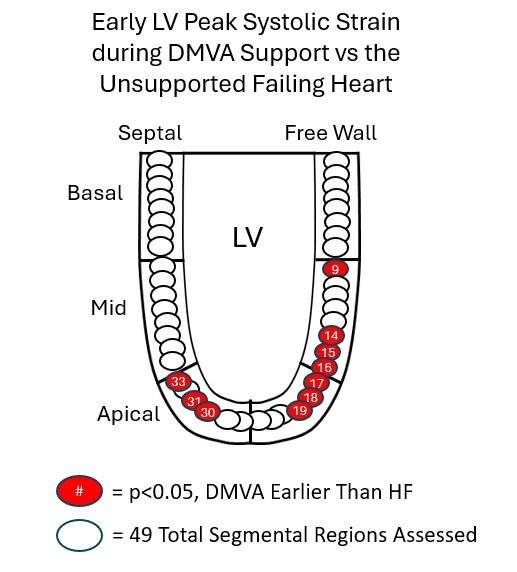
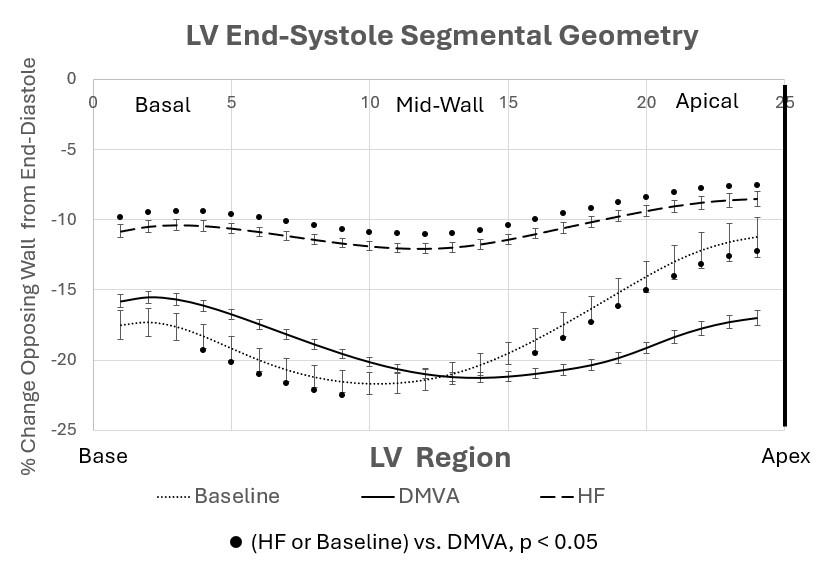
Results: Peak systolic strain occurred significantly earlier in the LV apical segments during DMVA compared to unsupported HF (Figure 1). LV segmental distance between the free wall and septum were significantly reduced in the apical and basal regions compared to unsupported HF (Figure 2).


Conclusion: These results indicate DMVA support results in early peak strain in the apical region with improved LV to septal wall apposition when supporting the failing heart. Notably, DMVA applies physical forces primarily to the mid and basilar regions. This study indicates that DMVA augments more normal myocardial contraction remote from its direct force delivery. The improved systolic LV segmental strain and geometric patterns imply DMVA improves intraventricular synchrony. Improving intraventricular synchrony is the basis for clinically proven biventricular pacing in the treatment of HF. DMVA is proven effective for augmenting diastolic function which likely explains, in part, how it leads to improved cardiac recovery. DMVA's affect on cardiac recovery may also be secondary to normalizing mechanical segmental strain patterns. Future work will be directed toward employing coordination index algorithms to optimize device synchronization. Synchronous support is anticipated to foster optimal intraventricular myocardial synchrony and pump function.
  • Anstadt, Mark  ( LifeBridge Technologies , Dayton , Ohio , United States )
  • Conley, Deborah  ( Miami Valley Heart Lung Surgeons , Dayton , Ohio , United States )
  • Schmitt, Benjamin  ( LifeBridge Technologies, LLC , Fairfield , Ohio , United States )
  • Author Disclosures:
    Mark Anstadt: DO have relevant financial relationships ; Ownership Interest:Lifebridge Technologies LLC:Active (exists now) | Deborah Conley: No Answer | Benjamin Schmitt: No Answer
Meeting Info:

Scientific Sessions 2025

2025

New Orleans, Louisiana

Session Info:

Clinical Decision Making in Pulmonary Hypertension: Navigating the Evolving Landscape

Saturday, 11/08/2025 , 12:15PM - 01:30PM

Moderated Digital Poster Session

More abstracts on this topic:
9-Year Longitudinal Assessment of the 12-lead Electrocardiogram of Volunteer Firefighters

Bae Alexander, Dzikowicz Dillon, Lai Chi-ju, Brunner Wendy, Krupa Nicole, Carey Mary, Tam Wai Cheong, Yu Yichen

Left Atrial Reservoir Phase Duration: A Novel Marker of Diastolic Function and Successful Cardiac Resynchronization Therapy

Hammersboen Lars-egil, Sletten Ole Jakob, Penicka Martin, Donal Erwan, Voigt Jens-uwe, Smiseth Otto, Stugaard Marie, Aalen John, Puvrez Alexis, Larsen Camilla, Remme Espen, Kongsgaard Erik, Duchenne Jurgen, Galli Elena, Khan Faraz

More abstracts from these authors:
You have to be authorized to contact abstract author. Please, Login
Not Available