
Logo

American Heart Association

  25
  0


Final ID: MP1193

Polygenic Risk-Based Detection and Treatment of Subclinical Coronary Atherosclerosis in the PROACT Clinical Trials

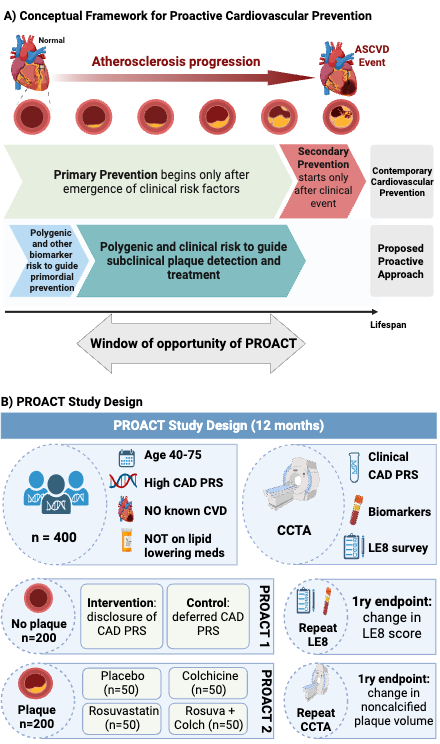
Abstract Body (Do not enter title and authors here): Background: Coronary artery disease polygenic risk scores (CAD PRS) identify individuals at low clinical, but elevated genetic risk who may “fly under the radar” in contemporary practice. The Polygenic-Risk Based Detection of Subclinical Atherosclerosis (PROACT) trials aim to prospectively identify these individuals, quantify subclinical coronary plaque, and slow its progression with pharmacological interventions (Fig 1A).
Methods: Adults aged 40-75 years without cardiovascular disease or lipid-lowering therapy but high CAD PRS undergo cardiovascular health evaluations and coronary computed tomography angiography (CCTA). Participants without plaque are enrolled in PROACT 1, a randomized trial (NCT05819814) evaluating the impact of high genetic risk disclosure vs. standard care on 12-month change in cardiovascular health, measured by the American Heart Association Life’s Essential 8 (LE8) score. Participants with quantifiable plaque are enrolled in PROACT 2, a double-blind, 4-arm randomized trial (NCT05850091) assessing rosuvastatin 20 mg and/or colchicine 0.6 mg vs. placebo on 12 month change in non-calcified plaque volume (Fig 1B).
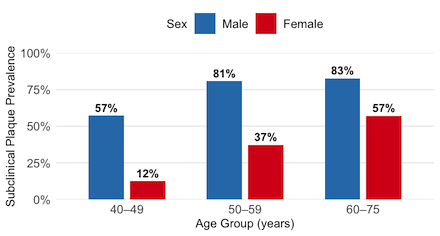
Results: Among 64,092 genotyped Mass General Brigham Biobank participants, 2,495 were eligible and had high CAD PRS despite low clinical risk – median 10-year Pooled Cohort Equations ASCVD risk 3% (IQR 1-8). Recruitment shows high engagement–among 1,314 invited individuals, 283 (21.5%) expressed interest. Analysis of the first 204 participants enrolled by January 31st, 2025 (mean age 55.7±8.6 years; 69% female) show that despite the low clinical risk and better cardiovascular health (mean LE8 73.3±11.5 compared to the US average of ~65), half the participants (102 of 204) had subclinical plaque. Subclinical plaque prevalence was high across sexes and age groups (Fig 2). Conventional clinical risk factors were not significant predictors of plaque in this low-clinical, high-genetic risk group.
Conclusions: Clinical risk-factor based models miss a substantial “silent” population with high genetic risk and subclinical coronary plaque. PROACT demonstrates that (1) these individuals are receptive to genetic-enriched plaque detection and (2) half already have subclinical coronary plaque despite low clinical risk. Ongoing randomized interventions in PROACT 1 and PROACT 2 will determine whether PRS disclosure and pharmacological interventions can improve cardiovascular health and regress subclinical coronary atherosclerosis.
  • Abou-karam, Roukoz  ( Massachusetts General Hospital , Boston , Massachusetts , United States )
  • Ellinor, Patrick  ( Massachusetts General Hospital , Boston , Massachusetts , United States )
  • Foldyna, Borek  ( Massachusetts General Hospital , Boston , Massachusetts , United States )
  • Ghebremichael, Musie  ( Ragon Institute of MGH, MIT, and Harvard , Cambridge , Massachusetts , United States )
  • Atlas, Steven  ( Massachusetts General Hospital , Boston , Massachusetts , United States )
  • Ridker, Paul  ( Brigham and Women's Hospital , Boston , Massachusetts , United States )
  • Lu, Michael  ( Massachusetts General Hospital , Boston , Massachusetts , United States )
  • Fahed, Akl  ( Massachusetts General Hospital , Boston , Massachusetts , United States )
  • Kim, Min Seo  ( Broad Institute of MIT and Harvard , Cambridge , Massachusetts , United States )
  • Cho, So Mi  ( Broad Institute of MIT and Harvard , Cambridge , Massachusetts , United States )
  • Bitar, Fouad  ( Massachusetts General Hospital , Boston , Massachusetts , United States )
  • Gady, Shoshana  ( Massachusetts General Hospital , Boston , Massachusetts , United States )
  • Cheng, Fangzhou  ( Massachusetts General Hospital , Boston , Massachusetts , United States )
  • Thompson, Abigail Grace  ( Massachusetts General Hospital , Boston , Massachusetts , United States )
  • Karlson, Elizabeth  ( Mass General Brigham , Boston , Massachusetts , United States )
  • Natarajan, Pradeep  ( Massachusetts General Hospital , Boston , Massachusetts , United States )
  • Author Disclosures:
    Roukoz Abou-Karam: DO have relevant financial relationships ; Consultant:Goodpath:Active (exists now) | Patrick Ellinor: No Answer | Borek Foldyna: No Answer | Musie Ghebremichael: DO NOT have relevant financial relationships | Steven Atlas: No Answer | Paul Ridker: DO have relevant financial relationships ; Research Funding (PI or named investigator):Kowa, Novartis, Pfizer, NovoNordisk:Active (exists now) ; Advisor:Uppton, Bitteroot Bio, Angiowave, Peter Munk University of Toronto, Leducq Foundation:Active (exists now) ; Consultant:Novartis, Novo Nordisk, Agepha, Ardelyx, Arrowhead, AstraZeneca, CSK Behring, Civi Biopharm, GSK, Eil Lilly, New Amsterdam, CardioTherapeutics, Caristo, Tourmaline Bio:Active (exists now) | Michael Lu: No Answer | Akl Fahed: DO have relevant financial relationships ; Ownership Interest:Goodpath:Active (exists now) ; Ownership Interest:Avigena:Active (exists now) ; Consultant:Aditum Bio:Active (exists now) ; Consultant:HeartFlow:Past (completed) ; Consultant:Arboretum Health:Active (exists now) ; Consultant:MyOme:Active (exists now) | Min Seo Kim: No Answer | So Mi Cho: DO NOT have relevant financial relationships | Fouad Bitar: DO NOT have relevant financial relationships | Shoshana Gady: No Answer | Fangzhou Cheng: DO NOT have relevant financial relationships | Abigail Grace Thompson: DO NOT have relevant financial relationships | Elizabeth Karlson: DO NOT have relevant financial relationships | Pradeep Natarajan: DO have relevant financial relationships ; Researcher:Amgen, Genentech / Roche:Active (exists now) ; Other (please indicate in the box next to the company name):Vertex Pharmaceuticals (spousal employment):Active (exists now) ; Ownership Interest:Bolt, Candela, Mercury, MyOme, Parameter Health, Preciseli, TenSixteen Bio:Active (exists now) ; Consultant:Allelica, CRISPR Therapeutics, Genentech/Roche, HeartFlow, Magnet Biomedicine:Past (completed) ; Consultant:AstraZeneca, Blackstone Life Sciences, Bristol Myers Squibb, Eli Lilly & Co, Esperion Therapeutics, Foresite Capital, Foresite Labs, GV, Merck, Novartis, Novo Nordisk, TenSixteen Bio, Tourmaline Bio:Active (exists now) ; Researcher:Allelica, Novartis:Past (completed)
Meeting Info:

Scientific Sessions 2025

2025

New Orleans, Louisiana

Session Info:

Multi-Omic Insights into Coronary Artery Disease 1

Saturday, 11/08/2025 , 03:15PM - 04:15PM

Moderated Digital Poster Session

More abstracts on this topic:
A Delayed Diagnosis of Anti-HMG-CoA Reductase Immune-Mediated Necrotizing Myopathy

Jadhav Reshma, Shekar Arush, Westenhaver Zack, Skandhan Amith

4D Flow MRI Allows for Enhanced Characterization of Aortic Regurgitation

Avgousti Harris, Johnson Ethan, Berhane Haben, Thomas James, Allen Bradley, Markl Michael, Appadurai Vinesh

More abstracts from these authors:
Age-Varying Implications of Recalibration of Cardiovascular Disease Risk Prediction in a New England-Based Healthcare System

Cho So Mi, Natarajan Pradeep, Rivera Rachel, Koyama Satoshi, Kim Min Seo, Honigberg Michael, Bhattacharya Romit, Paruchuri Kaavya, Allen Norrina, Hornsby Whitney

Diagnostic Yield and Testing Characteristics of an Invasive Coronary Function Testing Program

Bitar Fouad, Abou-karam Roukoz, Cheng Fangzhou, Gady Shoshana, Sakhuja Rahul, Jaffer Farouc, Fahed Akl

You have to be authorized to contact abstract author. Please, Login
Not Available