
Logo

American Heart Association

  12
  0


Final ID: MP1627

The National and Regional Impacts of Cold and Hot Ambient Temperature on Heart Failure Hospitalizations Among Older Adults in the United States

Abstract Body (Do not enter title and authors here): Introduction
Numerous studies have shown a U-shaped relationship between ambient temperature and cardiovascular mortality. However, few studies examined a temperature- heart failure (HF) hospitalization relationship or its regional variations in the United States (US).

Research Question
How does ambient temperature impact HF hospitalizations in older US adults? Does the temperature-HF relationship vary by region?

Methods
We conducted a place and time-stratified case-crossover study of older adults (age ≥ 66 years) hospitalized for HF between 2007-2022 using 20% national Medicare data. Daily mean temperatures (Tmean) were identified from the Parameter-elevation Relationships on Independent Slopes Model linked through residential zip code. HF cases were defined as hospitalization with a primary HF diagnosis. Up to 5 controls were selected as same day of week, month, and year as cases. We used conditional logit for distributed lag non-linear models in overall population and subgroups by region (Northeast, West, South, Midwest). We used 14-day lag for the primary analysis, which was varied from 2-28 days.

Results
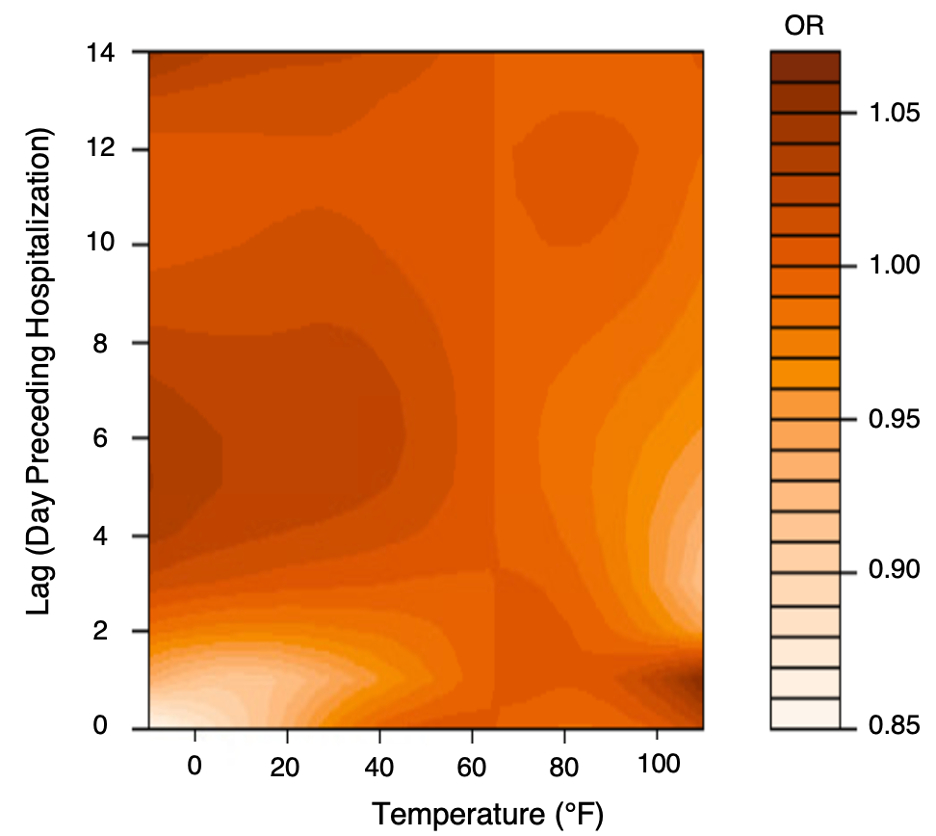
Among 1,517,756 HF hospitalization cases, the effect of cold Tmean on HF hospitalizations is delayed and peaked ~4-8 days after exposure; the risk ratio (RR) of temperatures < 50°F vs. 65°F ranged from 1.01-1.07 (Figure 1). The cumulative risk of colder Tmean were only significant in longer lag models (24°F vs. 65°F –lag 7: RR 0.98 [0.96–1.00]; lag 14: RR 1.06 [1.03–1.08]; lag 21: RR 1.1[1.07–1.13]). Overall, heat had minimum and non-significant effects that were near immediate (lag 0-2) (Figure 1).

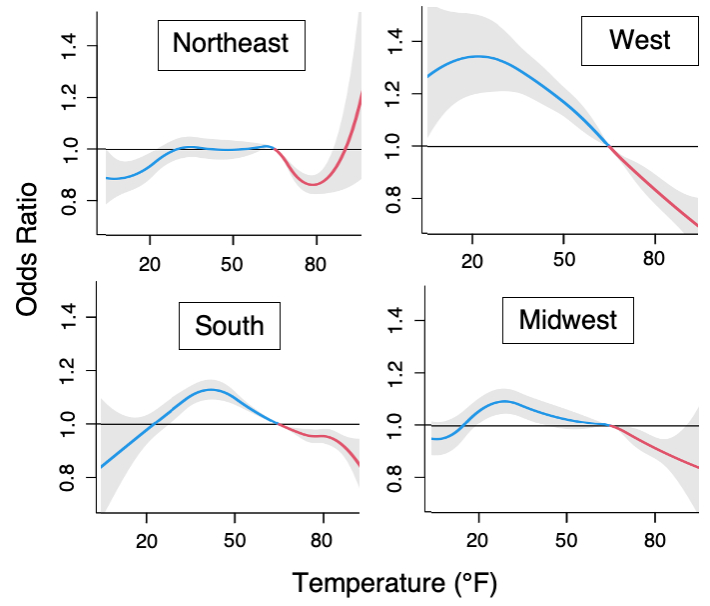
In regional analyses (Figure 2), the magnitude of colder Tmean effect varied (23°F vs. 65°F – Northeast: RR 0.96[0.92–1.01]; West: RR 1.34[1.21–1.50]; South: RR 1.01[0.96–1.06]; Midwest: RR 1.08[1.03–1.13]) The effect of high Tmean also varied; heat had non-significant increase in HF hospitalization in the Northeast region only with max RR of 1.42 (100°F vs. 65°F).

Conclusion
Colder Tmean was associated with increased HF hospitalizations. The elevated risk was apparent approximately 4 days after exposure; the magnitude varied by region. Extreme heat’s association with HF hospitalization was indicated in Northeast region and confined within 0-2 days after exposure. The regional variation may reflect acclimatization to regional climate, available local resources, and varied behavioral responses to temperature.
  • Kuhrt, Nathaniel  ( Thomas Jefferson University , Philadelphia , Pennsylvania , United States )
  • Parthasarathi, Ashwaghosha  ( Rutgers University , Princeton , New Jersey , United States )
  • Wo, Emily  ( Rutgers University , Princeton , New Jersey , United States )
  • Bisno, Daniel  ( University of Pennsylvania , Philadelphia , Pennsylvania , United States )
  • Rua, Melanie  ( Rutgers University , Princeton , New Jersey , United States )
  • Joseph, Susan  ( Thomas Jefferson University , Philadelphia , Pennsylvania , United States )
  • Gandhi, Poonam  ( Rutgers University , Princeton , New Jersey , United States )
  • Setoguchi, Soko  ( Rutgers University , Princeton , New Jersey , United States )
  • Author Disclosures:
    Nathaniel Kuhrt: DO NOT have relevant financial relationships | Ashwaghosha Parthasarathi: DO NOT have relevant financial relationships | Emily Wo: DO NOT have relevant financial relationships | Daniel Bisno: DO NOT have relevant financial relationships | Melanie Rua: DO have relevant financial relationships ; Researcher:Funding received from Pfizer Japan through my institution for unrelated work. :Active (exists now) ; Researcher:Funding received from Pfizer Inc. through my institution for unrelated work. :Past (completed) ; Researcher:Funding received from Daiichi Sankyo through my institution for unrelated work. :Active (exists now) | Susan Joseph: No Answer | Poonam Gandhi: DO NOT have relevant financial relationships | Soko Setoguchi: DO have relevant financial relationships ; Research Funding (PI or named investigator):Daiichi Sankyo:Active (exists now) ; Consultant:Regeneron:Past (completed) ; Consultant:BMS:Active (exists now) ; Consultant:Merck :Past (completed) ; Consultant:Pfizer Japan:Active (exists now) ; Research Funding (PI or named investigator):Pfizer Inc:Past (completed)
Meeting Info:

Scientific Sessions 2025

2025

New Orleans, Louisiana

Session Info:

Drivers of Heart Failure: Environmental and Behavioral Factors

Sunday, 11/09/2025 , 09:15AM - 10:30AM

Moderated Digital Poster Session

More abstracts on this topic:
A Contemporary Machine Learning-Based Risk Stratification for Mortality and Hospitalization in Heart Failure with Preserved Ejection Fraction Using Multimodal Real-World Data

Fudim Marat, Weerts Jerremy, Patel Manesh, Balu Suresh, Hintze Bradley, Torres Francisco, Micsinai Balan Mariann, Rigolli Marzia, Kessler Paul, Touzot Maxime, Lund Lars, Van Empel Vanessa, Pradhan Aruna, Butler Javed, Zehnder Tobias, Sauty Benoit, Esposito Christian, Balazard Félix, Mayer Imke, Hallal Mohammad, Loiseau Nicolas

A Real-world Evaluation of Longitudinal Healthcare Expenses in a Health System Registry of Type-2 Diabetes Mellitus and Cardiovascular Disease Enabled by the 21st Century Cures Act

Dhingra Lovedeep, Aminorroaya Arya, Pedroso Aline, Rajpura Jigar, Mehanna Sherif, Tonnu-mihara Ivy, Khera Rohan

You have to be authorized to contact abstract author. Please, Login
Not Available