Diagnostic Performance of AI-Assisted Coronary CT Angiography: A Systematic Review and Meta-Analysis
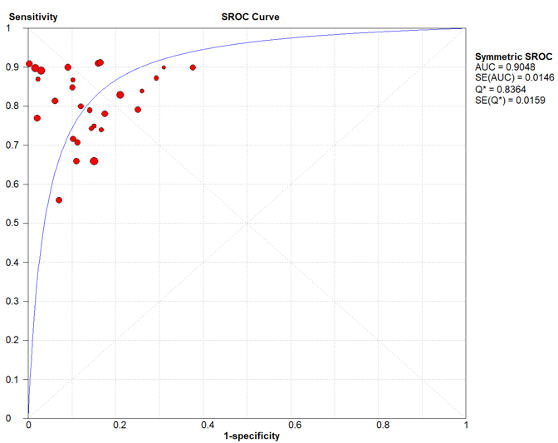
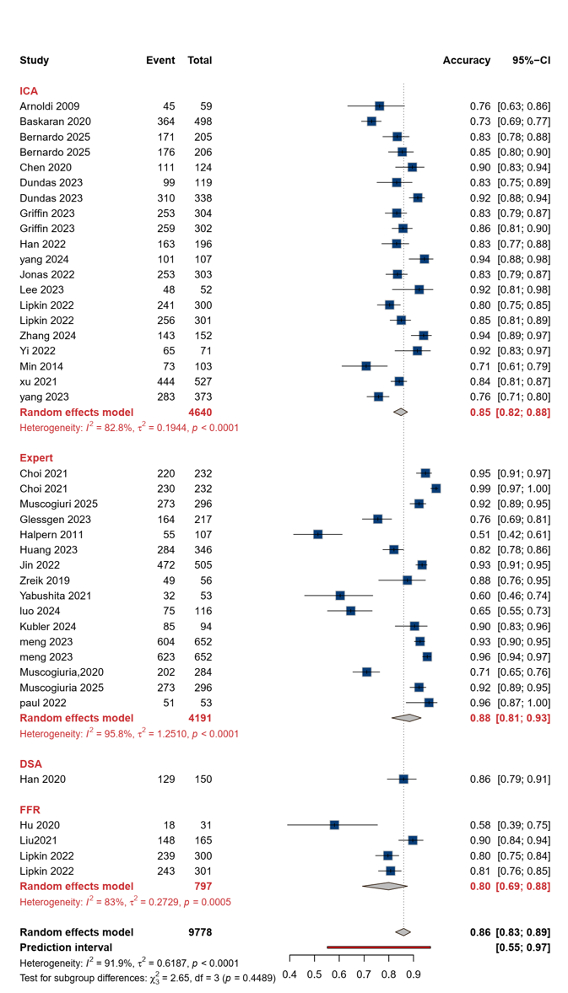
Abstract Body (Do not enter title and authors here): Background: Coronary computed tomography angiography (CCTA) is vital for diagnosing ischemic heart disease, yet its accuracy is affected by varying reader expertise. Artificial Intelligence (AI)-driven automated stenosis assessment offers promise for enhancing diagnostic consistency. Aim: We aim to evaluate an AI-CCTA assessment against invasive coronary angiography, invasive FFR, and expert readings. Methods: We performed a comprehensive search in Web of Science, Scopus, PubMed, Cochrane Library, and EMBASE from inception until March 2025. Two independent reviewers screened articles and extracted data on study design, patient demographics, AI methodology, stenosis thresholds, and outcomes. For statistical analysis, we constructed summary receiver operating characteristic (SROC) curves and used a bivariate random-effects model to derive pooled sensitivity, specificity, diagnostic odds ratios (DOR), and area under the curve (AUC). Forest plots were generated to visualize these metrics. Results: Our meta-analysis included 34 studies with 10,067 patients. AI-based CCTA demonstrated excellent diagnostic performance with an AUC of 0.932 for per-patient analysis. The pooled per-patient sensitivity was 0.89 (95% CI: 0.87–0.91) and specificity was 0.80 (95% CI: 0.74–0.86), with a DOR of 37.07 (95% CI: 24.57–55.92). AI validated against expert readers achieved the highest accuracy (0.94, 95% CI: 0.87-0.98). The >70% stenosis threshold demonstrated superior performance (accuracy: 0.89, specificity: 0.96) compared to the >50% threshold (accuracy: 0.86, specificity: 0.87). Per-vessel analysis showed comparable results with an AUC of 0.905. Conclusion: Our meta-analysis confirms that AI-assisted coronary CT angiography delivers high diagnostic performance for coronary stenosis detection, with strong AUC values, high sensitivity and specificity, and robust diagnostic odds ratios across both per-patient and per-vessel assessments.
Hafez, Abdelrahman
(
Cardiology Department, Mayo Clinic
, Phoenix , Arizona , United States )
Sobhy, Ahmed
(
Faculty of medicine, Kafr El-sheikh university
, Kafr elsheikh , Egypt )
Ashour, Mennatullah
(
College of Human Medicine, Benha University, Benha, Egypt
, Benha , Egypt )
Aiash, Karim
(
Jamesville-DeWitt High School, Syracuse, New York, USA
, NY , New York , United States )
Aldemerdash, Abdulrahman
(
University of Alexandria, Alexandria
, Alexandria , Alexandria , Egypt )
Elissawy, Amir
(
Touro College of Osteopathic Medicine
, NY , New York , United States )
Zahrawi, Khaled
(
Misr University for Science and Technology (MUST), Giza, Egypt
, Giza , Egypt )
Besheya, Tawfik
(
Faculty of Medicine, University of Tripoli, Tripoli, Libya
, Tripoli , Libya )
Riccelli, Richard
(
Christian Brothers Academy, Syracuse, New York, USA
, NY , New York , United States )
Elaraby, Ahmed
(
Al-Azhar University
, Cairo , Egypt )
Arora, Ayaan
(
Christian Brothers Academy, Syracuse, New York
, NY , New York , United States )
Almahmoud, Dina
(
Faculty of Medicine, Jordan University of Science and Technology, Irbid
, Irbid , Jordan )
Jishu, Jessan
(
Candidate at Tulane University School of Medicine
, New orleans , Louisiana , United States )
Toraih, Eman
(
Department of Cardiovascular Perfusion, Interprofessional Research, College of Health Professions, SUNY Upstate Medical University
, NY , New York , United States )
Aiash, Hani
(
SUNY Upstate Medical University, Syracuse, NY, USA
, NY , New York , United States )
Author Disclosures:
Abdelrahman Hafez:DO NOT have relevant financial relationships
| Richard Riccelli:No Answer
| Ahmed Elaraby:DO NOT have relevant financial relationships
| Ayaan Arora:No Answer
| dina almahmoud:No Answer
| Jessan Jishu:DO NOT have relevant financial relationships
| Eman Toraih:No Answer
| Hani Aiash:No Answer
| Ahmed Sobhy:DO NOT have relevant financial relationships
| Mennatullah Ashour:No Answer
| Karim Aiash:No Answer
| Abdulrahman Aldemerdash:DO NOT have relevant financial relationships
| Amro Mahmoud Radi:No Answer
| Amir Elissawy:No Answer
| khaled zahrawi:DO NOT have relevant financial relationships
| Tawfik Besheya:No Answer