
Logo

American Heart Association

  20
  0


Final ID: MP1766

Impact of Timing of Repeat Catheter Ablation on Long-Term Atrial Fibrillation Recurrence: Insights from the ITHACA Database

Abstract Body (Do not enter title and authors here):
Background: Recurrent atrial fibrillation (AF) following catheter ablation remains a significant clinical challenge, affecting 20–40% of patients. While current guidelines recommend a 3-month “blanking period” before considering reintervention, the optimal timing for repeat ablation remains undefined.

Objectives: To compare long term rates of AF recurrence among patients undergoing repeat ablation based on timing of re-intervention.

Methods:
We conducted a multicenter retrospective observational study using the ITHACA database, including patients who experienced AF after an initial ablation and underwent a repeat procedure. The primary outcome was a composite of AF recurrence defined as clinical AF recurrence, anti-arrhythmic use, cardioversion post-blanking period or a third ablation. Time-to-repeat ablation between patients who experience recurrence post second ablation was compared to patients who did not have a second recurrence using a two-sample t-test. A decision tree classifier was used to identify time intervals between index and repeat atrial fibrillation (AF) ablation that best predicts risk of recurrence. The Gini index guided the tree's construction, optimizing the separation of patients into recurrence and non-recurrence groups based on the time interval.

Results:
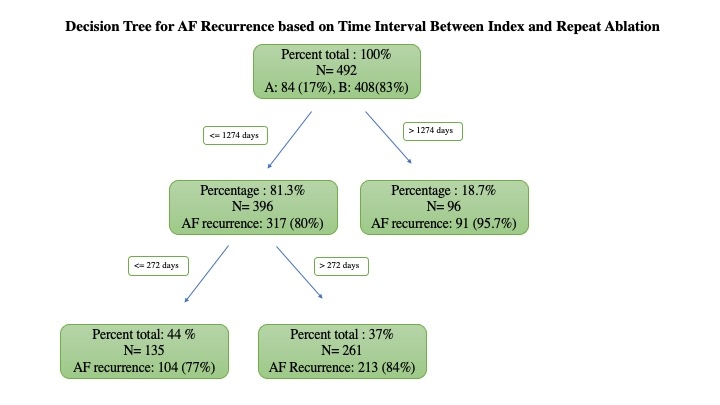
Of 3129 patients, 616 (19.6%) underwent repeat ablation. Among them, 105 (17%) had no AF recurrence, while 511 (83%) did. Median time to repeat ablation was 576 days (IQR 744 days). Patients who remained AF-free had a significantly shorter mean interval between ablations (656 vs. 833 days; p < 0.0001). The decision tree identified three distinct timing intervals differentiating our cohort into patients who were more or less likely to have AF recurrence post repeat ablation. Among patients with repeat ablation >1274 days after the index, 95% had recurrence. For those with repeat ablation between 273–1274 days, 84% had recurrence. Patients undergoing repeat ablation within 272 days of index ablation had the lowest rate of recurrence (77%).
Conclusion:
Patients who underwent repeat ablation after a shorter interval between index and repeat intervention had lower rates of long-term AF recurrence. Our decision tree model identified reintervention within <272 days post index as a potential marker of improved long-term outcomes.
  • Wang, Cassie  ( Northwell Health , Great Neck , New York , United States )
  • Lin, Kuan-yu  ( Northwell Health , Manhasset , New York , United States )
  • Huda, Senya  ( Northwell Health , Great Neck , New York , United States )
  • Patsiou, Vasiliki  ( The Feinstein Institutes , Glen Cove , New York , United States )
  • Varrias, Dimitrios  ( Northwell Health , Great Neck , New York , United States )
  • Coleman, Kristie  ( Northwell Health , New York , New York , United States )
  • Epstein, Laurence  ( Northwell Health , Manhasset , New York , United States )
  • Mountantonakis, Stavros  ( Northwell Health , New York , New York , United States )
  • Author Disclosures:
    Cassie Wang: DO NOT have relevant financial relationships | Kuan-Yu Lin: DO NOT have relevant financial relationships | Senya Huda: DO NOT have relevant financial relationships | Vasiliki Patsiou: DO NOT have relevant financial relationships | Dimitrios Varrias: No Answer | Kristie Coleman: DO NOT have relevant financial relationships | Laurence Epstein: DO have relevant financial relationships ; Consultant:Medtronic:Active (exists now) ; Consultant:Philips:Active (exists now) ; Speaker:Medtronic:Active (exists now) | Stavros Mountantonakis: DO have relevant financial relationships ; Researcher:Medtronic:Active (exists now) ; Speaker:Zoll :Active (exists now) ; Researcher:Abbott:Active (exists now) ; Researcher:Biotronik:Active (exists now) ; Researcher:CVRx:Active (exists now) ; Speaker:Biosense Webster:Active (exists now)
Meeting Info:

Scientific Sessions 2025

2025

New Orleans, Louisiana

Session Info:

New Advances for Earlier Detection and Treatment of AF in Special Populations

Sunday, 11/09/2025 , 09:15AM - 10:25AM

Moderated Digital Poster Session

More abstracts on this topic:
A Machine Learning-Derived Socio-Environmental Risk Score More Accurately Predicts Cardiovascular Events and Better Addresses Health Inequities than Social Deprivation Index

Chen Zhuo, Nasir Khurram, Al-kindi Sadeer, Rajagopalan Sanjay, Ponnana Sai Rahul, Dazard Jean-eudes, Zhang Tong, Dong Weichuan, Okyere Robert, Sirasapalli Santosh, Deo Salil, Khraishah Haitham

A novel deep learning framework identified associated genes and Interpretable deep learning translation of GWAS findings for drug repurposing in Atrial Fibrillation

Tonegawa-kuji Reina, Xu Jielin, Guntupalli Suman, Barnard John, Chung Mina, Cheng Feixiong

More abstracts from these authors:
Incidence of Stroke in Patients with AF and history of Catheter Ablation

Leavitt Jonas, Gasparis Christopher, Coleman Kristie, Zafeiropoulos Stefanos, Zimmer Ari, Wolf Elliot, Varrias Dimitrios, Epstein Laurence, Mountantonakis Stavros

All-cause mortality for Patients with Preserved Ejection Fraction Heart Failure stratified by B-blocker Therapy and Presence of Permanent Pacemaker.

Leavitt Jonas, Cunn Gregory, Coleman Kristie, Ahmad Sana, Bekiaridou Alexandra, Gasparis Christopher, Fishbein Joanna, Mountantonakis Stavros

You have to be authorized to contact abstract author. Please, Login
Not Available