
Logo

American Heart Association

  15
  0


Final ID: Su4098

Association Between Novel Arterial Wall Atherogenesis Markers With Incident Myocardial Infarction: Observations From The Dallas Heart Study

Abstract Body (Do not enter title and authors here): Background: Although traditional risk factors and chronic inflammation are drivers of coronary artery disease (CAD), risk factors and circulating inflammation markers do not fully capture those at risk for myocardial infarction (MI). This is likely due to their non-specific nature and inability to accurately capture atherogenesis potential at the arterial wall. To address these gaps, we developed an ex vivo arterial wall model that can determine atherogenesis potential testing a person’s plasma in assays that directly reflect key early steps of atherosclerosis. In this study, we aimed to demonstrate clinical relevance of these arterial wall markers with incident MI.
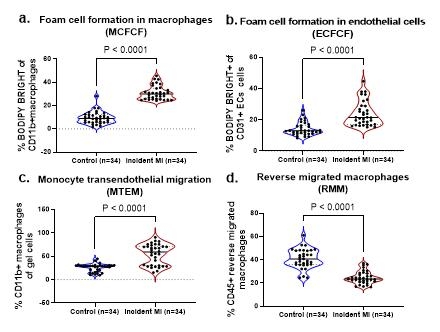
Method: In a nested case-control study, 34 incident myocardial infarction (MI) cases and 34 controls (matched for age, sex, and race/ethnicity) were selected from the Dallas Heart Study (a community-based cohort, >3,000 participants without prevalent CAD at baseline). Using stored plasma from participants at baseline, single-cell flow cytometry, and standardized peripheral blood mononuclear cells (pBMCs), atherogenesis phenotypes were assessed by 1) monocyte subset profile; 2) % monocyte transendothelial migration (MTEM) and % reverse migration of macrophages (RMM) using TNF-alpha stimulated endothelial cells and pBMCs in collagen gels over 48 hours; and 3) % foam cell formation in endothelial cells (ECFCF), and macrophages (MCFCF) using BODIPY cholesterol.
Results: Mean age was 58 years (49% women, 66% Black, and 9% Hispanic). We found lower classical monocytes (% CD14+CD16-: 7.7 vs 9.5; p=0.018, higher pro-inflammatory monocytes (% CD14dimCD16+: 8.9 vs 2.6; % CD14++CD16+: 5.7 vs 1.2; p<0.0001), higher foam cell formation (% MCFCF: 30.1 vs 9.0; % ECFCF: 21.5 vs 12.9; p<0.0001) and higher MTEM (59.5% vs 28.8%; p<0.0001) in incident MI cases vs controls. Further, RMM (23.4% vs 40.7%; p<0.0001) was reduced in incident MI cases vs controls. Our findings suggest these inflammatory parameters of atherogenesis are accurate MI risk predictors.
Conclusion: Our study demonstrated that arterial wall markers of atherogenesis measured at baseline when disease-free are accurate predictors of incident MI risk. These arterial wall markers may serve as ideal candidates to accurately assess risk, monitor therapy, and test novel therapeutic agents to lower the burden of coronary artery disease. These findings require external validation and assessment in response to therapies to determine clinical potential.
  • Gangwar, Anamika  ( UT Southwestern Medical Center , Dallas , Texas , United States )
  • Fotooh Abadi, Leila  ( UTsouthwestern Medical Center , Dallas , Texas , United States )
  • Saldanha, Suzanne  ( UT Southwestern Medical Center , Dallas , Texas , United States )
  • Kelesidis, Theodoros  ( UT Southwestern Medical Center , Dallas , Texas , United States )
  • Rohatgi, Anand  ( UT Southwestern Medical Center , Dallas , Texas , United States )
  • Author Disclosures:
    Anamika Gangwar: DO NOT have relevant financial relationships | Leila Fotooh Abadi: DO NOT have relevant financial relationships | Suzanne Saldanha: No Answer | Theodoros Kelesidis: DO NOT have relevant financial relationships | Anand Rohatgi: DO have relevant financial relationships ; Consultant:Raydel:Past (completed) ; Consultant:JP Morgan:Past (completed) ; Consultant:Johnson and Johnson:Past (completed) ; Other (please indicate in the box next to the company name):LabCorp:Active (exists now) ; Other (please indicate in the box next to the company name):Quest:Active (exists now) ; Research Funding (PI or named investigator):CSL Behring:Past (completed)
Meeting Info:

Scientific Sessions 2025

2025

New Orleans, Louisiana

Session Info:

Emerging Mechanisms in Heart Disease and Obesity

Sunday, 11/09/2025 , 11:30AM - 12:30PM

Abstract Poster Board Session

More abstracts on this topic:
A Loss of Function Polymorphism in the Propeptide of Lysyl Oxidase Exacerbates Atherosclerosis

Jung In-hyuk, Amrute Junedh, Luna Sophia, Wagoner Ryan, Lee Paul, Burks Kendall, Holloway Karyn, Alisio Arturo, Stitziel Nathan

9p21.3 variants drive coronary calcification by suppressing statherin expression

Soheili Fariborz, Almontashiri Naif, Heydarikhorneh Niloufar, Vilmundarson Ragnar, Chen Hsiao-huei, Stewart Alexandre

More abstracts from these authors:
Apolipoprotein A-I Proteoforms, Cardiometabolic Status, and Coronary Heart Disease: Insights from the Dallas Heart Study

Gangwar Anamika, Des Soye Benjamin, Saldanha Suzanne, Jaiswal Shailesh, Patel Parthvi Bharatkumar, Shah Amil, Pandey Ambarish, Wilkins John, Rohatgi Anand

Apolipoprotein A-I Proteoforms in Large HDL are Associated with Incident Myocardial Infarction: Observations from Dallas Heart Study

Gangwar Anamika, Des Soye Benjamin, Saldanha Suzanne, Jaiswal Shailesh, Melchior John, Mcdermott Jason, Wilkins John, Rohatgi Anand

You have to be authorized to contact abstract author. Please, Login
Not Available