The Frequency of False Positive Telemetry Alarms for Ventricular Arrhythmias in the Intensive Care Settings: Implications on Healthcare Resource Utilization
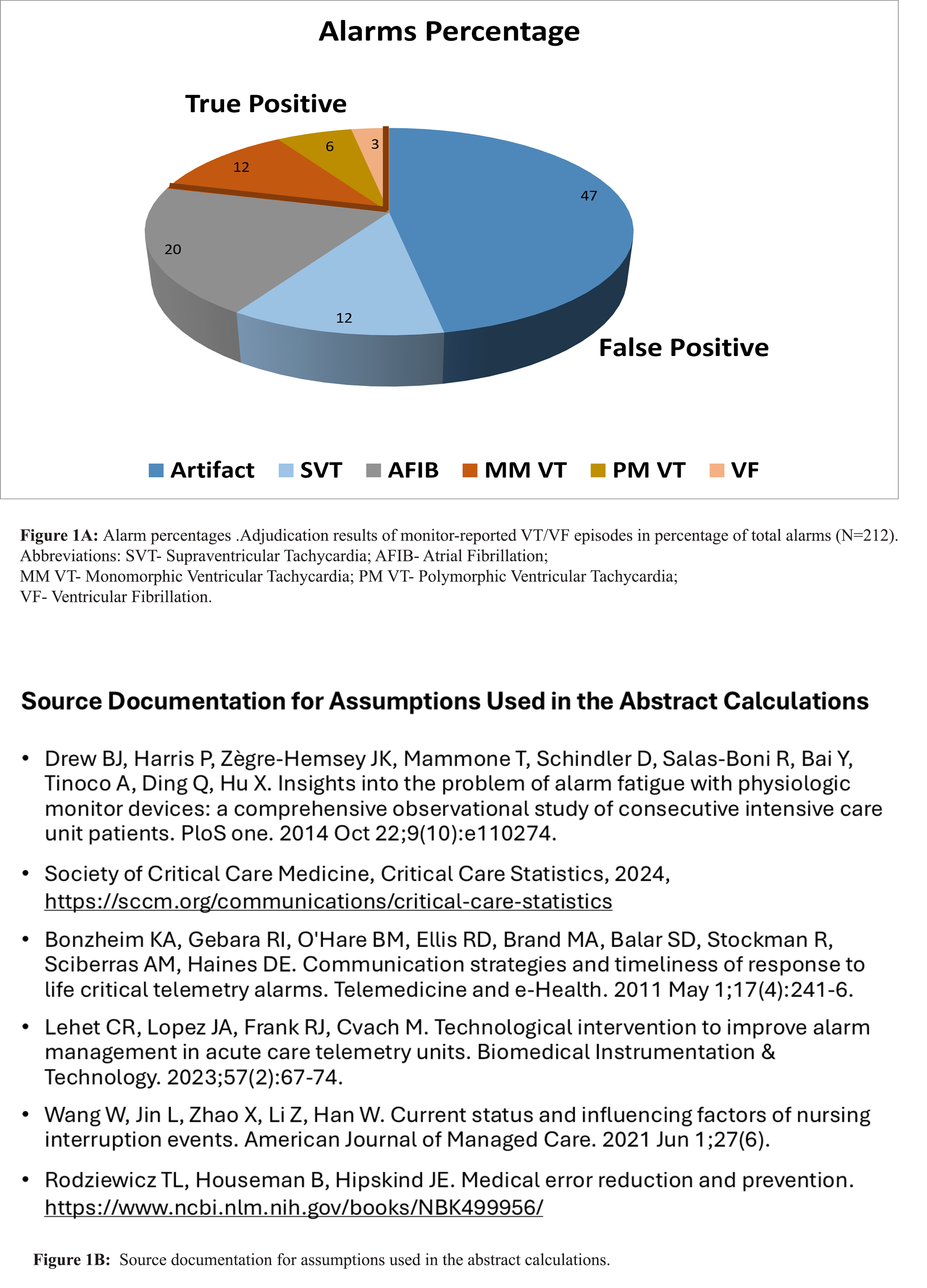
Abstract Body (Do not enter title and authors here): Background The performance profile of commercial telemetry systems used clinically to detect ventricular tachycardia (VT) or ventricular fibrillation (VF) includes an elevated rate of false-positive and false-negative results. These detection errors lead to unnecessary interruption in clinical care and present excess work burden. However, systematically collected data on resources utilization associated with inappropriate VT/VF alarms from bedside monitors are lacking. Methodology. We analyzed retrospectively VT/VF alarms generated by the GE Marquett telemetry system (General Electric, Fairfield, CT) in cardiac intensive care units at the University of Maryland Medical Center (Baltimore, MD) between June-November, 2024. The reported VT/VF alarms were expert adjudicated to establish true-positive from false-positive VT/VF alarms. Results. From N=212 patient monitor-reported VT/VF alarms, N=45 (21%) were true positive and N=167 (79%) were false positive. Among the true positive group, N=26, N=12, and N=7 were monomorphic VT (12%), polymorphic VT (6%), and VF (3%), respectively. Among the false positive group, the most common alternative classifications were artifact (47%), atrial fibrillation (20%), and supraventricular tachycardia (12%) (Figure 1A). Our preliminary analysis indicated that the daily U.S. intensive care unit census is approximately N=112,300 patients (Figure 1B). Based on our analysis, we estimate ~3.7 VT/VF alarms in this clinical setting per 24h, corresponding to N=328,455 unnecessary daily VT/VF alarm checks by clinical staff accounting for 999,120 working hours per year nationally. This work burden, in turn, accounts for 520 nursing positions at a cumulative cost of 52 million US$ each year (based on a standard 40 hr work week and $100,000 median annual salary). Conclusion. The elevated false positive rate of current clinical telemetry systems presents a significant clinical challenge to clinical practice by virtue of unnecessary resources utilization. These data suggest that optimized VT/VF detection methods are needed to improve cardiovascular clinical care models that emphasize efficiency and safety.
Khan, Ubaid
(
University of Maryland
, Baltimore , Maryland , United States )
Yang, Shiming
(
University of Maryland
, Baltimore , Maryland , United States )
Hu, Peter
(
University of Maryland
, Baltimore , Maryland , United States )
Zafari, Zafar
(
University of Maryland
, Baltimore , Maryland , United States )
Kong, Xiangxiang
(
University of Maryland
, Baltimore , Maryland , United States )
Burdette, Bradford
(
University of Maryland
, Baltimore , Maryland , United States )
Maron, Brad
(
University of Maryland
, Baltimore , Maryland , United States )
Dickfeld, Timm
(
University of Maryland
, Baltimore , Maryland , United States )
Author Disclosures:
Ubaid Khan:DO NOT have relevant financial relationships
| Shiming Yang:No Answer
| Peter Hu:DO NOT have relevant financial relationships
| Zafar Zafari:No Answer
| Xiangxiang Kong:DO NOT have relevant financial relationships
| Bradford Burdette:No Answer
| Brad Maron:DO NOT have relevant financial relationships
| Timm Dickfeld:No Answer