Socioeconomic Disparities in Acute Ischemic Stroke Care Among Atrial Fibrillation Patients
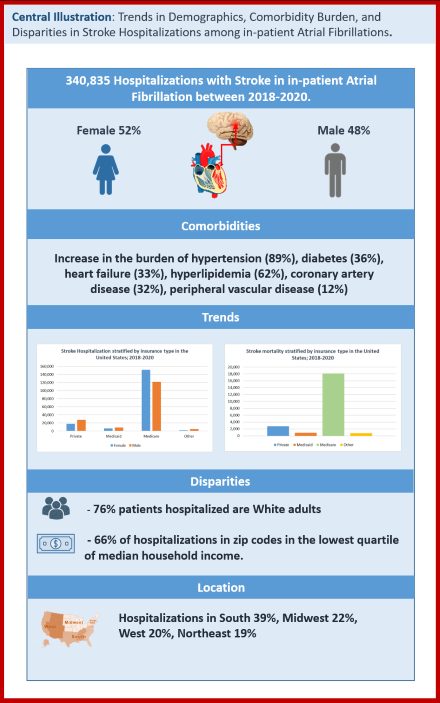
Abstract Body (Do not enter title and authors here): Background: Atrial fibrillation (AF) is a common comorbidity in the U.S. and significantly contributes to the incidence of acute ischemic strokes. This study examines the impact of household income on management and outcomes of Acute ischemic stroke in patients with AF. ResearchQuestion: How does socioeconomic status impact the management and outcomes of Acute ischemic stroke in patients with AF? Methods: We used data from the National Inpatient Sample database (2018-2020), analyzing adult hospitalizations with primary diagnosis of acute ischemic stroke and secondary diagnosis of AF. Patients were grouped into four income quartiles: Q1 ($1 - $51,999), Q2 ($52,000 - $65,999), Q3 ($66,000 - $87,999), and Q4 ($88,000+). Outcomes included in-hospital mortality, utilization of endovascular thrombectomy (EVT), length of stay (LOS), inflation-adjusted total charge (IATC), intracranial hemorrhage (ICH) and sepsis. Multivariable logistic and linear regression analyses were performed, for demographic, clinical, and hospital factors. Results: A total of 340,835 hospitalizations with Acute ischemic stroke and AF were identified. Mean age was 77 years (11), and 52% were female. When comparing highest income quartile to lowest, admissions in the highest income quartile had significantly lower in-hospital mortality rates (6.5% vs. 7.0%; p < 0.001), lower sepsis rates (2.7% vs. 3.3%; p = 0.032), shorter mean LOS (6.2 vs. 7.7 days; p < 0.001), and higher mean IATC ($116,076 vs. $107,568; p = 0.06). Hospitalizations in highest income quartile had higher rates of ICH (9.4% vs. 9.1%; p = 0.11) and EVT (6.8% vs. 6.1%; p = 0.7), but these differences were not statistically significant. After adjusting for confounders, higher income stayed markedly associated with lower in-hospital mortality (adjusted odds ratio [aOR]: 0.78, 95% CI: 0.70–0.86; p < 0.001), lower sepsis rates (aOR: 0.85, 95% CI: 0.74–0.99; p = 0.032), shorter LOS (aOR: -0.28, 95% CI: -0.43 to -0.14; p < 0.001), and higher IATC (aOR: 2,403, 95% CI: -4,911 to 105; p = 0.06). There were no significant differences observed in ICH (aOR: 0.95, 95% CI: 0.87–1.03; p = 0.02) and EVT (aOR: 1.06, 95% CI: 0.95–1.19; p = 0.3) between highest and lowest income quartiles. Conclusion: Higher socioeconomic status is associated with lower in-hospital mortality and sepsis rates, shorter LOS, and higher IATC. These disparities suggest the need for targeted interventions to address socioeconomic inequalities and improve stroke care.
Shaikh, Fahad
(
Mercy St. Vincent Medical Center
, Toledo , Ohio , United States )
Aisha, Eliza
(
Dow Medical College
, Karachi , Pakistan )
Ashraf, Syed Usama
(
Dow International Medical College
, Karachi , Pakistan )
Elle, Aqsa
(
Dow University of Health Sciences
, Karachi , Pakistan )
Mubariz, Muhammad
(
Doctors Hospital at Renaissance, Edinburg, Texas
, Texas , Texas , United States )
Ali Khan, Khushal
(
Aga Khan University, Karachi
, Karachi , Pakistan )
Ahmad, Mohammad
(
Bolan Medical College, Quetta
, Quetta , Pakistan )
Usman Baig, Mohammad
(
Ameer-ud-Din Medical College, Lahore
, Lahore , Pakistan )
Ikram Ul Haq, Fizzah
(
Allama Iqbal Medical College Lahore
, Lahore , Pakistan )
Altaf, Muhammad Taha
(
Ameer-ud-Din Medical College, Lahore
, Lahore , Pakistan )
Faheem, Ariba
(
Dow Medical College
, Karachi , Pakistan )
Kayani, Abdul Mueez Alam
(
AdventHealth Tampa
, Tampa , Florida , United States )
Haq, Asiya
(
Dow International Medical College
, Karachi , Pakistan )
Khan, Wajeeh
(
Dow Medical College, DUHS, Karachi
, Karachi , Pakistan )
Zaid, Muhammad
(
Al-Aleem Medical College, Lahore
, Lahore , Pakistan )
Baqi, Abdul
(
Mercy St Vincent Medical center Toledo OH.
, Ohio , Ohio , United States )
Ali, Sohail
(
Mercy St Vincent medical center Toledo OH.
, Ohio , Ohio , United States )
Author Disclosures:
Fahad Shaikh:DO NOT have relevant financial relationships
| Muhammad Taha Altaf:DO NOT have relevant financial relationships
| Ariba Faheem:DO NOT have relevant financial relationships
| Abdul Mueez Alam Kayani:DO NOT have relevant financial relationships
| Khalisa Naeem:No Answer
| Asiya Haq:DO NOT have relevant financial relationships
| Wajeeh Khan:DO NOT have relevant financial relationships
| Muhammad Zaid:No Answer
| Abdul Baqi:DO NOT have relevant financial relationships
| Sohail Ali:No Answer
| Eliza Aisha:DO NOT have relevant financial relationships
| Syed Usama Ashraf:DO NOT have relevant financial relationships
| Aqsa Elle:DO NOT have relevant financial relationships
| Muhammad Mubariz:DO NOT have relevant financial relationships
| Khushal Ali Khan:DO NOT have relevant financial relationships
| Mohammad Ahmad:DO NOT have relevant financial relationships
| Mohammad Usman Baig:No Answer
| Fizzah Ikram Ul Haq:DO NOT have relevant financial relationships
Xu Xiaohong, Preeti Preeti, Yu Ruoying, Shaykhalishahi Hamed, Zhang Cheng, Shen Chuanbin, Li Bei, Tang Naping, Chang Yan, Xiang Qian, Cui Yimin, Lei Xi, Ni Heyu, Zhu Guangheng, Liu Zhenze, Hu Xudong, Slavkovic Sladjana, Neves Miguel, Ma Wenjing, Xie Huifang
Aisha Eliza, Zaheer Haaris, Amir Eshal, Saghir Muhammad Talha, Abdi Syeda Rida, Tahir Muhammad Zubair, Masood Natasha, Baqi Abdul, Ali Sohail, Shaikh Fahad, Ahmed Aymen, Meghani Marium, Qaisar Ahmad, Khan Zaina, Rafi Hania, Ali Bismah Azam, Makhdoom Muhammad Ali
4368520_File000000.jpg
You have to be authorized to contact abstract author. Please, Login