Logo

American Heart Association

  24
  0


Final ID: MP881

Impact of Cerebral Embolic Protection Devices on Stroke Outcomes in TAVR: A Systematic Review and Meta-Analysis of Randomized and Real-World Studies

Abstract Body (Do not enter title and authors here): Background Stroke is a devastating complication of transcatheter aortic valve replacement (TAVR). Cerebral embolic protection devices (CEPD) have been introduced to reduce TAVR-related stroke by capturing or deflecting debris during the procedure. While these devices can capture embolic material, their clinical benefit in preventing stroke remains uncertain. We aimed to determine whether the use of CEPD during TAVR reduces the incidence of periprocedural stroke.
Methods We performed a systematic review and meta-analysis of studies comparing TAVR with versus without CEPD. We searched PubMed, Embase, and ClinicalTrials.gov for RCTs (randomized controlled trials) comparing CEPDs to no protection in TAVR patients from 2011 to May 2025. Nine RCTs involving a total of 11,608 patients (CEPD group n=5,953; control n=5,655) were included. Stroke outcomes were defined according to Valve Academic Research Consortium-2 (VARC-2) criteria and categorized as- all stroke, disabling stroke, or non-disabling stroke. Risk ratios (RR) with 95% confidence intervals (CI) were calculated using a fixed-effects model. Heterogeneity also was measured.
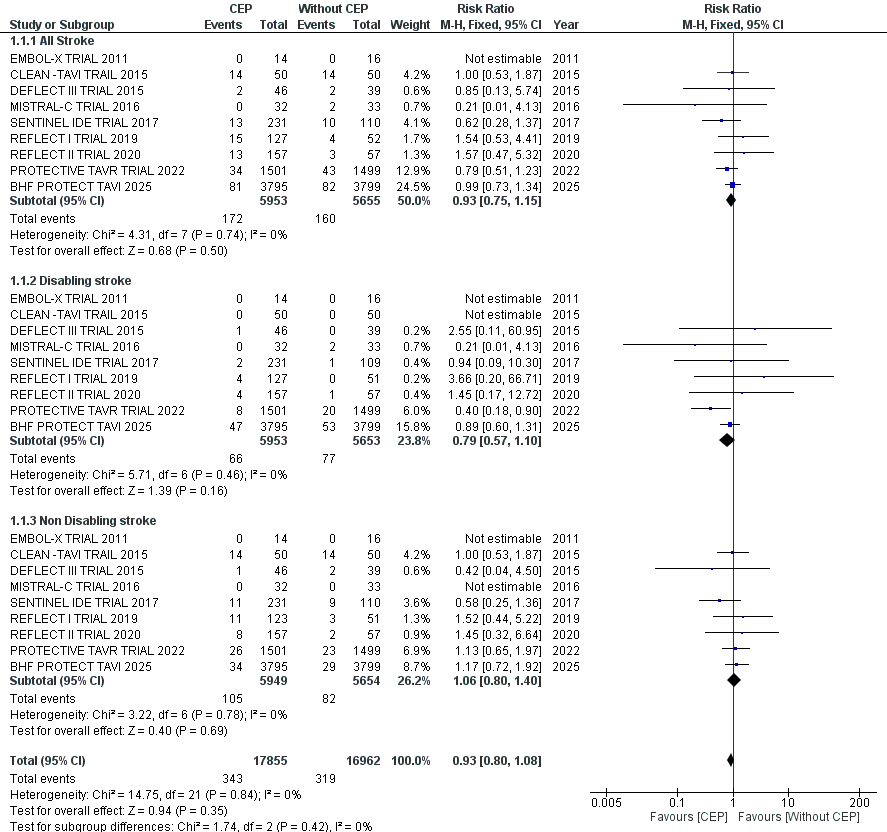
Results Stroke rates were low and did not differ significantly between the CEPD (n=343) and control (n=319) groups. The incidence of all strokes was 1.96% with CEPD vs 1.88% without CEPD (RR 0.97, 95% CI 0.75–1.15; p=0.50). Disabling stroke occurred in 0.79% of CEPD patients vs 0.95% of controls (RR 0.79, 95% CI 0.57-1.10; p=0.16). Non-disabling stroke occurred in 1.26% of patients in both groups (RR 1.06, 95% CI 0.8 -1.40; p=0.64). There was no significant heterogeneity across trials is (0) for all endpoints. Notably, the largest trial in the analysis (BHF PROTECT-TAVI, n=7,635) showed no difference in stroke rates with CEPD, aligning with the overall results. Subgroup analyses revealed a trend toward fewer disabling strokes with CEPD use, but this trend was not statistically significant.
Conclusion We found no significant stroke risk reduction with the use of CEPDs during TAVR. While a trend toward fewer disabling strokes was observed, it was not statistically significant. Routine use of CEPDs is not supported, and selective use in high-risk patients warrants further large RCTs.
  • Sanghvi, Urja  ( Mayo clinic, rochester, minnesota , Rochester , Minnesota , India )
  • Korlakunta, Bhavana  ( Osmania Medical College , Aswapuram , India )
  • Katikala, Venkata Ramana  ( KIMS, Amalapuram , Tadepalle , India )
  • Mandava, Snigdha  ( NRI Medical College and Hospital , NELLORE , India )
  • Bokka, Sri Lakshmi Ananya  ( Gandhi Medical College and Hospital , Secunderabad , India )
  • Wasir, Amanpreet  ( Bharati Vidyapeeth , Gurgaon , India )
  • Yonghang, Sapana  ( Nyc Health+Hospitals/Woodhull , New york , New York , United States )
  • Tandel, Hemeesh  ( C U Shah Medical college , Navsari , Gujarat , India )
  • Mohammed, Omer Farooq  ( Osmania Medical College , Hyderabad , Hyderabad , India )
  • Panjiyar, Binay  ( Harvard Medical School , Jamaica , New York , United States )
  • Nagoke, Simranjeet  ( Government Medical College Jammu , Jammu , Kashmir , India )
  • Afroze, Tanzina  ( Texas tech university health services , Amarillo , Texas , United States )
  • Madamanchi, Hari Krishna  ( Siddhartha Medical College , Nellore , India )
  • Author Disclosures:
    Urja Sanghvi: DO NOT have relevant financial relationships | Bhavana Korlakunta : DO NOT have relevant financial relationships | Venkata Ramana Katikala: DO NOT have relevant financial relationships | Snigdha Mandava: DO NOT have relevant financial relationships | Sri Lakshmi Ananya Bokka: DO NOT have relevant financial relationships | Amanpreet Wasir: DO NOT have relevant financial relationships | Sapana Yonghang: DO NOT have relevant financial relationships | Hemeesh Tandel: DO NOT have relevant financial relationships | Omer Farooq Mohammed: DO NOT have relevant financial relationships | Binay Panjiyar: DO NOT have relevant financial relationships | Simranjeet Nagoke: DO NOT have relevant financial relationships | Tanzina Afroze: DO NOT have relevant financial relationships | Hari Krishna Madamanchi: DO NOT have relevant financial relationships
Meeting Info:

Scientific Sessions 2025

2025

New Orleans, Louisiana

Session Info:

Stenosis and Beyond: Advances in Aortic Valve Disease Treatment

Saturday, 11/08/2025 , 03:15PM - 04:30PM

Moderated Digital Poster Session

More abstracts from these authors:
Risk Stratification with AI-Predictive Models vs. Traditional Clinical Risk Scores in Patients Undergoing Ablation for Atrial Fibrillation: A Systematic Review and Meta-Analysis

Mandava Snigdha, Shaik Deekshith Ameer, Katikala Venkata Ramana, Bokka Sri Lakshmi Ananya, Sanghvi Urja, Mohammed Omer Farooq, Panjiyar Binay, Nagoke Simranjeet, Afroze Tanzina, Madamanchi Hari Krishna, Korlakunta Bhavana

Impact of Genetic Polymorphism on Antihypertensive Drug Response: Comparing ACE Inhibitors and ARBs – A Systematic Review and Meta-Analysis

Shaik Deekshith Ameer, Madamanchi Hari Krishna, Korlakunta Bhavana, Vemulaghat Krishna Teja, Gopu Sahithi, Katikala Venkata Ramana, Mandava Snigdha, Bokka Sri Lakshmi Ananya, Sanghvi Urja, Mohammed Omer Farooq, Panjiyar Binay, Nagoke Simranjeet, Afroze Tanzina

You have to be authorized to contact abstract author. Please, Login
Not Available