
Logo

American Heart Association

  16
  0


Final ID: MP1586

Temporal Dynamics of Atrial Fibrillation Susceptibility Revealed by Beat-to-Beat Correlations During Sinus Rhythm

Abstract Body (Do not enter title and authors here): Background: Atrial fibrillation (AF) is a common cardiac arrhythmia associated with elevated risks of stroke and heart failure. Although current wearables can detect AF episodes, they lack predictive capacity. Identifying precursors of AF during normal sinus rhythm (NSR) could enable earlier intervention.

Hypothesis: We propose that AF patients exhibit persistent deviations in RR interval (RRI) dynamics even during NSR. These deviations, measured as altered temporal correlations, may indicate latent susceptibility to AF. We investigate whether this susceptibility evolves in a time-dependent manner around AF episodes.

Methods: We apply a newly developed dynamical detrended fluctuation analysis (DDFA), designed to capture time-varying correlations in RRI signals across multiple scales. DDFA metrics are aggregated with respect to heart rate and temporal distance to the nearest AF episode, both before and after. Only normal beats are included to avoid confounding by arrhythmic noise.

Data: The dataset includes 84 long-term ECG recordings (24–25 hours) from the PhysioNet Long-Term AF Database, annotated by experts to identify AF episodes and NSR segments precisely. As a control group, 202 healthy individuals from the THEW database were analyzed.

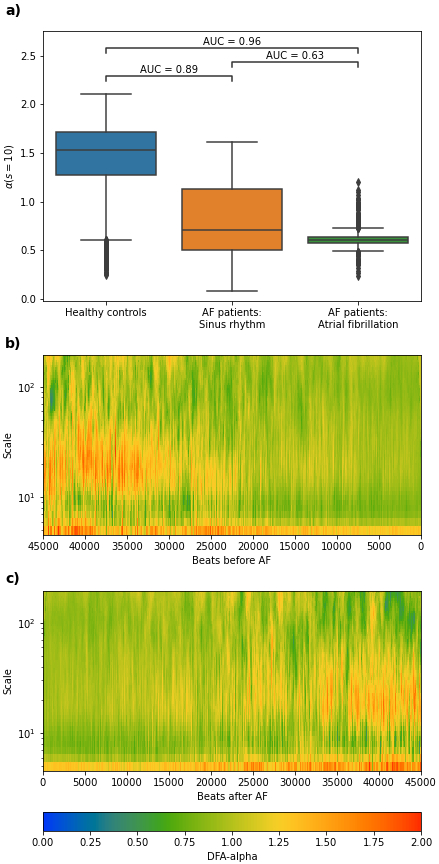
Results: DDFA reveals marked temporal changes in RRI correlations surrounding AF episodes. AF episodes are clearly distinguishable from controls (ROC-AUC = 0.96). Notably, NSR segments in AF patients are more similar to AF episodes (ROC-AUC = 0.72) than to healthy controls (ROC-AUC = 0.84), highlighting persistent correlation disruptions. These deviations emerge hours before episode onset and linger afterward, suggesting a gradual destabilization and recovery in autonomic regulation. Figures illustrate the time-resolved evolution of DDFA metrics relative to episode timing.

Conclusion: AF susceptibility can be captured in a time-dependent manner through analysis of RRI correlations during NSR. The progression of DDFA patterns before and after AF episodes provides new insight into the dynamic nature of AF risk. Importantly, the role of specific events such as premature atrial contractions before and/or after AF episodes remains to be examined. DDFA offers a practical tool to investigate these phenomena and refine AF prediction models in the future.
  • Nurmo, Marjaana  ( Tampere University , Tampere , Finland )
  • Pukkila, Teemu  ( Tampere University , Tampere , Finland )
  • Rasanen, Esa  ( Tampere University , Tampere , Finland )
  • Author Disclosures:
    Marjaana Nurmo: DO NOT have relevant financial relationships | Teemu Pukkila: DO have relevant financial relationships ; Individual Stocks/Stock Options:MoniCardi Ltd:Active (exists now) | Esa Rasanen: DO have relevant financial relationships ; Ownership Interest:MoniCardi:Active (exists now)
Meeting Info:

Scientific Sessions 2025

2025

New Orleans, Louisiana

Session Info:

Optimizing and Understanding Outcomes in Catheter Ablation and Complex Arrhythmia Management

Sunday, 11/09/2025 , 03:15PM - 04:15PM

Moderated Digital Poster Session

More abstracts on this topic:
A Machine Learning Approach to Predict Percutaneous Coronary Intervention in Patients with Critical Illness and Signs of Myocardial Injury

Mueller Joshua, Stepanova Daria, Chidambaram Vignesh, Nakarmi Ukash, Al'aref Subhi

Effect of Beta-Blockers on Mortality in Patients with Tachycardia in the Setting of Sepsis and Septic Shock: A Meta-Analysis of Randomized Controlled Trials

Chilingarashvili Giorgi, Samudrala Gayathri, Truong Vien, Ahluwalia Vibhor, Mondal Avilash, Ahluwalia Vaibhav, Siddique Muhammad Saad, Chung Duy, Jaiswal Jay, Ha Quang Dat, Dsilva Reeve

More abstracts from these authors:
You have to be authorized to contact abstract author. Please, Login
Not Available